







Question: research and define the problem, determine the causes generate solutions for the problem,decide on the best solution, implement the solution,evaluate the solition Uluuy Guldelines: Option
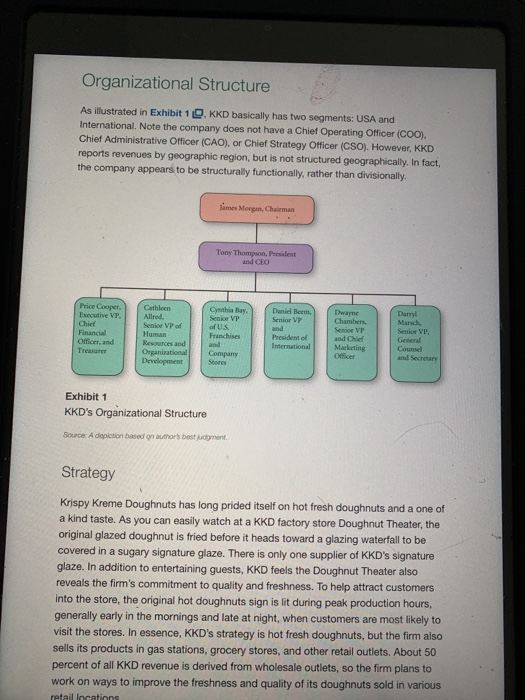
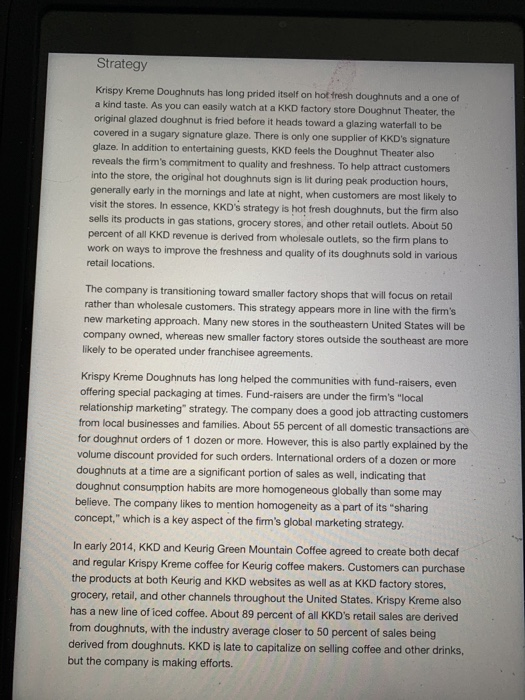
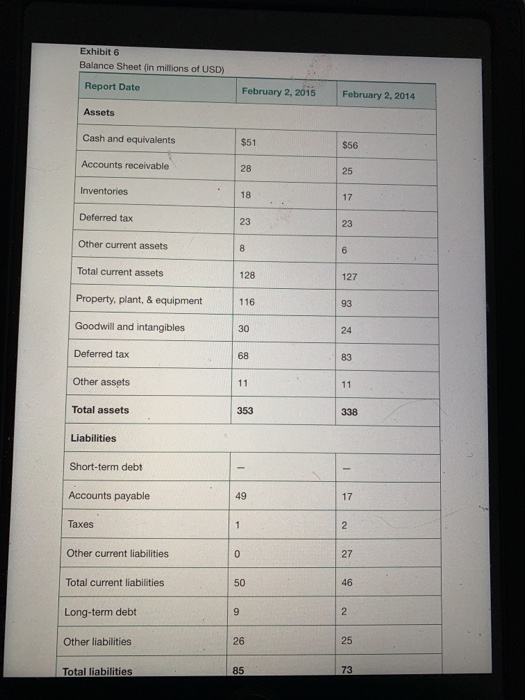
Uluuy Guldelines: Option #2) 1. Research and define the problem 2. Determine the cause(s) 3. Generate solution(s) for the problem and also compute the following Financial Ratios: a. Liquidity Ratio. b. Acid Test Ratio. c. Profitability-Performance Ratio or Profit Margin on Sales. d. Return on Sales. e. Return on Equity. f. Leverage. calidad commodo g. Activity Ratio or Inventory Turnover. 20 um blow obsady 4. Decide on the best solution 5. Implement the solution and b lasting bulalamil 6. Evaluate the solution History Krispy Kreme traces its roots back to 1933 when Vernon Rudolph bought a doughnut shop in Paducah, Kentucky. After selling doughnuts in Kentucky. Tennessee, and West Virginia, the store known today as Krispy Kreme was moved to Winston-Salem, Krispy Kreme doughnuts were sold to grocery stores at first, but became so popular with customers that they requested the option to buy the doughnuts fresh and hot from the store, thus launching the doughnut factory retail store and selling directly to the public. Krispy Kreme grew quickly over the next four decades before being sold to Beatrice Foods Company in 1976. Shortly after the purchase by Beatrice, in 1982, several Krispy Kreme franchisees purchased the company back from Beatrice Foods and quickly established the current Doughnut Theater style of factory stores where by customers can watch doughnuts being made. It was not until 1996 that KKD finally expanded outside the Southeast by opening a store in New York City, followed in 2001 by opening its first store outside the United States, in Canada. The company went public with its IPO launch in April 2000, In the United Kingdom, KKD just concocted a single, gigantic box that holds 2,400 doughnuts. The box (11.4 feet by 3 feet) was filled with doughnuts and required eight KKD employees to deliver it to 360 Resourcing Solutions. The box was part of a promotion for the new "Krispy Kreme Occasions" division that customizes doughnut offerings for corporate events or special occasions such as weddings and other celebrations. The division sells doughnut "towers" for special events or even personalized doughnuts with customized, chocolate nameplates or corporate logos. The company has no plans to create another box, but it is happy to sell 100 of the so-called double-dozen boxes for about $2,600. Krispy Kreme opened its first store in India in 2013 in Bangalore, Karnataka, and now there are seven in that city. Also in 2013, KKD began opening stores in Colombia, with a total of 25 planned, as the first South American country for the company. In late 2013, KKD opened its first store in Taipei, Taiwan. In 2014, KKD opened its first shop in Chennai in southern India. Internal Issues Vision/Mission Krispy Kreme Doughnuts does not appear to have a published vision statement. The company's mission statement, however, is given as follows: Consumers are our lifeblood, the center of the doughnut There is no substitute for quality in our service to consumers Impeccable presentation is critical wherever Krispy Kreme is sold We must produce a collaborative team effort that is unexcelled We must cast the best possible image in all that we do We must never settle for "second best;" we deliver on our commitments We must coach our team to ever-better results. (Source: Company documents) Distribution Krispy Kreme doughnuts are sold in KKD stores, grocery stores, convenience stores, gas stations, Walmart, and Target stores in the United States. Internationally, the doughnuts are sold in Loblaws supermarkets, Petro-Canada gas stations, and as freestanding stores in Canada, along with BP Service Stations and BP Travel Centers and 7-Eleven stores in Australia. In the United Kingdom, Tesco supermarkets, Tesco Extra, and most Tesco service stations carry KKD products, and service stations Moto, Welcome Break, and Road Chef also carry self-service KKD cabinets. Today, KKD has locations in the United Kingdom, Australia, Turkey, the Dominican Republic, Kuwait, Mexico, Puerto Rico, Taiwan, South Korea, Malaysia, Thailand, Indonesia, the Philippines, Japan, China, the United Arab Emirates, Qatar, Saudi Arabia Bahrain, Hong Kong, and Ethiopia. Organizational Structure As illustrated in Exhibit 10. KKD basically has two segments: USA and International. Note the company does not have a Chief Operating Officer (COO). Chief Administrative Officer (CAO), or Chief Strategy Officer (CSO). However, KKD reports revenues by geographic region, but is not structured geographically. In fact, the company appears to be structurally functionally, rather than divisionally. Names Morgan, Chairman Tony Thompson, President Price Cooper, Funcutive VP Cynthia Bay. Cathleen Allred. Senior VP of Human Chambers Officer, and and Child Marketing Senior VP General Cound and Secretary Organizational Development Company Exhibit 1 KKD's Organizational Structure Source: A depiction based on author's boot udgment Strategy Krispy Kreme Doughnuts has long prided itself on hot fresh doughnuts and a one of a kind taste. As you can easily watch at a KKD factor original glazed doughnut is fried before it heads toward a glazing waterfall to be covered in a sugary signature glaze. There is only one supplier of KKD's signature glaze. In addition to entertaining guests, KKD feels the Doughnut Theater also reveals the firm's commitment to quality and freshness. To help attract customers into the store, the original hot doughnuts sign is lit during peak production hours, generally early in the mornings and late at night, when customers are most likely to visit the stores. In essence, KKD's strategy is hot fresh doughnuts, but the firm also sells its products in gas stations, grocery stores, and other retail outlets. About 50 percent of all KKD revenue is derived from wholesale outlets, so the firm plans to work on ways to improve the freshness and quality of its doughnuts sold in various retail locations Strategy Krispy Kreme Doughnuts has long prided itself on hot fresh doughnuts and a one of a kind taste. As you can easily watch at a KKD factory store Doughnut Theater, the original glazed doughnut is fried before it heads toward a glazing waterfall to be covered in a sugary signature glaze. There is only one supplier of KKD's signature glaze. In addition to entertaining guests, KKD feels the Doughnut Theater also reveals the firm's commitment to quality and freshness. To help attract customers into the store, the original hot doughnuts sign is lit during peak production hours. generally early in the mornings and late at night, when customers are most likely to visit the stores. In essence, KKD's strategy is hot fresh doughnuts, but the firm also sells its products in gas stations, grocery stores, and other retail outlets. About 50 percent of all KKD revenue is derived from wholesale outlets, so the firm plans to work on ways to improve the freshness and quality of its doughnuts sold in various retail locations The company is transitioning toward smaller factory shops that will focus on retail rather than wholesale customers. This strategy appears more in line with the firm's new marketing approach. Many new stores in the southeastern United States will be company owned, whereas new smaller factory stores outside the southeast are more likely to be operated under franchisee agreements. Krispy Kreme Doughnuts has long helped the communities with fund-raisers, even offering special packaging at times. Fund-raisers are under the firm's "local relationship marketing strategy. The company does a good job attracting customers from local businesses and families. About 55 percent of all domestic transactions are for doughnut orders of 1 dozen or more. However, this is also partly explained by the volume discount provided for such orders. International orders of a dozen or more doughnuts at a time are a significant portion of sales as well, indicating that doughnut consumption habits are more homogeneous globally than some may believe. The company likes to mention homogeneity as a part of its "sharing concept," which is a key aspect of the firm's global marketing strategy. In early 2014, KKD and Keurig Green Mountain Coffee agreed to create both decaf and regular Krispy Kreme coffee for keurig coffee makers. Customers can purchase the products at both Keurig and KKD websites as well as at KKD factory stores, grocery, retail, and other channels throughout the United States. Krispy Kreme also has a new line of iced coffee. About 89 percent of all KKD's retail sales are derived from doughnuts, with the industry average closer to 50 percent of sales being derived from doughnuts. KKD is late to capitalize on selling coffee and other drinks, but the company is making efforts. Exhibit 6 Balance Sheet (in millions of USD) Report Date February 2, 2015 February 2, 2014 Assets Cash and equivalents $51 Accounts receivable Inventories Deferred tax Other current assets Total current assets Property, plant, & equipment Goodwill and intangibles Deferred tax Other assets Total assets Liabilities Short-term debt Accounts payable Taxes Other current liabilities Total current liabilities Long-term debt Other liabilities Total liabilities Uluuy Guldelines: Option #2) 1. Research and define the problem 2. Determine the cause(s) 3. Generate solution(s) for the problem and also compute the following Financial Ratios: a. Liquidity Ratio. b. Acid Test Ratio. c. Profitability-Performance Ratio or Profit Margin on Sales. d. Return on Sales. e. Return on Equity. f. Leverage. calidad commodo g. Activity Ratio or Inventory Turnover. 20 um blow obsady 4. Decide on the best solution 5. Implement the solution and b lasting bulalamil 6. Evaluate the solution History Krispy Kreme traces its roots back to 1933 when Vernon Rudolph bought a doughnut shop in Paducah, Kentucky. After selling doughnuts in Kentucky. Tennessee, and West Virginia, the store known today as Krispy Kreme was moved to Winston-Salem, Krispy Kreme doughnuts were sold to grocery stores at first, but became so popular with customers that they requested the option to buy the doughnuts fresh and hot from the store, thus launching the doughnut factory retail store and selling directly to the public. Krispy Kreme grew quickly over the next four decades before being sold to Beatrice Foods Company in 1976. Shortly after the purchase by Beatrice, in 1982, several Krispy Kreme franchisees purchased the company back from Beatrice Foods and quickly established the current Doughnut Theater style of factory stores where by customers can watch doughnuts being made. It was not until 1996 that KKD finally expanded outside the Southeast by opening a store in New York City, followed in 2001 by opening its first store outside the United States, in Canada. The company went public with its IPO launch in April 2000, In the United Kingdom, KKD just concocted a single, gigantic box that holds 2,400 doughnuts. The box (11.4 feet by 3 feet) was filled with doughnuts and required eight KKD employees to deliver it to 360 Resourcing Solutions. The box was part of a promotion for the new "Krispy Kreme Occasions" division that customizes doughnut offerings for corporate events or special occasions such as weddings and other celebrations. The division sells doughnut "towers" for special events or even personalized doughnuts with customized, chocolate nameplates or corporate logos. The company has no plans to create another box, but it is happy to sell 100 of the so-called double-dozen boxes for about $2,600. Krispy Kreme opened its first store in India in 2013 in Bangalore, Karnataka, and now there are seven in that city. Also in 2013, KKD began opening stores in Colombia, with a total of 25 planned, as the first South American country for the company. In late 2013, KKD opened its first store in Taipei, Taiwan. In 2014, KKD opened its first shop in Chennai in southern India. Internal Issues Vision/Mission Krispy Kreme Doughnuts does not appear to have a published vision statement. The company's mission statement, however, is given as follows: Consumers are our lifeblood, the center of the doughnut There is no substitute for quality in our service to consumers Impeccable presentation is critical wherever Krispy Kreme is sold We must produce a collaborative team effort that is unexcelled We must cast the best possible image in all that we do We must never settle for "second best;" we deliver on our commitments We must coach our team to ever-better results. (Source: Company documents) Distribution Krispy Kreme doughnuts are sold in KKD stores, grocery stores, convenience stores, gas stations, Walmart, and Target stores in the United States. Internationally, the doughnuts are sold in Loblaws supermarkets, Petro-Canada gas stations, and as freestanding stores in Canada, along with BP Service Stations and BP Travel Centers and 7-Eleven stores in Australia. In the United Kingdom, Tesco supermarkets, Tesco Extra, and most Tesco service stations carry KKD products, and service stations Moto, Welcome Break, and Road Chef also carry self-service KKD cabinets. Today, KKD has locations in the United Kingdom, Australia, Turkey, the Dominican Republic, Kuwait, Mexico, Puerto Rico, Taiwan, South Korea, Malaysia, Thailand, Indonesia, the Philippines, Japan, China, the United Arab Emirates, Qatar, Saudi Arabia Bahrain, Hong Kong, and Ethiopia. Organizational Structure As illustrated in Exhibit 10. KKD basically has two segments: USA and International. Note the company does not have a Chief Operating Officer (COO). Chief Administrative Officer (CAO), or Chief Strategy Officer (CSO). However, KKD reports revenues by geographic region, but is not structured geographically. In fact, the company appears to be structurally functionally, rather than divisionally. Names Morgan, Chairman Tony Thompson, President Price Cooper, Funcutive VP Cynthia Bay. Cathleen Allred. Senior VP of Human Chambers Officer, and and Child Marketing Senior VP General Cound and Secretary Organizational Development Company Exhibit 1 KKD's Organizational Structure Source: A depiction based on author's boot udgment Strategy Krispy Kreme Doughnuts has long prided itself on hot fresh doughnuts and a one of a kind taste. As you can easily watch at a KKD factor original glazed doughnut is fried before it heads toward a glazing waterfall to be covered in a sugary signature glaze. There is only one supplier of KKD's signature glaze. In addition to entertaining guests, KKD feels the Doughnut Theater also reveals the firm's commitment to quality and freshness. To help attract customers into the store, the original hot doughnuts sign is lit during peak production hours, generally early in the mornings and late at night, when customers are most likely to visit the stores. In essence, KKD's strategy is hot fresh doughnuts, but the firm also sells its products in gas stations, grocery stores, and other retail outlets. About 50 percent of all KKD revenue is derived from wholesale outlets, so the firm plans to work on ways to improve the freshness and quality of its doughnuts sold in various retail locations Strategy Krispy Kreme Doughnuts has long prided itself on hot fresh doughnuts and a one of a kind taste. As you can easily watch at a KKD factory store Doughnut Theater, the original glazed doughnut is fried before it heads toward a glazing waterfall to be covered in a sugary signature glaze. There is only one supplier of KKD's signature glaze. In addition to entertaining guests, KKD feels the Doughnut Theater also reveals the firm's commitment to quality and freshness. To help attract customers into the store, the original hot doughnuts sign is lit during peak production hours. generally early in the mornings and late at night, when customers are most likely to visit the stores. In essence, KKD's strategy is hot fresh doughnuts, but the firm also sells its products in gas stations, grocery stores, and other retail outlets. About 50 percent of all KKD revenue is derived from wholesale outlets, so the firm plans to work on ways to improve the freshness and quality of its doughnuts sold in various retail locations The company is transitioning toward smaller factory shops that will focus on retail rather than wholesale customers. This strategy appears more in line with the firm's new marketing approach. Many new stores in the southeastern United States will be company owned, whereas new smaller factory stores outside the southeast are more likely to be operated under franchisee agreements. Krispy Kreme Doughnuts has long helped the communities with fund-raisers, even offering special packaging at times. Fund-raisers are under the firm's "local relationship marketing strategy. The company does a good job attracting customers from local businesses and families. About 55 percent of all domestic transactions are for doughnut orders of 1 dozen or more. However, this is also partly explained by the volume discount provided for such orders. International orders of a dozen or more doughnuts at a time are a significant portion of sales as well, indicating that doughnut consumption habits are more homogeneous globally than some may believe. The company likes to mention homogeneity as a part of its "sharing concept," which is a key aspect of the firm's global marketing strategy. In early 2014, KKD and Keurig Green Mountain Coffee agreed to create both decaf and regular Krispy Kreme coffee for keurig coffee makers. Customers can purchase the products at both Keurig and KKD websites as well as at KKD factory stores, grocery, retail, and other channels throughout the United States. Krispy Kreme also has a new line of iced coffee. About 89 percent of all KKD's retail sales are derived from doughnuts, with the industry average closer to 50 percent of sales being derived from doughnuts. KKD is late to capitalize on selling coffee and other drinks, but the company is making efforts. Exhibit 6 Balance Sheet (in millions of USD) Report Date February 2, 2015 February 2, 2014 Assets Cash and equivalents $51 Accounts receivable Inventories Deferred tax Other current assets Total current assets Property, plant, & equipment Goodwill and intangibles Deferred tax Other assets Total assets Liabilities Short-term debt Accounts payable Taxes Other current liabilities Total current liabilities Long-term debt Other liabilities Total liabilities
Step by Step Solution
There are 3 Steps involved in it

Get step-by-step solutions from verified subject matter experts
 Study Help