







Question: Resolve using the Haskell programming language. Your code for this part will go in the fine hof.ml IMPORTANT: In this part, you may not use
Resolve using the Haskell programming language.
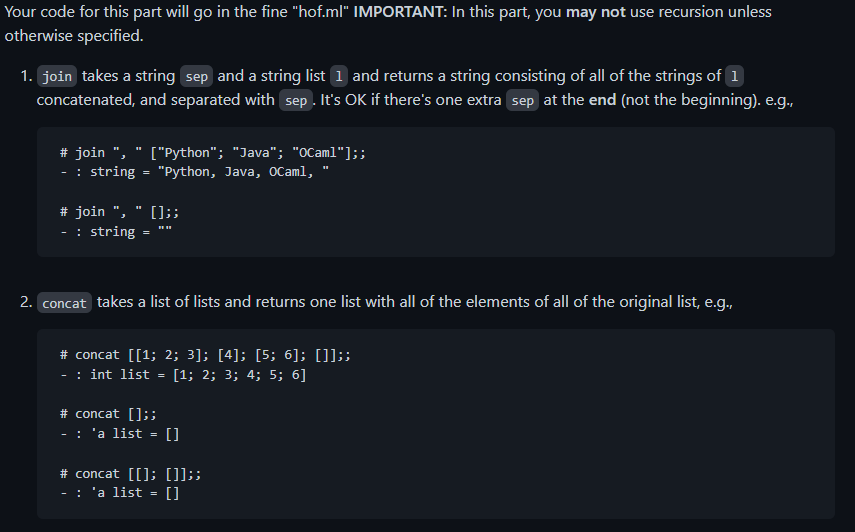
Your code for this part will go in the fine "hof.ml" IMPORTANT: In this part, you may not use recursion unless otherwise specified. 1. join takes a string sep and a string list 1 and returns a string consisting of all of the strings of 1 concatenated, and separated with sep. It's OK if there's one extra sep at the end (not the beginning). e.g.r \# join ", " ["Python"; "Java"; "OCaml" ]; - : string = "Python, Java, OCaml, " \# join ", " [];; - : string = "" 2. concat takes a list of lists and returns one list with all of the elements of all of the original list, e.g., \# concat [[1;2;3];[4];[5;6];[]]; - : int list =[1;2;3;4;5;6] \# concat []; - : 'a list =[] \# concat [[];[]]; - : 'a list = []
Step by Step Solution
There are 3 Steps involved in it

Get step-by-step solutions from verified subject matter experts
 Study Help