







Question: Resolving Challenges Please complete the case study at the end of Chapter 6 of your textbook (p. 178 of the 11th edition). The short case
Resolving Challenges
Please complete the case study at the end of Chapter 6 of your textbook (p. 178 of the 11th edition). The short case study is titled, Resolving Ethical Business Challenges.
Here are the questions for you to answer once you complete the reading and consider the situation (same questions as in textbook):
1. Describe Saul's ethical dilemma.
2. Why would Medicare fraud be a white-collar crime?
3. How should Saul approach the situation?
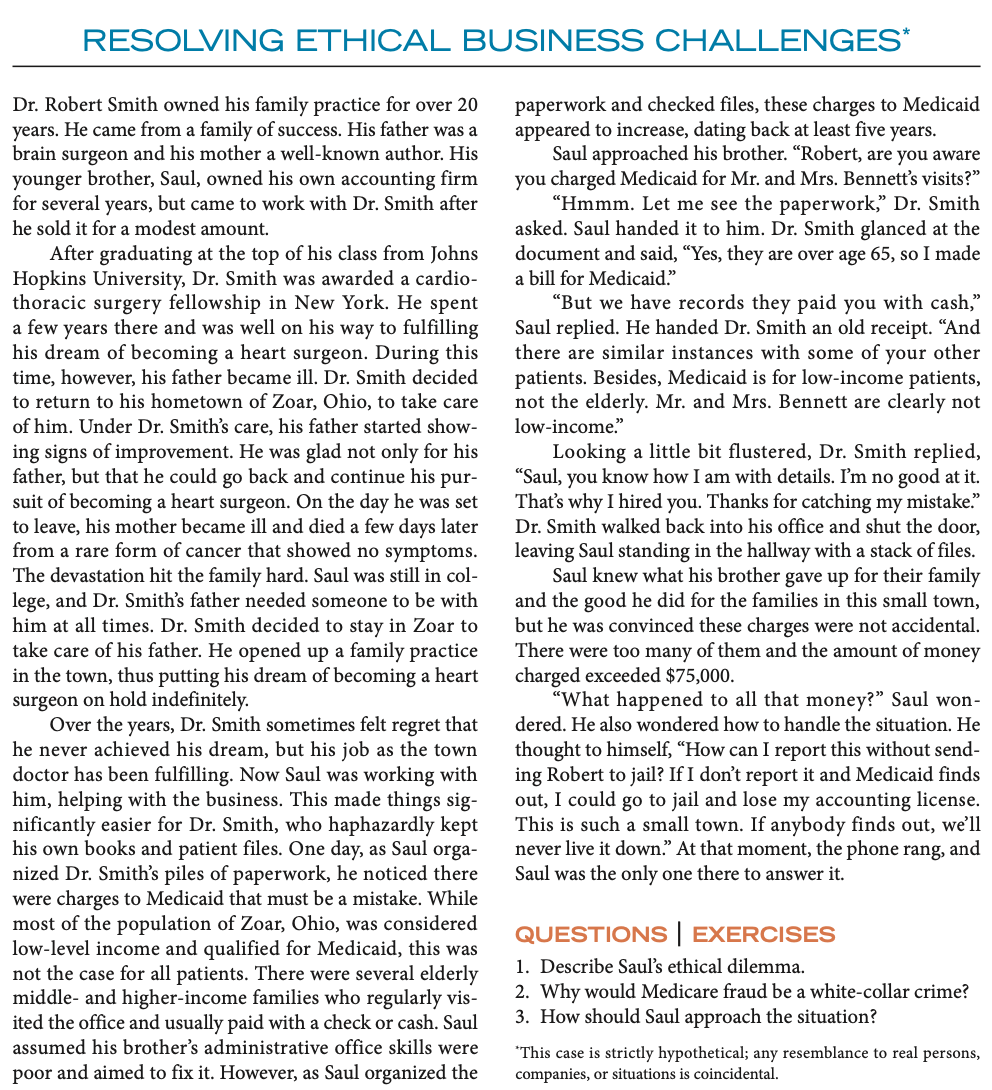
RESOLVING ETHICAL BUSINESS CHALLENGES* Dr. Robert Smith owned his family practice for over 20 paperwork and checked files, these charges to Medicaid years. He came from a family of success. His father was a appeared to increase, dating back at least five years. brain surgeon and his mother a well-known author. His Saul approached his brother. "Robert, are you aware younger brother, Saul, owned his own accounting firm you charged Medicaid for Mr. and Mrs. Bennett's visits?" for several years, but came to work with Dr. Smith after "Hmmm. Let me see the paperwork," Dr. Smith he sold it for a modest amount. asked. Saul handed it to him. Dr. Smith glanced at the After graduating at the top of his class from Johns document and said, "Yes, they are over age 65, so I made Hopkins University, Dr. Smith was awarded a cardio- a bill for Medicaid." thoracic surgery fellowship in New York. He spent "But we have records they paid you with cash," a few years there and was well on his way to fulfilling Saul replied. He handed Dr. Smith an old receipt. "And his dream of becoming a heart surgeon. During this there are similar instances with some of your other time, however, his father became ill. Dr. Smith decided patients. Besides, Medicaid is for low-income patients, to return to his hometown of Zoar, Ohio, to take care not the elderly. Mr. and Mrs. Bennett are clearly not of him. Under Dr. Smith's care, his father started show- low-income." ing signs of improvement. He was glad not only for his Looking a little bit flustered, Dr. Smith replied, father, but that he could go back and continue his pur- "Saul, you know how I am with details. I'm no good at it. suit of becoming a heart surgeon. On the day he was set That's why I hired you. Thanks for catching my mistake." to leave, his mother became ill and died a few days later Dr. Smith walked back into his office and shut the door, from a rare form of cancer that showed no symptoms. leaving Saul standing in the hallway with a stack of files. The devastation hit the family hard. Saul was still in col- Saul knew what his brother gave up for their family lege, and Dr. Smith's father needed someone to be with and the good he did for the families in this small town, him at all times. Dr. Smith decided to stay in Zoar to but he was convinced these charges were not accidental. take care of his father. He opened up a family practice There were too many of them and the amount of money in the town, thus putting his dream of becoming a heart charged exceeded $75,000. surgeon on hold indefinitely. "What happened to all that money?" Saul won- Over the years, Dr. Smith sometimes felt regret that dered. He also wondered how to handle the situation. He he never achieved his dream, but his job as the town thought to himself, "How can I report this without senddoctor has been fulfilling. Now Saul was working with ing Robert to jail? If I don't report it and Medicaid finds him, helping with the business. This made things sig- out, I could go to jail and lose my accounting license. nificantly easier for Dr. Smith, who haphazardly kept This is such a small town. If anybody finds out, we'll his own books and patient files. One day, as Saul orga- never live it down." At that moment, the phone rang, and nized Dr. Smith's piles of paperwork, he noticed there Saul was the only one there to answer it. were charges to Medicaid that must be a mistake. While most of the population of Zoar, Ohio, was considered QUESTIONS I EXERCISES low-level income and qualified for Medicaid, this was not the case for all patients. There were several elderly 1. Describe Saul's ethical dilemma. middle- and higher-income families who regularly vis- 2. Why would Medicare fraud be a white-collar crime? ited the office and usually paid with a check or cash. Saul 3. How should Saul approach the situation? assumed his brother's administrative office skills were 'This case is strictly hypothetical; any resemblance to real persons, poor and aimed to fix it. However, as Saul organized the companies, or situations is coincidental
Step by Step Solution
There are 3 Steps involved in it

Get step-by-step solutions from verified subject matter experts
 Study Help