Question: Respect for Law Week 2 Journal Video Link: https://youtu.be/T94agavDVUw We have respect for the law, as an institution, even though we may have little or
Respect for Law Week 2 Journal
Video Link:
https://youtu.be/T94agavDVUw
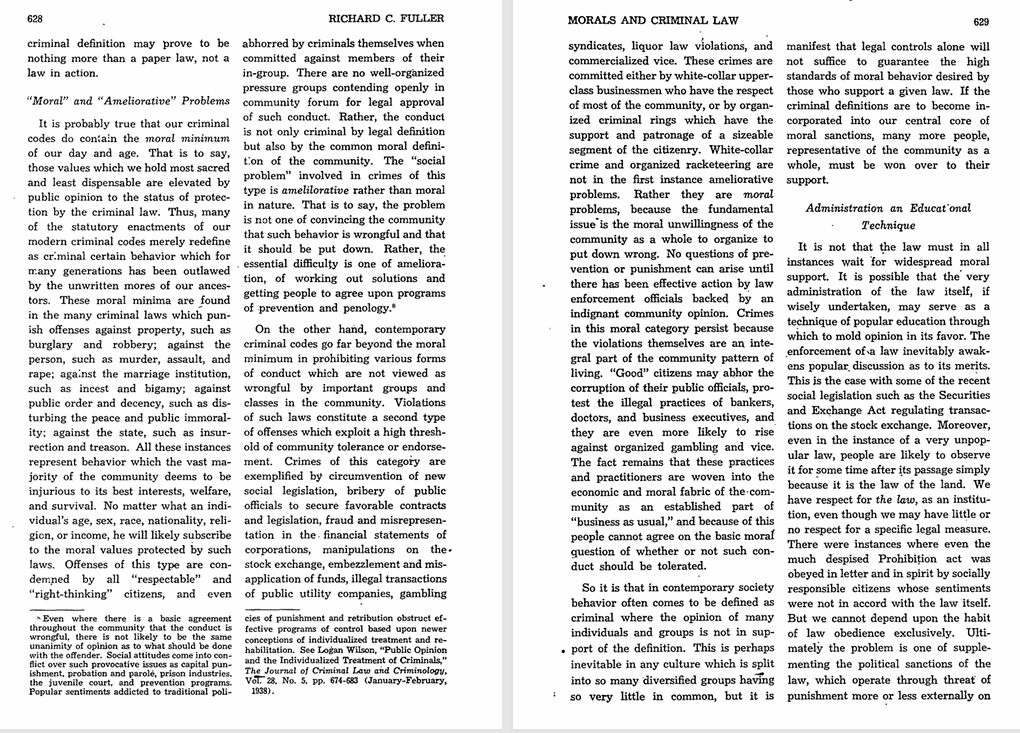
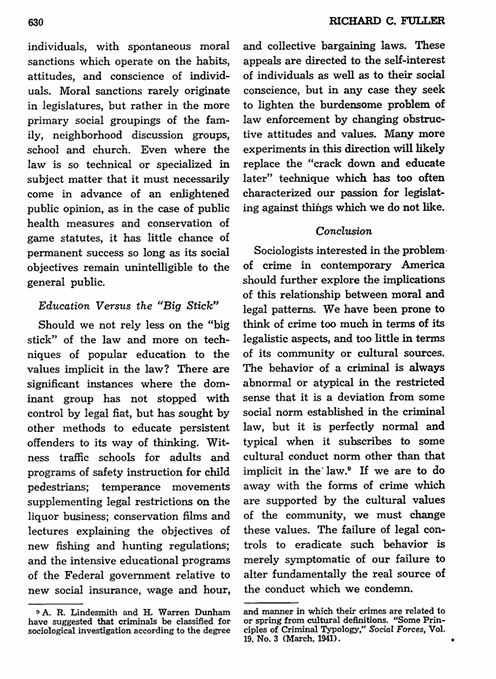
"We have respect for the law, as an institution, even though we may have little or no respect for a specific legal measure. There were instances where even the much-despised Prohibition act was obeyed in letter and in spirit by socially responsible citizens whose sentiments were not in accord with the law itself," (Fuller 629).
identify and describe a present-day law or legal code from the quote above.
First identify the law (or code) and then describe it in detail (background, compliance, and reasons why people follow even though it is not popular). Lastly, describe personal view of the law/code u have decided to talk about.
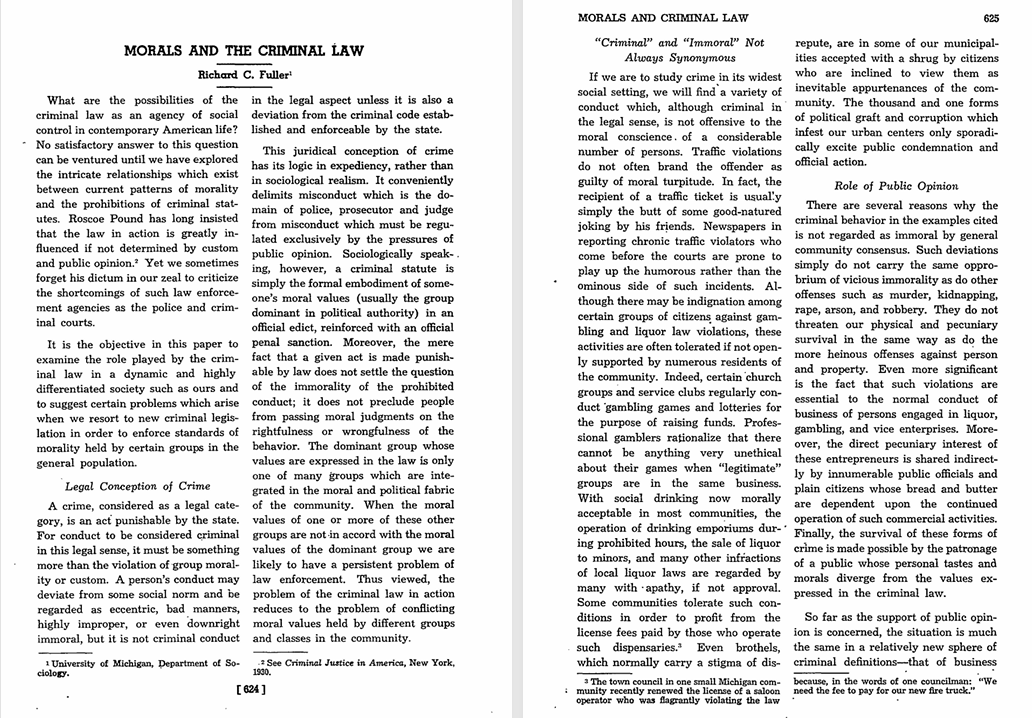
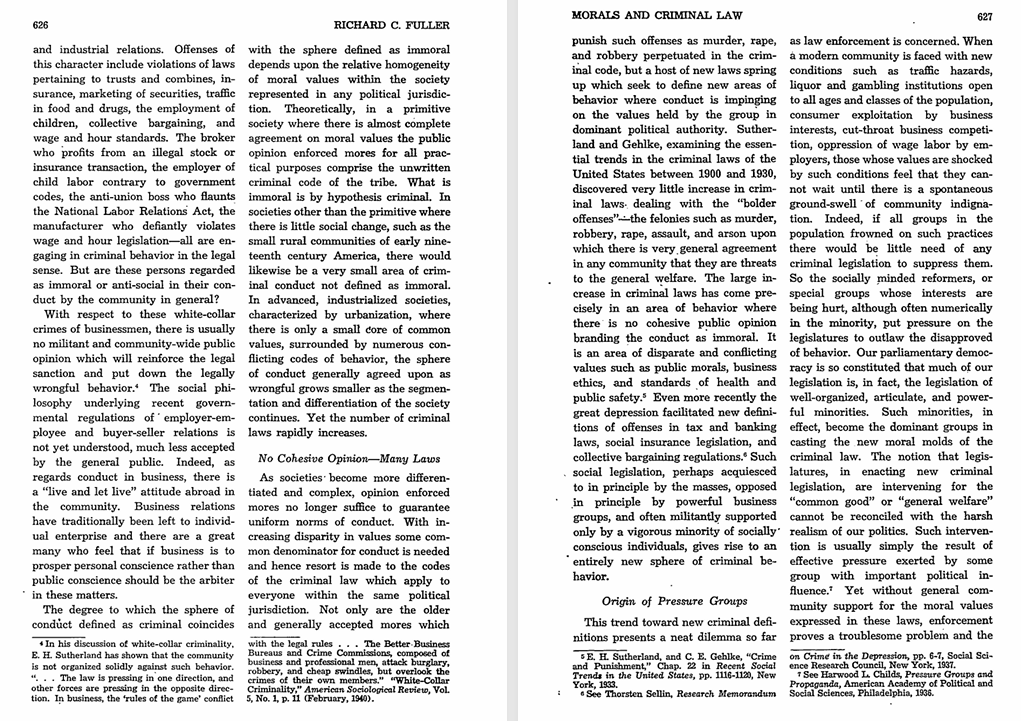
Journal of Criminal Law and Criminology Volume 32 | Issue 6 Article 3 1942 Morals and the Criminal Law Richard C. Fuller Follow this and additional works at: https://scholarlycommons.law.northwestern.edu/jclc Part of the Criminal Law Commons, Criminology Commons, and the Criminology and Criminal Justice Commons Recommended Citation Richard C. Fuller, Morals and the Criminal Law, 32 J. Crim. L. Criminology 624 (1941-1942) This Article is brought to you for free and open access by Northwestern University School of Law Scholarly Commons. It has been accepted for inclusion in Journal of Criminal Law and Criminology by an authorized editor of Northwestern University School of Law Scholarly Commons.MORALS AND THE CRIMINAL LAW Richard C, Fuller* What are the possibilities of the criminal law as am agency of social control in contemporary American life? No satisfactory answer to this question can be ventured until we have explored the intricate relationships which exist between current patterns of morality and the prohibitions of criminal stat- utes. Roscoe Pound has long insisted that the law in action is greatly in- fluenced if not determined by custom and public opinion? Yet we sometimes forget his dictum in our zeal to criticize the shortcomings of such law enforee- ment agencies as the police and crim- inal courts. It is the objective in this paper to examine the role played by the crim- inal law in a dynamic and highly differentiated society such as ours and to suggest certain problems which arise when we resort to new criminal legis- lation in order to enforce standards of morality held by certain groups in the general population. Legal Conception of Crime A crime, considered as a legal cate- gory, is an act punishable by the state. For conduct to be considered criminal in this legal sense, it must be something more than the violation of group moral- ity or custom, A person's conduct may deviate from some social norm and be regarded as eccentric, bad manners, highly improper, or even downright immoral, but it is not criminal conduct \\ University of Michigan, Department of So- ciology. in the legal aspect unless it is also a deviation from the criminal code estab- lished and enforceable by the state. This juridical conception of crime has its logic in expediency, rather than in sociological realism. It conveniently delimits misconduct which is the do- main of police, prosecutor and judge from misconduct which must be regu- lated exclusively by the pressures of public opinion. Sociologically speak- . ing, however, a criminal statute is simply the formal embodiment of some- one's moral values (usually the group dominant in political authority) in an official edict, reinforced with an official penal sanction. Moreover, the mere fact that a given act is made punish- able by law does not settle the question of the immorality of the prohibited conduct; it does not preclude people from passing moral judgments on the rightfulness or wrongfulness of the behavior. The dominant group whose values are expressed in the law is only one of many groups which are inte- frated in the moral and political fabric of the community. When the moral values of one or more of these other groups are not in accord with the moral values of the dominant group we are likely to have a persistent problem of law enforcement. Thus viewed, the problem of the criminal law in action reduces to the problem of conflicting moral values held by different groups and classes in the community. seat Criminal Justice in Americe, How York, [624] MORALS AND CRIMINAL LAW \"Criminal\" and \"Immoral\" Not Always Synonymous If we are to study crime in its widest social setting, we will find a variety of conduct which, although criminal in the legal sense, is not offensive to the moral conscience. of a considerable number of persons, Traffic violations do not often brand the offender as guilty of moral turpitude. In fact, the recipient of a traffic ticket is usual!y simply the butt of some good-natured joking by his friends. Newspapers in reporting chronic traffie violators who come before the courts are prone to play up the humorous rather than the ominous side of such incidents. Al- though there may be indignation among certain groups of citizens against gam- bling and liquor law violations, these activities are often tolerated if not open- ly supported by numerous residents of the community. Indeed, certain church groups and service clubs regularly con- duct gambling games and lotteries for the purpose of raising funds. Profes- sional gamblers rationalize that there cannot be anything very unethical about their games when \"legitimate\" groups are in the same business. With social drinking now morally acceptable im most communities, the operation of drinking emporiums dur-* ing prohibited hours, the sale of liquor to minors, and many other infractions of local liquor laws are regarded by many with-apathy, if not approval. Some communities tolerate such con- ditions in order to profit from the license fees paid by those who operate such dispensaries." Even brothels, which normally carry a stigma of dis- 3 The town council in one small Michigan com- renewed the license of a saloon operator who was flagrantly violating the law 63 repute, are in some of our municipal- ities accepted with a shrug by citizens who are inclined to view them as inevitable appurtenances of the com- munity, The thousand and one forms of political graft and corruption which infest our urban centers only sporadi- cally excite public condemnation and official action. Role of Public Opinion There are several reasons why the criminal behavior in the examples cited is not regarded as immoral by general community consensus, Such deviations simply do not carry the same oppro- brium of vicious immorality as do other offenses such as murder, kidnapping, rape, arson, and robbery. They do not threaten our physical and pecuniary survival in the same way as do the more heinous offenses against person and property. Even more significant is the fact that such violations are essential to the normal conduct of business of persons engaged in liquor, gambling, and vice enterprises. More- over, the direct pecuniary interest of these entreprencurs is shared indirect- ly by innumerable public officials and plain citizens whose bread and butter are dependent upon the continued operation of such commercial activities. Finally, the survival of these forms of erime is made possible by the patronage of a public whose personal tastes and morals diverge from the values ex- pressed in the criminal law. So far as the support of public opin- ion is concerned, the situation is much the same in a relatively new sphere of criminal definitionsthat of business because, in the words of one councilman; \"We need the fee to pay for our mow fire truck.\" 626 and industrial relations. Offenses of this character include violations of laws pertaining to trusts and combines, in- surance, marketing of securities, traffic in food and drugs, the employment of children, collective bargaining, and wage and hour standards. The broker who profits from an illegal stock or insurance transaction, the employer of child labor contrary to government codes, the anti-union boss who flaunts the National Labor Relations Act, the manufacturer who defiantly violates wage and hour legislationall are en- gaging in criminal behavior in the legal sense. But are these persons regarded as immoral or anti-social in their con- duct by the community in general? With respect to these white-collar crimes of businessmen, there is usually no militant and community-wide public opinion which will reinforce the legal sanction and put down the legally wrongful behavior The social phi- losophy underlying recent govern- mental regulations of' employer-em- ployee and buyer-seller relations is not yet understood, much less accepted by the general public. Indeed, as regards conduct in business, there is a \"live and let live\" attitude abroad in the community. Business relations have traditionally been left to individ- ual enterprise and there are a great many who feel that if business is to prosper personal conscience rather than public conscience should be the arbiter * in these matters. The degree to which the sphere of conduct defined as criminal coincides 'In his discussion of white-collar criminality, E. I. Sutherland has shown that the community is not organized solidly against such behavior. \". . . The law is pressing in one direction, and other forces are pressing in the opposite direc- tion, In business, the 'rules of the game' conflict RICHARD C. FULLER with the sphere defined as immoral depends upon the relative homogeneity of moral values within the society represented in any political jurisdic- tion, Theoretically, in a primitive society where there is almost complete agreement on moral values the public opinion enforced mores for all prac- tical purposes comprise the unwritten criminal code of the tribe. What is immoral is by hypothesis criminal. In societies other than the primitive where there is little social change, such as the small rural communities of early nine- teenth century Americas, there would likewise be a very small area of crim- inal conduct mot defined as immoral. In advanced, industrialized societies, characterized by urbanization, where there is only a small core of common values, surrounded by numerous con- flicting codes of behavior, the sphere of conduct generally agreed upon as wrongful grows smaller as the segmen- tation and differentiation of the society continues. Yet the number of criminal laws rapidly increases, No Cohesive OpinionMany Laws As societies: become more differen- tiated and complex, opinion enforced mores no longer suffice to guarantee uniform norms of conduct. With in- creasing disparity in values some com=- mon denominator for conduct is needed and hence resort is made to the codes of the criminal law which apply to everyone within the same political jurisdiction, Not only are the older and generally accepted mores which with the legal rules their \"White-Collar Criminality," American Sociological Review, Vol. 5, No. 1, p. 11 (February, 100), MORALS AND CRIMINAL LAW punish such offenses as murder, rape, and robbery perpetuated in the crim- inal code, but a host of new laws spring up which seek to define new areas of behavior where conduct is impinging on the values held by the group in dominant political authority. Suther- land and Gehlke, examining the essen- tial trends in the eriminal laws of the United States between 1900 and 1930, discovered very little increase in crim- inal laws- dealing with the \"bolder offenses\"the felonies such as murder, robbery, rape, assault, and arson upon which there is very general agreement in any community that they are threats to the general welfare. The large in- crease in criminal laws has come pre- cisely in an area of behavior where there is no cohesive public opinion branding the conduct as immoral. It is an area of disparate and conflicting values such as public morals, business ethics, and standards of health and public safety.' Even more recently the great depression facilitated new defini- tions of offenses in tax and banking laws, social insurance legislation, and collective bargaining regulations." Such . social legislation, perhaps acquiesced to in principle by the masses, opposed in principle by powerful business groups, and often militantly supported only by a vigorous minority of socially- conscious individuals, gives rise to an \"entirely new sphere of criminal be- havior. . Origin of Pressure Groups This trend toward new criminal defi- nitions presents a neat dilemma so far SE. HL Sutherland, and C. E. Gehike, \"Crime and Punishment," Chap. 2 in Recent Soctal Trendz in the United States, pp. 1116-112), New York, 1553. @See Thorsten Sellin, Research Memorandum 627 as law enforcement is concerned. When a modern community is faced with new conditions such as traffic hazards, liquor and gambling institutions open to all ages and classes of the population, consumer exploitation by business interests, cut-throat business competi- tion, oppression of wage labor by em- ployers, those whose values are shocked by such conditions feel that they can- not wait until there is a spontaneous ground-swell 'of community indigna- tion, Indeed, if all groups in the population frowned on such practices there would be little need of any criminal legislation to suppress them. So the socially minded reformers, or special groups whose interests are being hurt, although often numerically in the minority, put pressure on the legislatures to outlaw the disapproved of behavior. Our parliamentary democ- racy is so constituted that much of our legislation is, in fact, the legislation of well-organized, articulate, and power- ful minorities. Such minorities, in effect, become the dominant groups in casting the new moral molds of the criminal law. The notion that legis- latures, in enacting new criminal legislation, are intervening for the \"common good\" or \"general welfare\" cannot be reconciled with the harsh realism of our polities. Such interven- tion is usually simply the result of effective pressure exerted by some group with important political in- fluence? Yet without general com- munity support for the moral values expressed in these laws, enforcement proves a troublesome problem and the on om Grin i the Depression pp. 6-7, Social Scl- New York, 1837. 7 See Harwood L, Childs, Social Selences, Philadelphia, 1996. 628 criminal definition may prove to be nothing more than a paper law, not a law in action. \"Moral\" and \"Ameliorative' Problems It is probably true that our criminal odes do contain the moral minimum of our day and age. That is to say, those values which we hold most sacred and least dispensable are elevated by public opinion to the status of protec- tion by the criminal law. Thus, many of the statutory enactments of our modern criminal codes merely redefine as er:minal certain behavior which for many generations has been outlawed by the unwritten mores of our ances- tors. These moral minima are found in the many criminal laws which pun- ish offenses against property, such as burglary and robbery; against the person, such as murder, assault, and rape; agamst the marriage institution, such as incest and bigamy; against public order and decency, such as dis- turbing the peace and public immoral- ity: against the state, such as insur- rection and treason. All these instances represent behavior which the vast ma- jority of the community deems to be injurious to its best interests, welfare, and survival. No matter what an indi- vidual's age, sex, race, nationality, reli- gion, or income, he will likely subscribe to the moral values protected by such laws. Offenses of ihis type are con- demned by all \"respectable\" and \"right-thinking\" citizens, and even *Even where there is a basle agreement throughout the community that the conduct is wrongful, there is net likely to be the same unanimity of opinion at to whal should be done with the offender. Social attitudes come into con= ict over such provocative ismtes as capital pun- ishment, probation and parol, prison industries. the juvenile court, and prevention programs. Popular sentiments addicted to traditional poli- RICHARD C. FULLER abhorred by riminals themselves when committed against members of their in-group. There are no well-organized pressure groups contending openly in community forum for legal approval of such conduct. Rather, the conduct is not only criminal by legal definition. but also by the common moral defini- tion of the community, The \"social problem" involved in crimes of this type is amelilorative rather than moral in nature. That is to say, the problem is not one of convincing the community that such behavior is wrongful and that it should be put down. Rather, the essential difficulty is one of ameliora- tion, of working out solutions and getting people to agree upon programs of prevention and penology.* 'On the other hand, contemporary criminal codes go far beyond the moral minimum in prohibiting various forms of conduct which are not viewed as wrongful by important groups and classes in the community. Violations of such laws constitute a second type of offenses which exploit a high thresh- old of community tolerance or endorse- ment. Crimes of this category are exemplified by circumvention of new social legislation, bribery of public officials to secure favorable contracts and legislation, fraud and misrepresen- tation in the. financial statements of corporations, manipulations on the stock exchange, embezzlement and mis- application of funds, illegal transactions of public utility companies, gambling cies of punishment and retribution obstruct ef- fective programs ef control based upon newer fons of individualized treatment and re- habilitation. See Logan Wilson, \"Public Opinion and the Individualized Treatment of Criminals," The Joursal of Criminal Law and Criminology, Val. 2, No. 5. pp. 614-683 (January-February, 1938). MORALS AND CRIMINAL LAW syndicates, liquor law violations, and commercialized vice. These crimes are committed either by white-collar upper- class businessmen who have the respect of most of the community, or by organ- ized criminal rings which have the support and patronage of a sizeable segment of the citizenry. White-collar crime and organized racketeering are not in the first instance ameliorative problems, Rather they are moral problems, because the fundamental issue is the moral unwillingness of the community as a whole to organize to put down wrong. No questions of pre- vention or punishment can arise until there has been effective action by law enforcement officials backed by an indignant community opinion. Crimes in this moral category persist because the violations themselves are an inte- gral part of the community pattern of living. \"Good\" citizens may abhor the corruption of their public officials, pro- test the illegal practices of bankers, doctors, and business executives, and they are even more likely to rise against organized gambling and vice. The fact remains that these practices and practitioners are woven into the economic and moral fabric of the-com- munity as an established part of \"business as usual," and because of this people cannot agree on the basic moral question of whether or not such con- duct should be tolerated. So it is that in contemporary society behavior often comes to be defined as criminal where the opinion of many individuals and groups is not in sup- port of the definition. 'This is perhaps inevitable in any culture which is split into so many diversified groups having so very little in common, but it is 629 manifest that legal controls alone will not suffice to guarantee the high standards of moral behavior desired by those who support a given law. If the criminal definitions are to become in- corporated into our central core of moral sanctions, many more people, representative of the community as a whole, must be won over to their support, Administration an Educat'onal Technique It is not that the law must in all instances wait for widespread moral support. It is possible that the very administration of the faw itself, if wisely undertaken, may serve as a technique of popular education through which to mold opinion in its favor. The enforcement of.a law inevitably awak- ens popular, discussion as to its merits. 'This is the case with some of the recent social legislation such as the Securities and Exchange Act regulating transac- tions on the stock exchange. Moreover, even in the instance of a very unpop- ular law, people are likely to observe it for some time after its passage simply because it is the law of the land. We have respect for the law, as an institu- tion, even though we may have little or no respect for a specific legal measure. There were instances where even the much despised Prohibition act was obeyed in letter and in spirit by socially responsible citizens whose sentiments were not in accord with the law itself. But we cannot depend upon the habit of law obedience exelusively. Ulti- mately the problem is one of supple- menting the political sanctions of the law, which operate through threat of punishment more or less externally on. 630 individuals, with spontaneous moral sanctions which operate on the habits, attitudes, and conscience of individ- uals. Moral sanctions rarely originate in legislatures, but rather in the more primary social groupings of the fam- ily, neighborhood discussion groups, school and church. Even where the law is so technical or specialized in subject matter that it must necessarily come in advance of an enlightened public opinion, as in the case of public health measures and conservation of game statutes, it has little chance of permanent success so long as its social objectives remain unintelligible to the general public. Education Versus the \"Big Stick\" Should we not rely less on the \"big stick\" of the law and more on tech- niques of popular education to the values implicit in the law? There are significant instances where the dom- inant group has not stopped with control by legal fiat, but has sought by other methods to educate persistent offenders to its way of thinking. Wit- ness traffic schools for adults and programs of safety instruction for child pedestrians; temperance movements supplementing legal restrictions on the liquor business; conservation films and lectures explaining the objectives of new fishing and hunting regulations; and the intensive educational programs of the Federal government relative to new social insurance, wage and hour, A, R, Lindesmith and H. Warren Dunham have suggested that criminals be classified for sociological investigation according to the degree RICHARD . FULLER and collective bargaining laws. These appeals are directed to the self-interest of individuals as well as to their social conscience, but in any case they seek to lighten the burdensome problem of law enforcement by changing obstruc- tive attitudes and values, Many more experiments in this direction will likely replace the \"crack down and educate later\" technique which has too often characterized our passion for legislat- ing against things which we do not like. Conclusion Sociologists interested in the problem: of crime in contemporary America should further explore the implications of this relationship between moral and legal patterns. We have been prone to think of crime too much in terms of its legalistic aspects, and too little in terms of its community or cultural sources. The behavior of a criminal is always abnormal or atypical in the restricted sense that it is a deviation from some social norm established in the criminal law, but it is perfectly normal and typical when it subseribes to some cultural conduct norm other than that implicit in the' law.* If we are to do away with the forms of crime which are supported by the cultural values of the community, we must change these values, The failure of legal con- trols to eradicate such behavior is merely symptomatic of our failure to alter fundamentally the real source of the conduct which we condemn, and manner in which their erimes are related to or spring from cultural definitions. \"Some Prin- elples of Criminal Typology," Social Forces, Vol. 19, No. 3 (March, IMI)
Step by Step Solution
There are 3 Steps involved in it
1 Expert Approved Answer
Step: 1 Unlock
Question Has Been Solved by an Expert!
Get step-by-step solutions from verified subject matter experts
Step: 2 Unlock
Step: 3 Unlock
Students Have Also Explored These Related Law Questions!








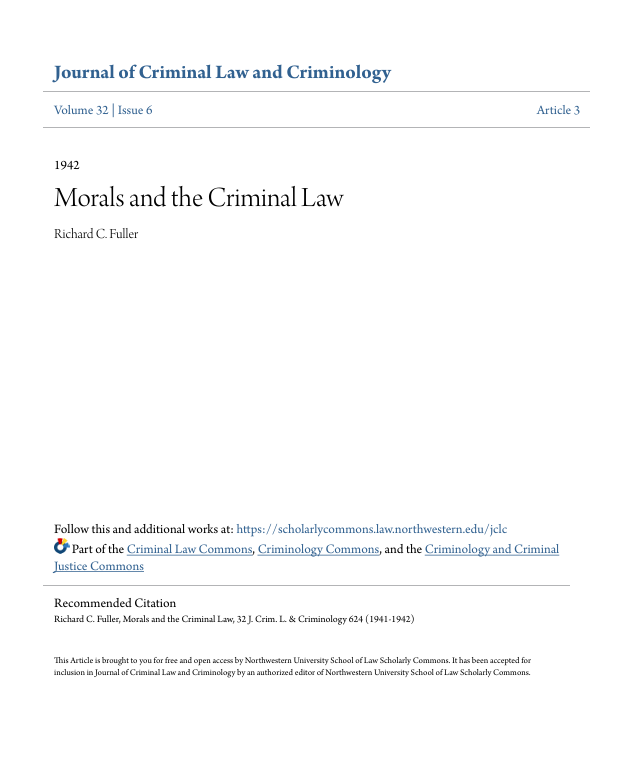
 Journal of Criminal Law and Criminology Volume 32 | Issue 6 Article 3 1942 Morals and the Criminal Law Richard C. Fuller Follow this and additional works at: https://scholarlycommons.law.northwestern.edu/jclc Part of the Criminal Law Commons, Criminology Commons, and the Criminology and Criminal Justice Commons Recommended Citation Richard C. Fuller, Morals and the Criminal Law, 32 J. Crim. L.
 Study Help