







Question: Respond to Questions a, b, d, and e (1, 2, 3, 4). Please answer each question asked, detailing the calculation process. Karen Johnson, CFO for
Respond to Questions a, b, d, and e (1, 2, 3, 4). Please answer each question asked, detailing the calculation process.
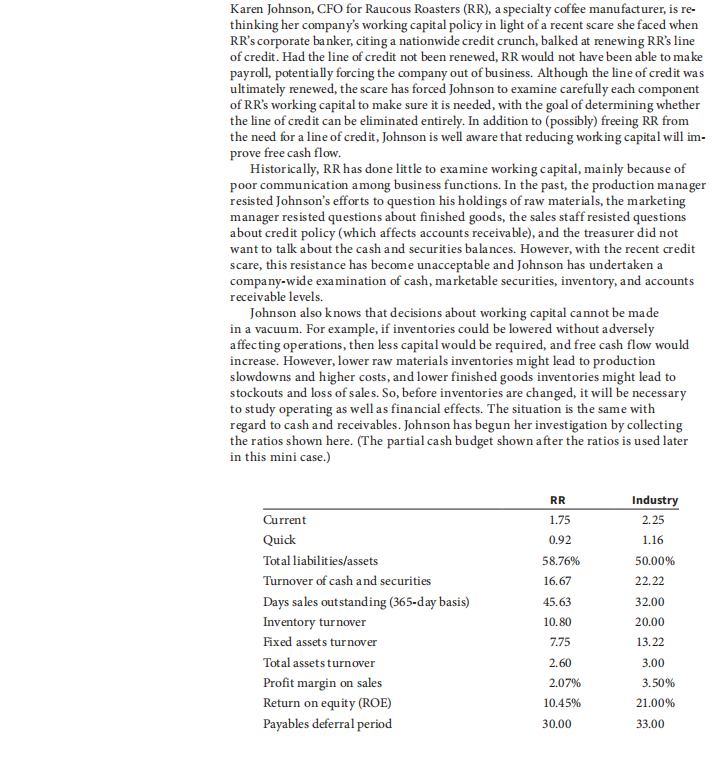
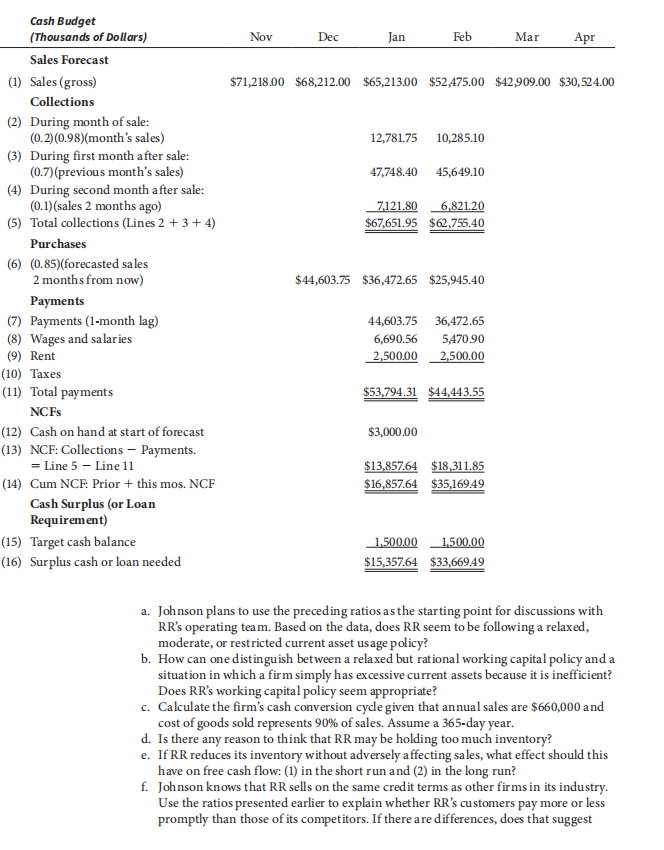
Karen Johnson, CFO for Raucous Roasters (RR), a specialty coffee manufacturer, is re- thinking her company's working capital policy in light of a recent scare she faced when RR's corporate banker, citing a nationwide credit crunch, balked at renewing RR's line of credit. Had the line of credit not been renewed, RR would not have been able to make payroll, potentially forcing the company out of business. Although the line of credit was ultimately renewed, the scare has forced Johnson to examine carefully each component of RR's working capital to make sure it is needed, with the goal of determining whether the line of credit can be eliminated entirely. In addition to (possibly) freeing RR from the need for a line of credit, Johnson is well aware that reducing working capital will im- prove free cash flow. Historically, RR has done little to examine working capital, mainly because of poor communication among business functions. In the past, the production manager resisted Johnson's efforts to question his holdings of raw materials, the marketing manager resisted questions about finished goods, the sales staff resisted questions about credit policy (which affects accounts receivable), and the treasurer did not want to talk about the cash and securities balances. However, with the recent credit scare, this resistance has become unacceptable and Johnson has undertaken a company-wide examination of cash, marketable securities, inventory, and accounts receivable levels. Johnson also knows that decisions about working capital cannot be made in a vacuum. For example, if inventories could be lowered without adversely affecting operations, then less capital would be required, and free cash flow would increase. However, lower raw materials inventories might lead to production slowdowns and higher costs, and lower finished goods inventories might lead to stockouts and loss of sales. So, before inventories are changed, it will be necessary to study operating as well as financial effects. The situation is the same with regard to cash and receivables. Johnson has begun her investigation by collecting the ratios shown here. (The partial cash budget shown after the ratios is used later in this mini case.) Current Quick Total liabilities/assets Turnover of cash and securities Days sales outstanding (365-day basis) Inventory turnover Fixed assets turnover Total assets turnover Profit margin on sales Return on equity (ROE) Payables deferral period RR 1.75 0.92 58.76% 16.67 45.63 10.80 7.75 2.60 2.07% 10.45% Industry 2.25 1.16 50.00% 22.22 32.00 20.00 13.22 3.00 3.50% 21.00% 30.00 33.00 Nov Dec Jan Feb Mar Apr $71,218.00 $68,212.00 $65,213.00 $52,475.00 $42,909.00 $30,524.00 12,781.75 10,285.10 47,748.40 45,649.10 7,121.80 6,821.20 $67,651.95 $62,755.40 $44,603.75 $36,472.65 $25,945.40 Cash Budget (Thousands of Dollars) Sales Forecast (1) Sales (gross) Collections (2) During month of sale: (0.2)(0.98)(month's sales) (3) During first month after sale: (0.7) (previous month's sales) (4) During second month after sale: (0.1) (sales 2 months ago) (5) Total collections (Lines 2 + 3 + 4) Purchases (6(0.85)(forecasted sales 2 months from now) Payments (7) Payments (1-month lag) (8) Wages and salaries (9) Rent (10) Taxes (11) Total payments NCFS (12) Cash on hand at start of forecast (13) NCF: Collections Payments. = Line 5 - Line 11 (14) Cum NCF: Prior + this mos. NCF Cash Surplus (or Loan Requirement) (15) Target cash balance (16) Surplus cash or loan needed 44,603.75 6,690.56 2,500.00 36,472.65 5470.90 2,500.00 $53,794.31 $44,443.55 $3,000.00 $13,857.64 $18,311.85 $16,857.64 $35,169.49 1,500.00 1,500.00 $15,357.64 $33,669.49 a. Johnson plans to use the preceding ratios as the starting point for discussions with RR's operating team. Based on the data, does RR seem to be following a relaxed, moderate, or restricted current asset usage policy? b. How can one distinguish between a relaxed but rational working capital policy and a situation in which a firm simply has excessive current assets because it is inefficient? Does RR's working capital policy seem appropriate? C. Calculate the firm's cash conversion cyde given that annual sales are $660,000 and cost of goods sold represents 90% of sales. Assume a 365-day year. d. Is there any reason to think that RR may be holding too much inventory? e. If RR reduces its inventory without adversely affecting sales, what effect should this have on free cash flow: (1) in the short run and (2) in the long run? f. Johnson knows that RR sells on the same credit terms as other firms in its industry. Use the ratios presented earlier to explain whether RR's customers pay more or less promptly than those of its competitors. If there are differences, does that suggest a
Step by Step Solution
There are 3 Steps involved in it

Get step-by-step solutions from verified subject matter experts
 Study Help