Question: respond to this dicussion post by processing their results with them and sharing insights and observations. use references to support Gail Cato-Strong : May 30
respond to this dicussion post by processing their results with them and sharing insights and observations. use references to support
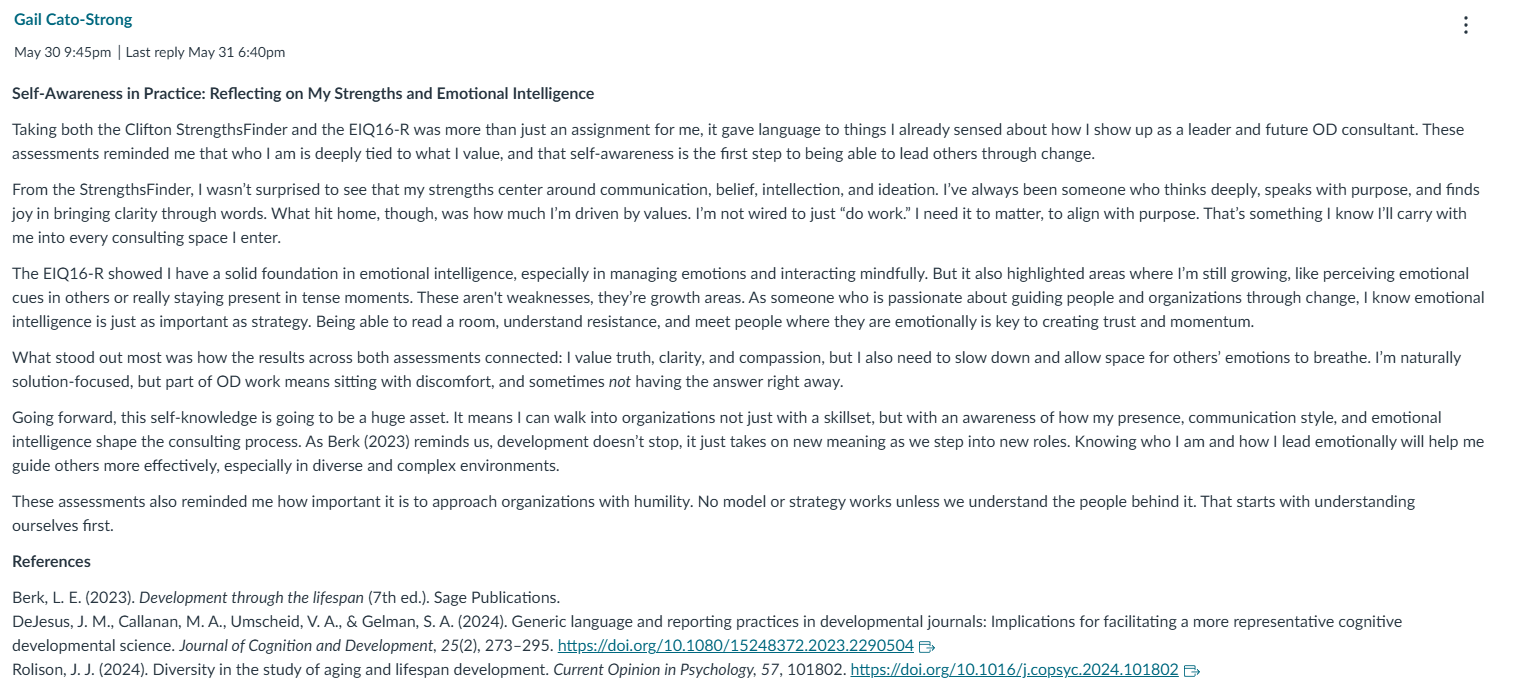
Gail Cato-Strong : May 30 9:45pm | Last reply May 31 6:40pm Self-Awareness in Practice: Reflecting on My Strengths and Emotional Intelligence Taking both the Clifton StrengthsFinder and the EIQ16-R was more than just an assignment for me, it gave language to things | already sensed about how | show up as a leader and future OD consultant. These assessments reminded me that who | am is deeply tied to what I value, and that self-awareness is the first step to being able to lead others through change. From the StrengthsFinder, | wasn't surprised to see that my strengths center around communication, belief, intellection, and ideation. I've always been someone who thinks deeply, speaks with purpose, and finds joy in bringing clarity through words. What hit home, though, was how much I'm driven by values. I'm not wired to just \"do work." | need it to matter, to align with purpose. That's something | know I'll carry with me into every consulting space | enter. The E1Q16-R showed | have a solid foundation in emotional intelligence, especially in managing emotions and interacting mindfully. But it also highlighted areas where I'm still growing, like perceiving emotional cues in others or really staying present in tense moments. These aren't weaknesses, they're growth areas. As someone who is passionate about guiding people and organizations through change, | know emotional intelligence is just as important as strategy. Being able to read a room, understand resistance, and meet people where they are emotionally is key to creating trust and momentum. What stood out most was how the results across both assessments connected: | value truth, clarity, and compassion, but | also need to slow down and allow space for others' emotions to breathe. I'm naturally solution-focused, but part of OD work means sitting with discomfort, and sometimes not having the answer right away. Going forward, this self-knowledge is going to be a huge asset. It means | can walk into organizations not just with a skillset, but with an awareness of how my presence, communication style, and emotional intelligence shape the consulting process. As Berk (2023) reminds us, development doesn't stop, it just takes on new meaning as we step into new roles. Knowing who | am and how | lead emotionally will help me guide others more effectively, especially in diverse and complex environments. These assessments also reminded me how important it is to approach organizations with humility. No model or strategy works unless we understand the people behind it. That starts with understanding ourselves first. References Berk, L. E. (2023). Development through the lifespan (7th ed.). Sage Publications. DeJesus, J. M., Callanan, M. A., Umscheid, V. A., & Gelman, S. A. (2024). Generic language and reporting practices in developmental journals: Implications for facilitating a more representative cognitive developmental science. Journal of Cognition and Development, 25(2), 273-295. https://doi.org/10.1080/15248372.2023.2290504 By Rolison, J. J. (2024). Diversity in the study of aging and lifespan development. Current Opinion in Psychology, 57, 101802. https://doi.org/10.1016/j.copsyc.2024.101802 B D









 Study Help