Question: respond to this dicussion post by processing their results with them and sharing insights and observations. use references to support Main Post Self-Awareness for OD
respond to this dicussion post by processing their results with them and sharing insights and observations. use references to support
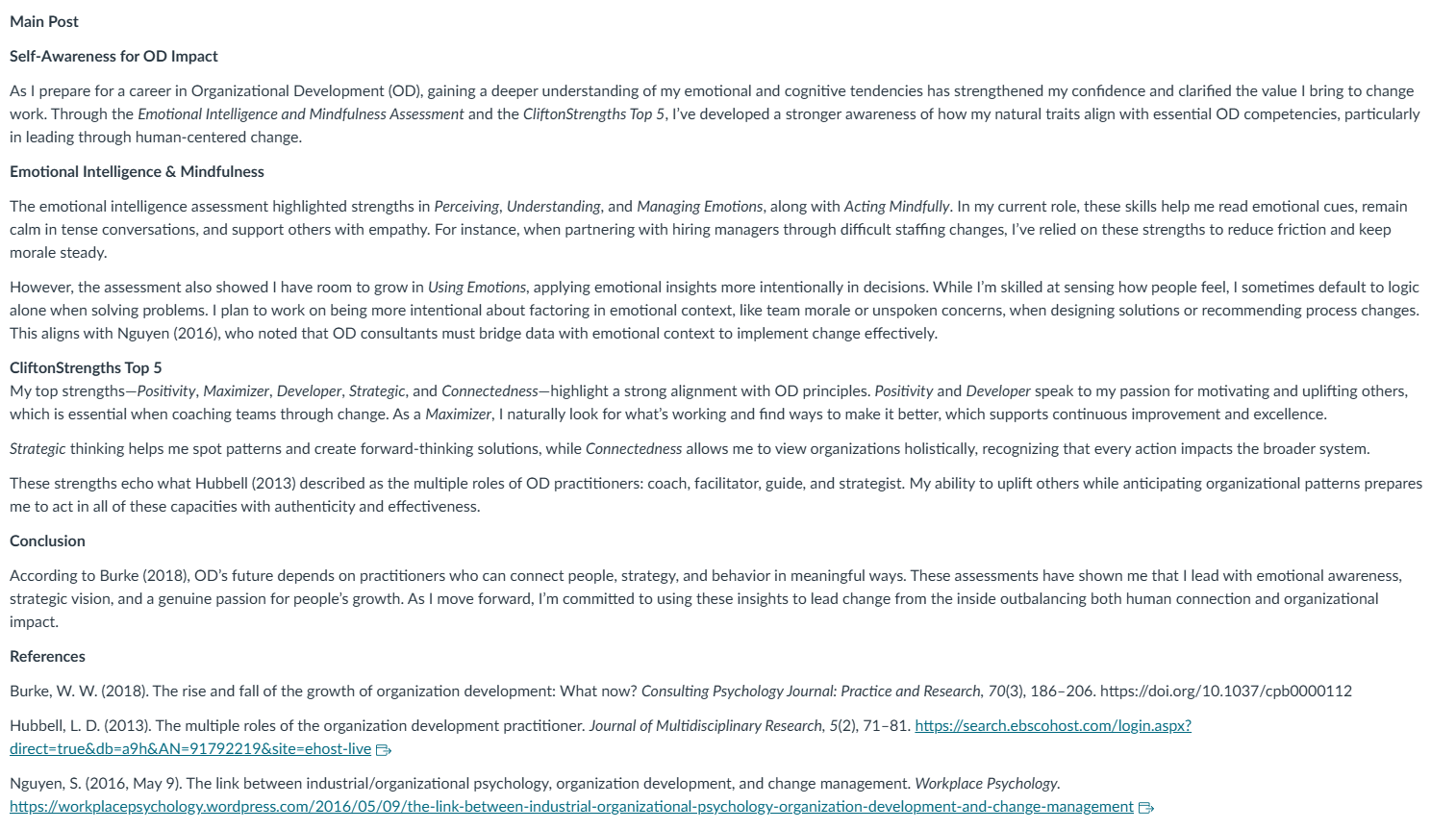
Main Post Self-Awareness for OD Impact As | prepare for a career in Organizational Development (OD), gaining a deeper understanding of my emotional and cognitive tendencies has strengthened my confidence and clarified the value | bring to change work. Through the Emotional Intelligence and Mindfulness Assessment and the CliftonStrengths Top 5, I've developed a stronger awareness of how my natural traits align with essential OD competencies, particularly in leading through human-centered change. Emotional Intelligence & Mindfulness The emotional intelligence assessment highlighted strengths in Perceiving, Understanding, and Managing Emotions, along with Acting Mindfully. In my current role, these skills help me read emotional cues, remain calm in tense conversations, and support others with empathy. For instance, when partnering with hiring managers through difficult staffing changes, I've relied on these strengths to reduce friction and keep morale steady. However, the assessment also showed | have room to grow in Using Emotions, applying emotional insights more intentionally in decisions. While I'm skilled at sensing how people feel, | sometimes default to logic alone when solving problems. | plan to work on being more intentional about factoring in emotional context, like team morale or unspoken concerns, when designing solutions or recommending process changes. This aligns with Nguyen (2016), who noted that OD consultants must bridge data with emotional context to implement change effectively. CliftonStrengths Top 5 My top strengthsPositivity, Maximizer, Developer, Strategic, and Connectednesshighlight a strong alignment with OD principles. Positivity and Developer speak to my passion for motivating and uplifting others, which is essential when coaching teams through change. As a Maximizer, | naturally look for what's working and find ways to make it better, which supports continuous improvement and excellence. Strategic thinking helps me spot patterns and create forward-thinking solutions, while Connectedness allows me to view organizations holistically, recognizing that every action impacts the broader system. These strengths echo what Hubbell (2013) described as the multiple roles of OD practitioners: coach, facilitator, guide, and strategist. My ability to uplift others while anticipating organizational patterns prepares me to act in all of these capacities with authenticity and effectiveness. Conclusion According to Burke (2018), OD's future depends on practitioners who can connect people, strategy, and behavior in meaningful ways. These assessments have shown me that | lead with emotional awareness, strategic vision, and a genuine passion for people's growth. As | move forward, I'm committed to using these insights to lead change from the inside outbalancing both human connection and organizational impact. References Burke, W. W. (2018). The rise and fall of the growth of organization development: What now? Consulting Psychology Journal: Practice and Research, 70(3), 186-206. https://doi.org/10.1037/cpb0000112 Hubbell, L. D. (2013). The multiple roles of the organization development practitioner. Journal of Multidisciplinary Research, 5(2), 71-81. https://search.ebscohost.com/login.aspx? direct=true&db=a9hG&AN=9179221 9&site=ehost-live E> Nguyen, S. (2016, May 9). The link between industrial/organizational psychology, organization development, and change management. Workplace Psychology. https://workplacepsychology.wordpress.com/2016/05/09/the-link-between-industrial-organizational-psychology-organization-development-and-change-management E>









 Study Help