Question: Respond to this discussion as a peer with references U D2-Bennett - HRMN 400 638 x Course Hero x G Grammarly x Week 2 Discussion
Respond to this discussion as a peer with references
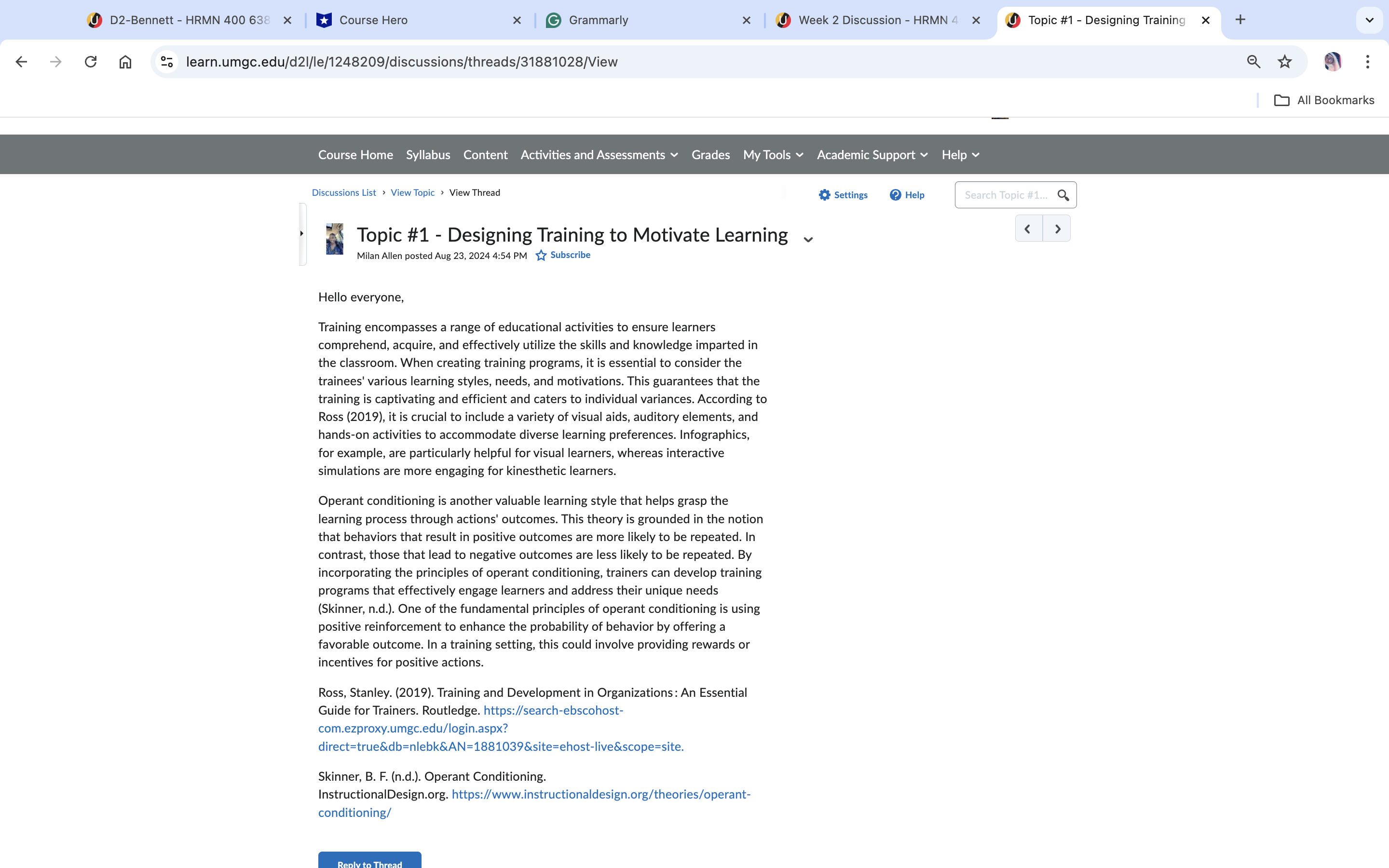
U D2-Bennett - HRMN 400 638 x Course Hero x G Grammarly x Week 2 Discussion - HRMN 4 X U Topic #1 - Designing Training X go learn.umgc.edu/d21/le/1248209/discussions/threads/31881028/View All Bookmarks Course Home Syllabus Content Activities and Assessments ~ Grades My Tools " Academic Support ~ Help v Discussions List > View Topic > View Thread Settings Help Search Topic # 1... C Topic #1 - Designing Training to Motivate Learning Milan Allen posted Aug 23, 2024 4:54 PM Subscribe Hello everyone, Training encompasses a range of educational activities to ensure learners comprehend, acquire, and effectively utilize the skills and knowledge imparted in the classroom. When creating training programs, it is essential to consider the trainees' various learning styles, needs, and motivations. This guarantees that the training is captivating and efficient and caters to individual variances. According to Ross (2019), it is crucial to include a variety of visual aids, auditory elements, and hands-on activities to accommodate diverse learning preferences. Infographics, for example, are particularly helpful for visual learners, whereas interactive simulations are more engaging for kinesthetic learners. Operant conditioning is another valuable learning style that helps grasp the learning process through actions' outcomes. This theory is grounded in the notion that behaviors that result in positive outcomes are more likely to be repeated. In contrast, those that lead to negative outcomes are less likely to be repeated. By incorporating the principles of operant conditioning, trainers can develop training programs that effectively engage learners and address their unique needs (Skinner, n.d.). One of the fundamental principles of operant conditioning is using positive reinforcement to enhance the probability of behavior by offering a favorable outcome. In a training setting, this could involve providing rewards or incentives for positive actions. Ross, Stanley. (2019). Training and Development in Organizations: An Essential Guide for Trainers. Routledge. https://search-ebscohost- com.ezproxy.umgc.edu/login.aspx? direct=true&db=nlebk&AN=1881039&site=ehost-live&scope=site. Skinner, B. F. (n.d.). Operant Conditioning. InstructionalDesign.org. https://www.instructionaldesign.org/theories/operant- conditioning/
Step by Step Solution
There are 3 Steps involved in it
1 Expert Approved Answer
Step: 1 Unlock
Question Has Been Solved by an Expert!
Get step-by-step solutions from verified subject matter experts
Step: 2 Unlock
Step: 3 Unlock
Students Have Also Explored These Related Business Writing Questions!