Question: Response me all question the answer. More Men Enter Fields Dominated by Women Shaila Dewan and Robert Gebeloff (The New York Times, May 20, 2012)
Response me all question the answer.
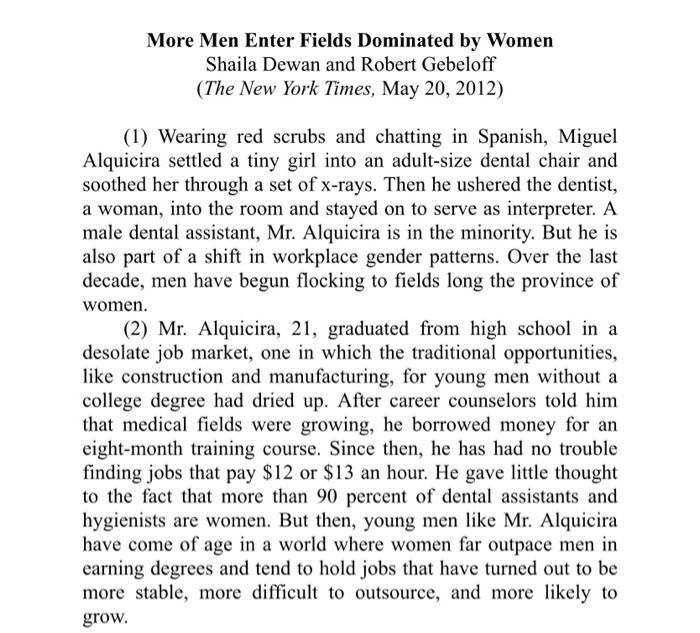
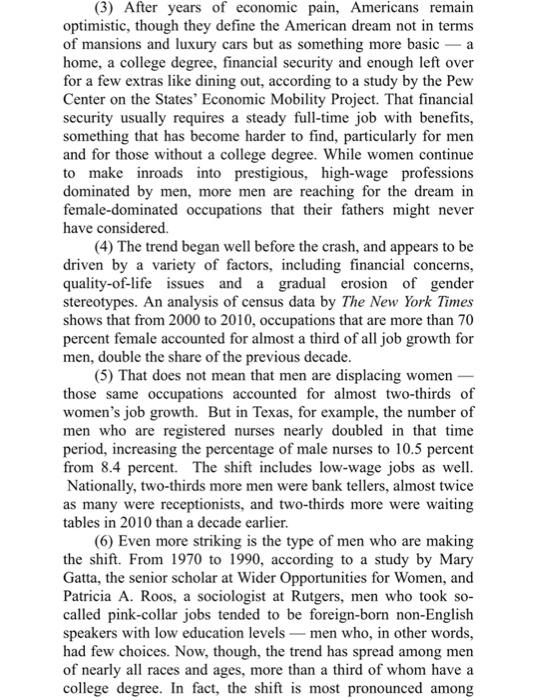
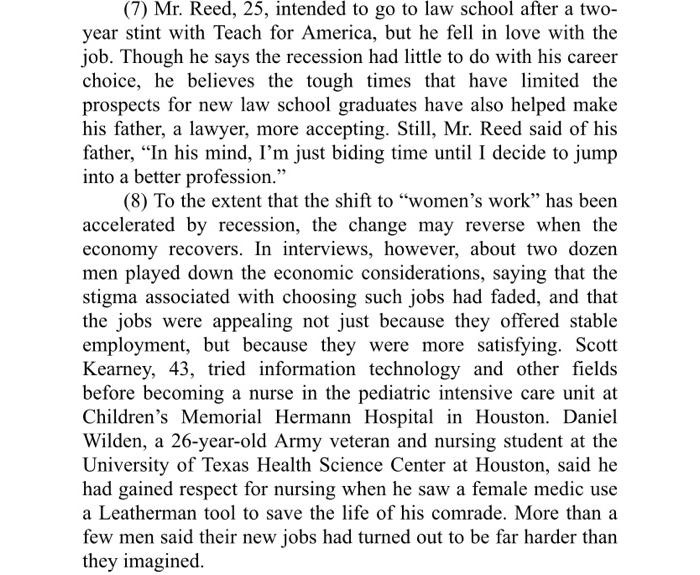
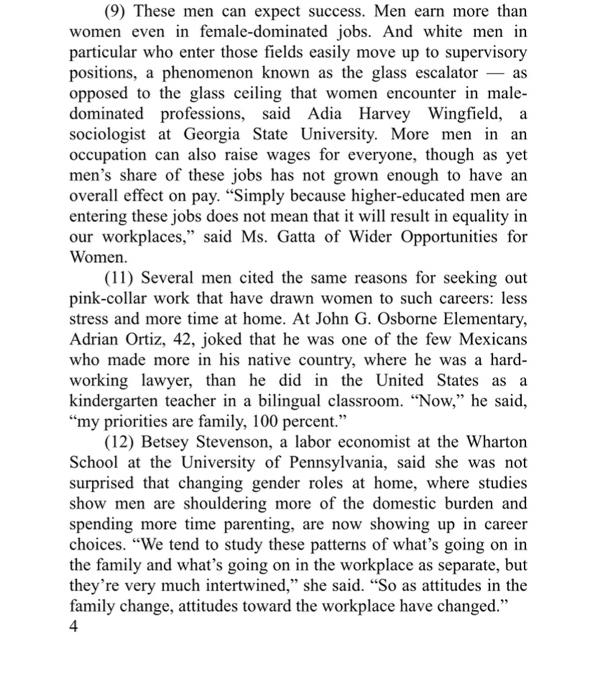
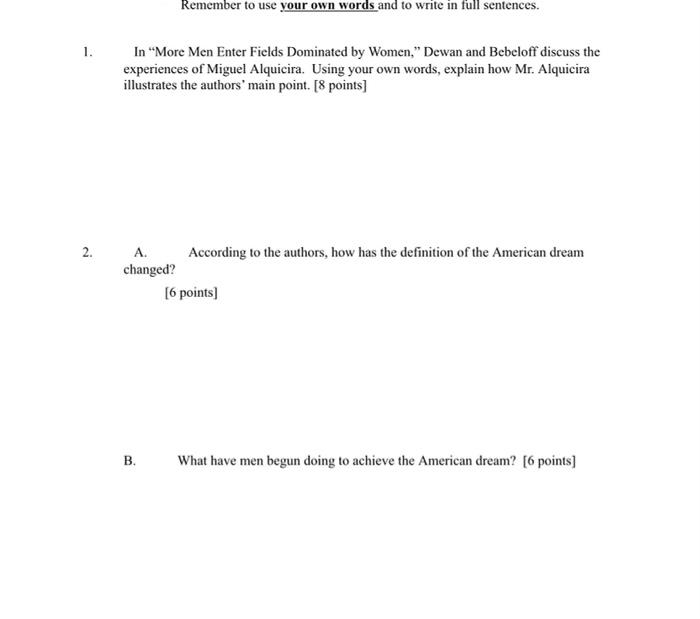
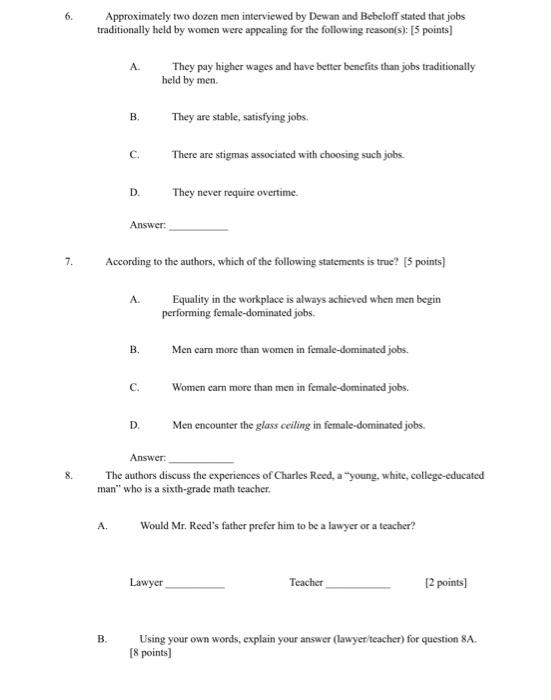
More Men Enter Fields Dominated by Women Shaila Dewan and Robert Gebeloff (The New York Times, May 20, 2012) (1) Wearing red scrubs and chatting in Spanish, Miguel Alquicira settled a tiny girl into an adult-size dental chair and soothed her through a set of x-rays. Then he ushered the dentist, a woman, into the room and stayed on to serve as interpreter. A male dental assistant, Mr. Alquicira is in the minority. But he is also part of a shift in workplace gender patterns. Over the last decade, men have begun flocking to fields long the province of women. (2) Mr. Alquicira, 21, graduated from high school in a desolate job market, one in which the traditional opportunities, like construction and manufacturing, for young men without a college degree had dried up. After career counselors told him that medical fields were growing, he borrowed money for an eight-month training course. Since then, he has had no trouble finding jobs that pay $12 or $13 an hour. He gave little thought to the fact that more than 90 percent of dental assistants and hygienists are women. But then, young men like Mr. Alquicira have come of age in a world where women far outpace men in earning degrees and tend to hold jobs that have turned out to be more stable, more difficult to outsource, and more likely to grow. (3) After years of economic pain, Americans remain optimistic, though they define the American dream not in terms of mansions and luxury cars but as something more basic - a home, a college degree, financial security and enough left over for a few extras like dining out, according to a study by the Pew Center on the States' Economic Mobility Project. That financial security usually requires a steady full-time job with benefits, something that has become harder to find, particularly for men and for those without a college degree. While women continue to make inroads into prestigious, high-wage professions dominated by men, more men are reaching for the dream in female-dominated occupations that their fathers might never have considered. (4) The trend began well before the crash, and appears to be driven by a variety of factors, including financial concerns, quality-of-life issues and a gradual erosion of gender stereotypes. An analysis of census data by The New York Times shows that from 2000 to 2010, occupations that are more than 70 percent female accounted for almost a third of all job growth for men, double the share of the previous decade. (5) That does not mean that men are displacing women those same occupations accounted for almost two-thirds of women's job growth. But in Texas, for example, the number of men who are registered nurses nearly doubled in that time period, increasing the percentage of male nurses to 10.5 percent from 8.4 percent. The shift includes low-wage jobs as well. Nationally, two-thirds more men were bank tellers, almost twice as many were receptionists, and two-thirds more were waiting tables in 2010 than a decade earlier. (6) Even more striking is the type of men who are making the shift. From 1970 to 1990, according to a study by Mary Gatta, the senior scholar at Wider Opportunities for Women, and Patricia A. Roos, a sociologist at Rutgers, men who took so- called pink-collar jobs tended to be foreign-born non-English speakers with low education levels men who, in other words, had few choices. Now, though, the trend has spread among men of nearly all races and ages, more than a third of whom have a college degree. In fact, the shift is most pronounced among (7) Mr. Reed, 25, intended to go to law school after a two- year stint with Teach for America, but he fell in love with the job. Though he says the recession had little to do with his career choice, he believes the tough times that have limited the prospects for new law school graduates have also helped make his father, a lawyer, more accepting. Still, Mr. Reed said of his father, In his mind, I'm just biding time until I decide to jump into a better profession." (8) To the extent that the shift to "women's work has been accelerated by recession, the change may reverse when the economy recovers. In interviews, however, about two dozen men played down the economic considerations, saying that the stigma associated with choosing such jobs had faded, and that the jobs were appealing not just because they offered stable employment, but because they were more satisfying. Scott Kearney, 43, tried information technology and other fields before becoming a nurse in the pediatric intensive care unit at Children's Memorial Hermann Hospital in Houston. Daniel Wilden, a 26-year-old Army veteran and nursing student at the University of Texas Health Science Center at Houston, said he had gained respect for nursing when he saw a female medic use a Leatherman tool to save the life of his comrade. More than a few men said their new jobs had turned out to be far harder than they imagined (9) These men can expect success. Men earn more than women even in female-dominated jobs. And white men in particular who enter those fields easily move up to supervisory positions, a phenomenon known as the glass escalator as opposed to the glass ceiling that women encounter in male- dominated professions, said Adia Harvey Wingfield, a sociologist at Georgia State University. More men in an occupation can also raise wages for everyone, though as yet men's share of these jobs has not grown enough to have an overall effect on pay. "Simply because higher-educated men are entering these jobs does not mean that it will result in equality in our workplaces, said Ms. Gatta of Wider Opportunities for Women. (11) Several men cited the same reasons for seeking out pink-collar work that have drawn women to such careers: less stress and more time at home. At John G. Osborne Elementary, Adrian Ortiz, 42, joked that he was one of the few Mexicans who made more in his native country, where he was a hard- working lawyer, than he did in the United States as a kindergarten teacher in a bilingual classroom. Now," he said, my priorities are family, 100 percent." (12) Betsey Stevenson, a labor economist at the Wharton School at the University of Pennsylvania, said she was not surprised that changing gender roles at home, where studies show men are shouldering more of the domestic burden and spending more time parenting, are now showing up in career choices. "We tend to study these patterns of what's going on in the family and what's going on in the workplace as separate, but they're very much intertwined, she said. So as attitudes in the family change, attitudes toward the workplace have changed." 4 Remember to use your own words and to write in full sentences. 1. In "More Men Enter Fields Dominated by Women, Dewan and Bebeloff discuss the experiences of Miguel Alquicira. Using your own words, explain how Mr. Alquicira illustrates the authors' main point. [8 points] 2. A. According to the authors, how has the definition of the American dream changed? [6 points) B. What have men begun doing to achieve the American dream? [6 points) 3. In paragraph 9, Dewan and Gebeloff discuss the glass escalator and the glass ceiling. Is the glass escalator the same as the glass ceiling? A. Yes No [2 points] B. Using your own words, explain your answer (yeso) for question 3A. [8 points) In paragraph 4, the authors refer to an analysis of census data by The New York Times. Using your own words, explain why the authors include this information in their article. [8 points) 5. A Who are Mary Gatta and Patricia Roos? (4 points] B. List two things Gatta and Roos have learned about workplace gender patterns. [6 points) In paragraph 12, the authors discuss the observations of Betsey Stevenson, a labor economist at the Wharton School at the University of Pennsylvania. Stevenson is not surprised that men are seeking out pink-collar work. Using your own words, explain why she isn't surprised by this. (8 points] 10. Based on clues from the text, the word desolate (paragraph 2) means: [5 points) A. Full / Overflowing / Plentiful B. Empty / Bare C. Not competitive D. None of the above Answer: 11. Based on clues from the text, the word intertwined (paragraph 12) means: (5 points) A. Separate / Unrelated B. In constant conflict C. Connected D. Unconnected 12. Answer: Summarize Dewan and Gebeloft's article. Be sure to include the title of the article and the authors' names in your summary. Also, remember to include their main idea and how they support the main iden. (Don't forget that a summary should not include all of the specific details and examples discussed in the article.) Begin your summary in the space below. [12 points) Approximately two dozen men interviewed by Dewan and Bebeloff stated that jobs traditionally held by women were appealing for the following reason(s): [5 points] A They pay higher wages and have better benefits than jobs traditionally held by men. B They are stable, satisfying jobs. C. There are stigmas associated with choosing such jobs D. They never require overtime Answer: 7. According to the authors, which of the following statements is true? 5 points] . Equality in the workplace is always achieved when men begin performing female-dominated jobs. B. Men cam more than women in female-dominated jobs. C. Women earn more than men in female-dominated jobs. D. Men encounter the glass ceiling in female-dominated jobs. Answer: The authors discuss the experiences of Charles Reed, a "young, white, college-educated man" who is a sixth-grade math teacher. A Would Mr. Reed's father prefer him to be a lawyer or a teacher? Lawyer Teacher 2 points) B Using your own words, explain your answer (lawyer teacher) for question 8A. [8 points)











 Study Help