Question: RESPONSE QUESTIONS PART A TO PART B A) WRITE 100 WORDS FOR YOUR RESPONSE: Please comment on how the team below can improve the assignment
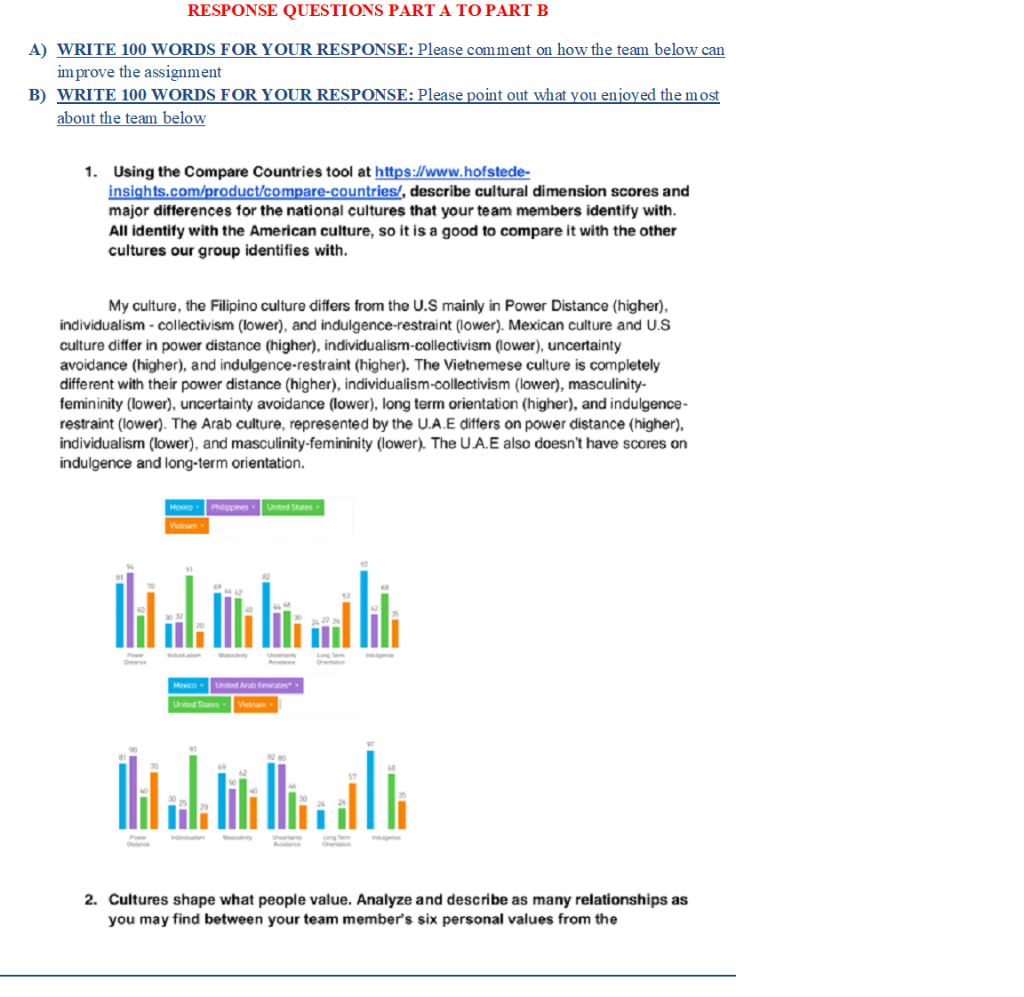
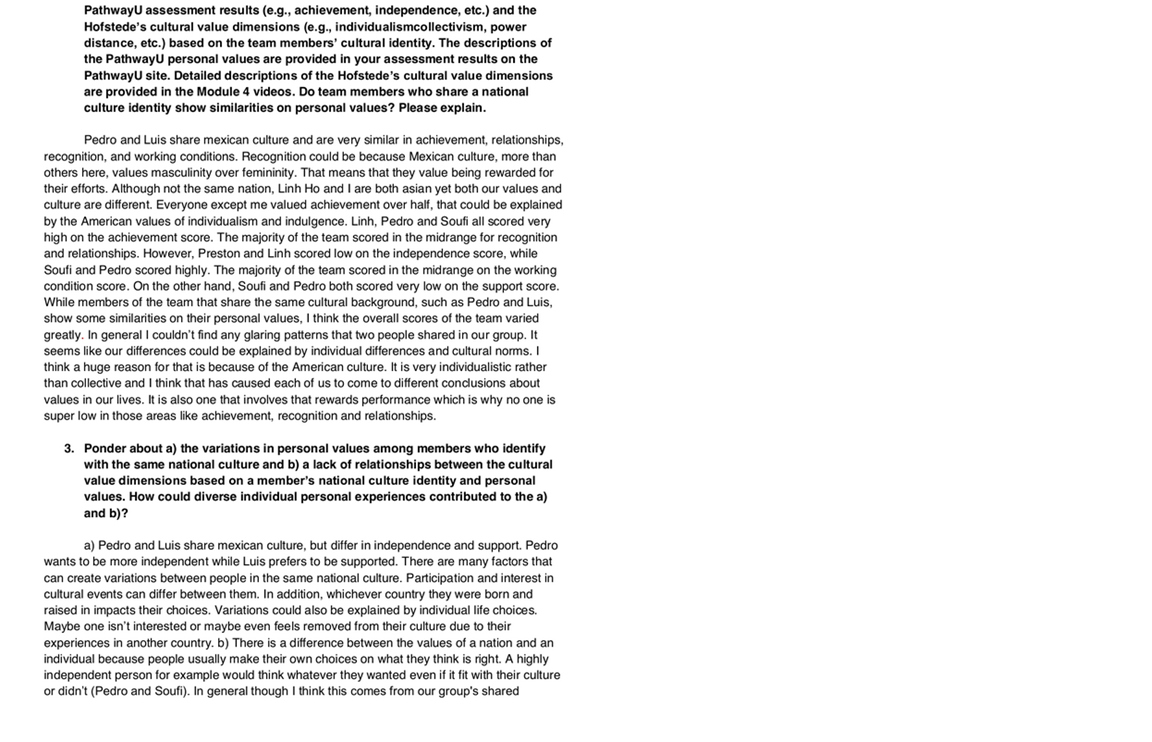
RESPONSE QUESTIONS PART A TO PART B A) WRITE 100 WORDS FOR YOUR RESPONSE: Please comment on how the team below can improve the assignment B) WRITE 100 WORDS FOR YOUR RESPONSE: Please point out what you enjoyed the most about the team below 1. Using the Compare Countries tool at https://www.hofstede- insights.com/product/compare-countries/, describe cultural dimension scores and major differences for the national cultures that your team members identify with. All identify with the American culture, so it is a good to compare it with the other cultures our group identifies with. My culture, the Filipino culture differs from the U.S mainly in Power Distance (higher), individualism - collectivism (lower), and indulgence-restraint (lower). Mexican culture and U.S culture differ in power distance (higher), individualism-collectivism (lower), uncertainty avoidance (higher), and indulgence-restraint (higher). The Vietnemese culture is completely different with their power distance (higher), individualism-collectivism (lower), masculinity- femininity (lower), uncertainty avoidance (lower), long term orientation (higher), and indulgence- restraint (lower). The Arab culture, represented by the U.A.E differs on power distance (higher). individualism (lower), and masculinity-femininity (lower). The U.A.E also doesn't have scores on indulgence and long-term orientation. MOPhlippines Uned States Vietnam United Arab Emirates United States Vietnam ili 2. Cultures shape what people value. Analyze and describe as many relationships as you may find between your team member's six personal values from the Pathway assessment results (e.g., achievement, independence, etc.) and the Hofstede's cultural value dimensions (e.g., individualismcollectivism, power distance, etc.) based on the team members' cultural identity. The descriptions of the Pathwayu personal values are provided in your assessment results on the Pathwayu site. Detailed descriptions of the Hofstede's cultural value dimensions are provided in the Module 4 videos. Do team members who share a national culture identity show similarities on personal values? Please explain. recognition Pedro and Luis share mexican culture and are very similar in achievement, relationships, recognition, and working conditions. Recognition could be because Mexican culture, more than others here, values masculinity over femininity. That means that they value being rewarded for their efforts. Although not the same nation, Linh Ho and I are both asian yet both our values and culture are different. Everyone except me valued achievement over half, that could be explained by the American values of individualism and indulgence. Linh, Pedro and Soufi all scored very high on the achievement score. The majority of the team scored in the midrange for and relationships. However, Preston and Linh scored low on the independence score, while Soufi and Pedro scored edro scored highly. The majority of the team scored in the midrange on the working condition score. On the other hand, Soufi and Pedro both scored very low on the support score. While members of the team that share the same cultural background, such as Pedro and Luis, show some similarities on their personal values, I think the overall scores of the team varied greatly. In general I couldn't find any glaring patterns that two people shared in our group. It seems like our differences could be explained by individual differences and cultural norms. think a huge reason for that because of the American culture. It is very individualistic rather than collective and I think that has caused each of us to come to different conclusions about values in our lives. It is also one that involves that rewards performance which is why no one is super low in those areas like achievement, recognition and relationships. 1 3. Ponder about a) the variations in personal values among members who identify with the same national culture and b) a lack of relationships between the cultural value dimensions based on a member's national culture identity and personal values. How could diverse individual personal experiences contributed to the a) and b)? a) Pedro and Luis share mexican culture, but differ in independence and support. Pedro wants to be more independent while Luis prefers to be supported. There are many factors that can create variations between people in the same national culture. Participation and interest in cultural events can differ between them. In addition, whichever country they were born and raised in impacts their choices. Variations could also be explained by individual life choices. Maybe one isn't interested or maybe even feels removed from their culture due to their experiences in another country. b) There is a difference between the values of a nation and an individual because people usually make their own choices on what they think is right. A highly independent person for example would think whatever they wanted even if it fit with their culture or didn't (Pedro and Soufi). In general though I think this comes from our group's shared American background. For example, I am Filipino, but my family and I have never done anything traditionally Filipino, for the most part we just eat the food. This has its positives, but also some drawbacks, like the fact that I and many people don't have that genuine relationship with their other culture. This could be one of the reasons there is a lack of relationship between a person's cultural values and personal values. 4. Examine how differences in personal values may influence teamwork on your team. Consider various functions of teamwork (e.g., collaboration, coordination, facilitation, leadership, scheduling, decision-making, document-controlling, goal- setting, conflict-management, etc.). Examine the norms you expressed for your teamwork in your Team Contract. Are members' personal values reflected in your team's norms? Have some members felt the need to adjust to team's norms because they may not have reflected their individual values? What are the lessons you learned with regards to alignment of team norms and personal values? Personal values can impact teamwork. For example, Preston was the only one who was on the right half of valuing relationships. This could mean while he is communicating to try to build relationships with his team others could be communicating to simply get the task done. On the other hand, Soufi and Pedro value independence which isn't bad at all, but could clash with the fact everyone else wants to work with each other. In our contract, we stated that every member is expected to check the group chat and do the activity. This reflects many of our values because only Preston valued recognition and relationships and with our system it doesn't promote relationships or recognition. No one has really felt the need to change our norms, it seems like a good compromise for everyone. In terms of norms and personal values, I found that in a group people usually regress or progress to the mean. For example, if someone prefers to work alone they will still promote teamwork because they realize that important when it comes to group activities. RESPONSE QUESTIONS PART A TO PART B A) WRITE 100 WORDS FOR YOUR RESPONSE: Please comment on how the team below can improve the assignment B) WRITE 100 WORDS FOR YOUR RESPONSE: Please point out what you enjoyed the most about the team below 1. Using the Compare Countries tool at https://www.hofstede- insights.com/product/compare-countries/, describe cultural dimension scores and major differences for the national cultures that your team members identify with. All identify with the American culture, so it is a good to compare it with the other cultures our group identifies with. My culture, the Filipino culture differs from the U.S mainly in Power Distance (higher), individualism - collectivism (lower), and indulgence-restraint (lower). Mexican culture and U.S culture differ in power distance (higher), individualism-collectivism (lower), uncertainty avoidance (higher), and indulgence-restraint (higher). The Vietnemese culture is completely different with their power distance (higher), individualism-collectivism (lower), masculinity- femininity (lower), uncertainty avoidance (lower), long term orientation (higher), and indulgence- restraint (lower). The Arab culture, represented by the U.A.E differs on power distance (higher). individualism (lower), and masculinity-femininity (lower). The U.A.E also doesn't have scores on indulgence and long-term orientation. MOPhlippines Uned States Vietnam United Arab Emirates United States Vietnam ili 2. Cultures shape what people value. Analyze and describe as many relationships as you may find between your team member's six personal values from the Pathway assessment results (e.g., achievement, independence, etc.) and the Hofstede's cultural value dimensions (e.g., individualismcollectivism, power distance, etc.) based on the team members' cultural identity. The descriptions of the Pathwayu personal values are provided in your assessment results on the Pathwayu site. Detailed descriptions of the Hofstede's cultural value dimensions are provided in the Module 4 videos. Do team members who share a national culture identity show similarities on personal values? Please explain. recognition Pedro and Luis share mexican culture and are very similar in achievement, relationships, recognition, and working conditions. Recognition could be because Mexican culture, more than others here, values masculinity over femininity. That means that they value being rewarded for their efforts. Although not the same nation, Linh Ho and I are both asian yet both our values and culture are different. Everyone except me valued achievement over half, that could be explained by the American values of individualism and indulgence. Linh, Pedro and Soufi all scored very high on the achievement score. The majority of the team scored in the midrange for and relationships. However, Preston and Linh scored low on the independence score, while Soufi and Pedro scored edro scored highly. The majority of the team scored in the midrange on the working condition score. On the other hand, Soufi and Pedro both scored very low on the support score. While members of the team that share the same cultural background, such as Pedro and Luis, show some similarities on their personal values, I think the overall scores of the team varied greatly. In general I couldn't find any glaring patterns that two people shared in our group. It seems like our differences could be explained by individual differences and cultural norms. think a huge reason for that because of the American culture. It is very individualistic rather than collective and I think that has caused each of us to come to different conclusions about values in our lives. It is also one that involves that rewards performance which is why no one is super low in those areas like achievement, recognition and relationships. 1 3. Ponder about a) the variations in personal values among members who identify with the same national culture and b) a lack of relationships between the cultural value dimensions based on a member's national culture identity and personal values. How could diverse individual personal experiences contributed to the a) and b)? a) Pedro and Luis share mexican culture, but differ in independence and support. Pedro wants to be more independent while Luis prefers to be supported. There are many factors that can create variations between people in the same national culture. Participation and interest in cultural events can differ between them. In addition, whichever country they were born and raised in impacts their choices. Variations could also be explained by individual life choices. Maybe one isn't interested or maybe even feels removed from their culture due to their experiences in another country. b) There is a difference between the values of a nation and an individual because people usually make their own choices on what they think is right. A highly independent person for example would think whatever they wanted even if it fit with their culture or didn't (Pedro and Soufi). In general though I think this comes from our group's shared American background. For example, I am Filipino, but my family and I have never done anything traditionally Filipino, for the most part we just eat the food. This has its positives, but also some drawbacks, like the fact that I and many people don't have that genuine relationship with their other culture. This could be one of the reasons there is a lack of relationship between a person's cultural values and personal values. 4. Examine how differences in personal values may influence teamwork on your team. Consider various functions of teamwork (e.g., collaboration, coordination, facilitation, leadership, scheduling, decision-making, document-controlling, goal- setting, conflict-management, etc.). Examine the norms you expressed for your teamwork in your Team Contract. Are members' personal values reflected in your team's norms? Have some members felt the need to adjust to team's norms because they may not have reflected their individual values? What are the lessons you learned with regards to alignment of team norms and personal values? Personal values can impact teamwork. For example, Preston was the only one who was on the right half of valuing relationships. This could mean while he is communicating to try to build relationships with his team others could be communicating to simply get the task done. On the other hand, Soufi and Pedro value independence which isn't bad at all, but could clash with the fact everyone else wants to work with each other. In our contract, we stated that every member is expected to check the group chat and do the activity. This reflects many of our values because only Preston valued recognition and relationships and with our system it doesn't promote relationships or recognition. No one has really felt the need to change our norms, it seems like a good compromise for everyone. In terms of norms and personal values, I found that in a group people usually regress or progress to the mean. For example, if someone prefers to work alone they will still promote teamwork because they realize that important when it comes to group activities









 Study Help