







Question: Return to ques 3 When planets orbit a star, both orbit their common center of mass, which lies at a point between them closer to
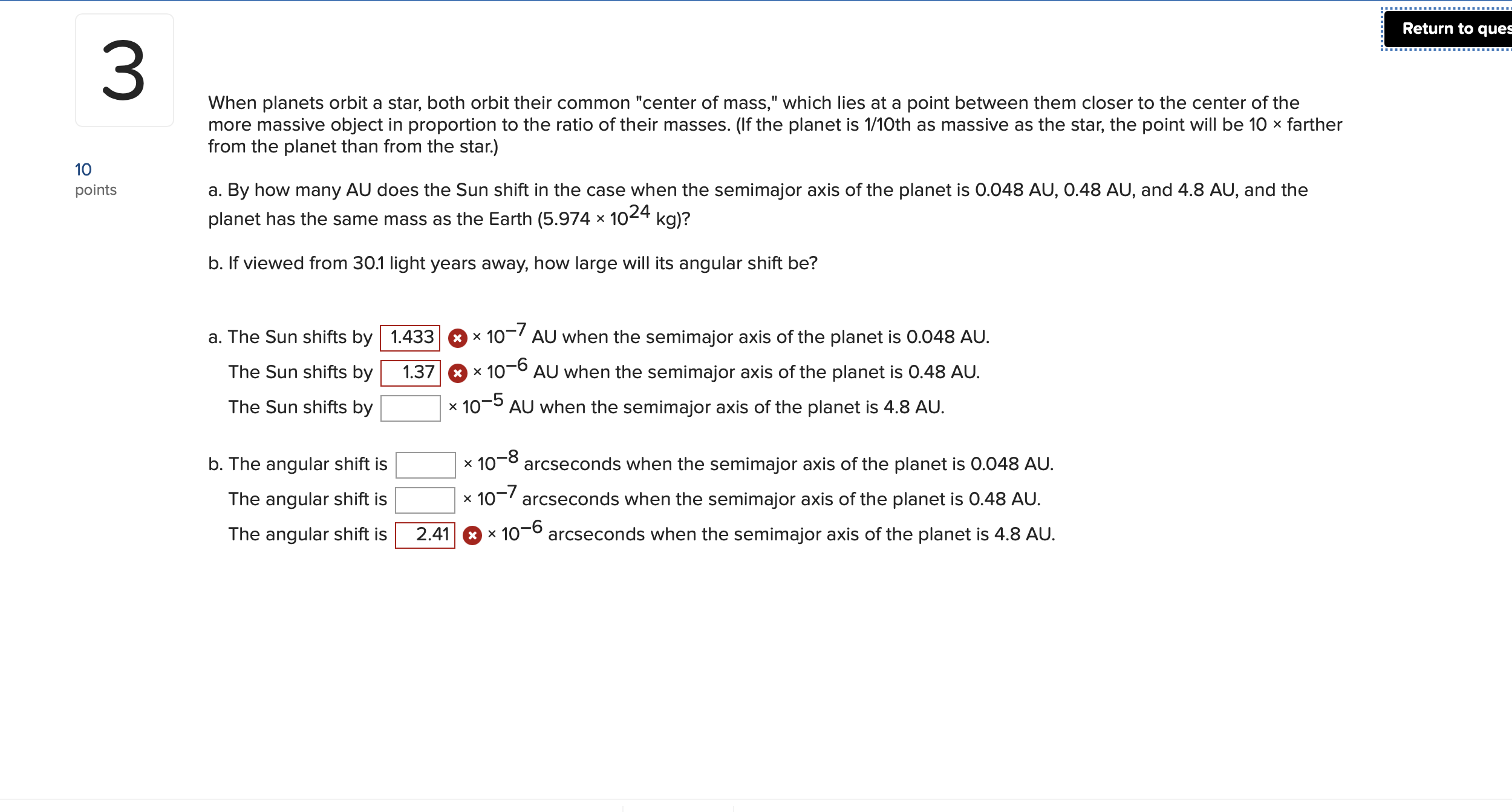
Return to ques 3 When planets orbit a star, both orbit their common "center of mass," which lies at a point between them closer to the center of the more massive object in proportion to the ratio of their masses. (If the planet is 1/10th as massive as the star, the point will be 10 x farther from the planet than from the star.) 10 points a. By how many AU does the Sun shift in the case when the semimajor axis of the planet is 0.048 AU, 0.48 AU, and 4.8 AU, and the planet has the same mass as the Earth (5.974 x 1024 kg)? b. If viewed from 30.1 light years away, how large will its angular shift be? a. The Sun shifts by 1.433 x x 107/ AU when the semimajor axis of the planet is 0.048 AU. The Sun shifts by| 1.37 x 10⁻⁶ AU when the semimajor axis of the planet is 0.48 AU. The Sun shifts by x 10-5 AU when the semimajor axis of the planet is 4.8 AU. b. The angular shift is x 10- arcseconds when the semimajor axis of the planet is 0.048 AU. The angular shift is x 10- arcseconds when the semimajor axis of the planet is 0.48 AU. The angular shift is 2.41 x x 10- arcseconds when the semimajor axis of the planet is 4.8 AU
Step by Step Solution
There are 3 Steps involved in it

Get step-by-step solutions from verified subject matter experts
 Study Help