Question: Review Case Study 5.1: Live Racking at B.M.W. (attached). Assume that you are the warehouse director for B.M.W. B.M.W. has learned that the 39-second cycle
Review Case Study 5.1: Live Racking at B.M.W. (attached). Assume that you are the warehouse director for B.M.W. B.M.W. has learned that the 39-second cycle time described in the case is inadequate for 21st-century operations and has asked you to reduce the cycle time down to 30 seconds or less. Identify a technique described in Chapter 4 or 5 that could potentially be used to reduce cycle time down to 30 seconds or less (i.e., adjustable pallet racking (APR), drive in racking (DIR), powered mobile racking (PMR).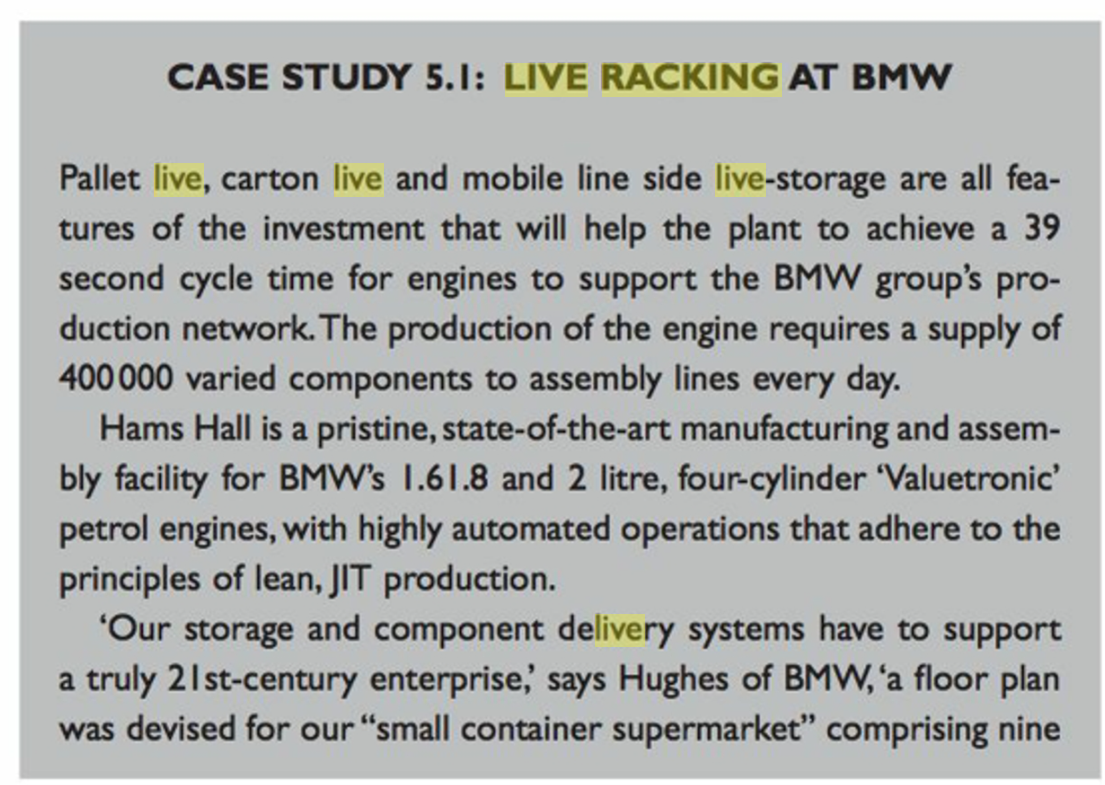
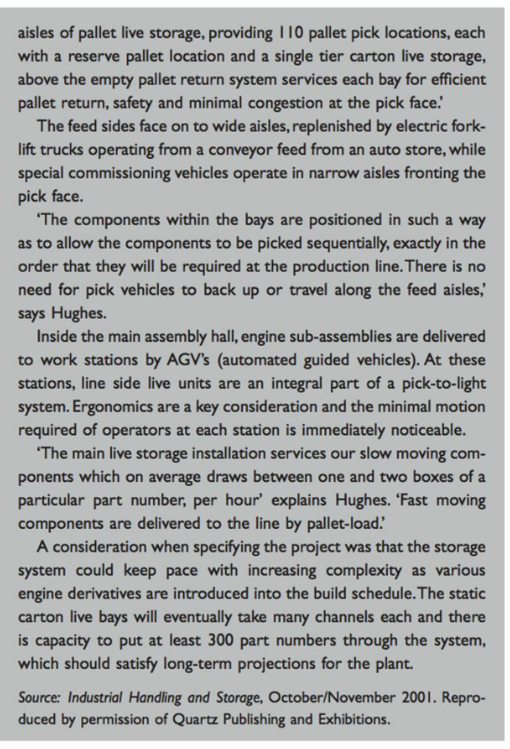
Pallet live, carton live and mobile line side live-storage are all features of the investment that will help the plant to achieve a 39 second cycle time for engines to support the BMW group's production network. The production of the engine requires a supply of 400000 varied components to assembly lines every day. Hams Hall is a pristine, state-of-the-art manufacturing and assembly facility for BMW's 1.61.8 and 2 litre, four-cylinder 'Valuetronic' petrol engines, with highly automated operations that adhere to the principles of lean, JIT production. 'Our storage and component delivery systems have to support a truly 2 I st-century enterprise,' says Hughes of BMW,'a floor plan was devised for our "small container supermarket" comprising nine aisles of pallet live storage, providing 110 pallet pick locations, each with a reserve pallet location and a single tier carton live storage, above the empty pallet return system services each bay for efficient pallet return, safety and minimal congestion at the pick face.' The feed sides face on to wide aisles, replenished by electric forklift trucks operating from a conveyor feed from an auto store, while special commissioning vehicles operate in narrow aisles fronting the pick face. 'The components within the bays are positioned in such a way as to allow the components to be picked sequentially, exactly in the order that they will be required at the production line. There is no need for pick vehicles to back up or travel along the feed aisles,' says Hughes. Inside the main assembly hall, engine sub-assemblies are delivered to work stations by AGV's (automated guided vehicles). At these stations, line side live units are an integral part of a pick-to-light system. Ergonomics are a key consideration and the minimal motion required of operators at each station is immediately noticeable. 'The main live storage installation services our slow moving components which on average draws between one and two boxes of a particular part number, per hour' explains Hughes. 'Fast moving components are delivered to the line by pallet-load.' A consideration when specifying the project was that the storage system could keep pace with increasing complexity as various engine derivatives are introduced into the build schedule. The static carton live bays will eventually take many channels each and there is capacity to put at least 300 part numbers through the system, which should satisfy long-term projections for the plant. Source: Industrial Handling and Storage, October/November 200I. Reproduced by permission of Quartz Publishing and Exhibitions




