







Question: Review Question Experimental Setup and Procedure: If another student wanted to complete the experiment the same way that you did, they would need to know
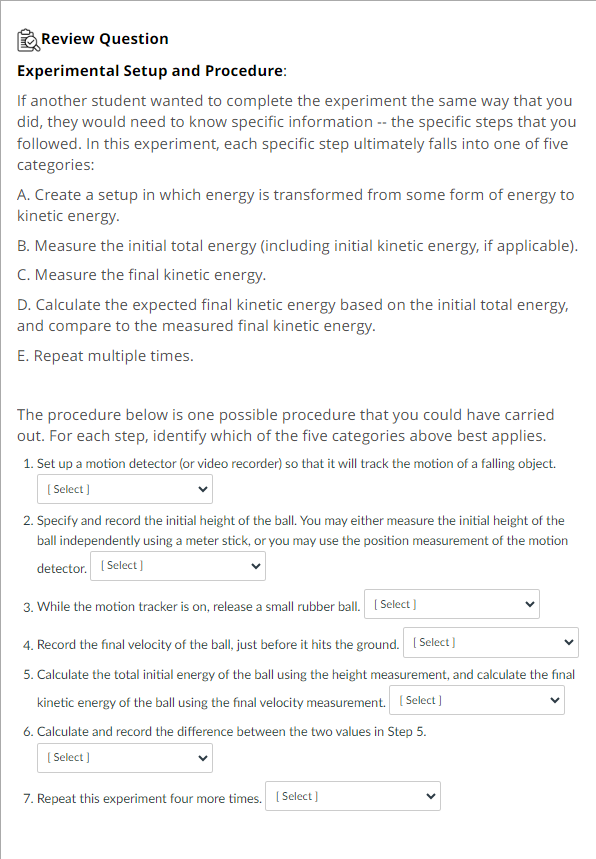

Review Question Experimental Setup and Procedure: If another student wanted to complete the experiment the same way that you did, they would need to know specific information -- the specific steps that you followed. In this experiment, each specific step ultimately falls into one of five categories: A. Create a setup in which energy is transformed from some form of energy to kinetic energy. B. Measure the initial total energy (including initial kinetic energy, if applicable). C. Measure the final kinetic energy. D. Calculate the expected final kinetic energy based on the initial total energy, and compare to the measured final kinetic energy. E. Repeat multiple times. The procedure below is one possible procedure that you could have carried out. For each step, identify which of the five categories above best applies. 1. Set up a motion detector (or video recorder) so that it will track the motion of a falling object. [ Select ] 2. Specify and record the initial height of the ball. You may either measure the initial height of the ball independently using a meter stick, or you may use the position measurement of the motion detector. [ Select ] 3. While the motion tracker is on, release a small rubber ball. [ Select ] 4. Record the final velocity of the ball, just before it hits the ground. [ Select ] 5. Calculate the total initial energy of the ball using the height measurement, and calculate the final kinetic energy of the ball using the final velocity measurement. [ Select ] 6. Calculate and record the difference between the two values in Step 5. [ Select ] 7. Repeat this experiment four more times. [ Select ][ Select ] Create a setup in which energy is transformed from some form of energy to kinetic energy. Measure the initial total energy (including initial kinetic energy, if applicable). Measure the final kinetic energy. Calculate the expected final kinetic energy based on the initial total energy, and compare to the measured final kinetic energy. Repeat multiple times
Step by Step Solution
There are 3 Steps involved in it

Get step-by-step solutions from verified subject matter experts
 Study Help