Question: Review the example of Multistage Process with Buffer on p. 267 of the textbook (or at 39 min 16 sec of the lecture video). This
Review the example of Multistage Process with Buffer on p. 267 of the textbook (or at 39 min 16 sec of the lecture video). This simple process includes stage 1 and 2, of which the cycle times are 30 seconds and 45 seconds. Because the stage 1 is faster than the stage 2, the process is unbalanced with the stage 2 being a bottleneck. Without a buffer between the two stages, stage 1 would be blocked for 15 seconds for each unit. With a buffer being placed, the process completes 100 units in 4,530 seconds. What would happen if stage 1 required 45 seconds and stage 2 required 30 seconds? Which stage is the bottleneck in this new process? Without a buffer, do we experience blocking or starving? How long does it take for this process to complete 100 units with a buffer? Read about the multi-stage process and explain your solution.
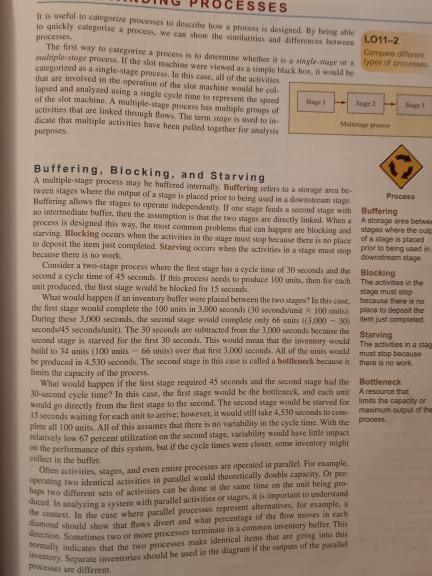
processes CESSES It is well to categorie processes to describe how a process is desighed. Hy being while to quickly categorie proces, we can show the similarities and differences between LO11-2 Compareditor The first way to categorize a process is to determine whether it is a single stope of multiple stage process. If the slot machine were viewed as a simple black box, it would be categorized as a single-stage process. In this case, all of the activities slutare involved in the operation of the slot machine would he col. lapsed and analyzed using a simple cycle time to represent the speed Sat - of the slot machine. A multiple-stage process has multiple groups of activities that are linked through flows. The term stege is used to in dicate that multiple activities have been pulled together for analysis purposes Buffering, Blocking, and Starving A multiple-stage process may be buffered internally. Buffering refers to per te tween stapes where the output of a stage is placed price to being dinama Process Buffering allows the stages to operate independently. If one stage feeds a second stage with Buffering no intermediate batter, then the assumption is that the two stages are directly linked. When a storage aree bet process is designed this way, the most common problems that can happen are blocking and stages where the out starving Blocking occurs when the activities in the stage must stop because there is no place a stage is placed to deposit the item just completed. Starving occurs when ts activities in a stage must stop prior to be used in because there is no work downstream stage Consider a two-stage process where the first stage has a cycle time of 30 seconds and the Blocking second a cycle time of 45 seconds. If this process needs to produce 100 units, then for each The activities in the unit produced, the first stage would be blocked for 15 seconds stage must stop What would happen if an inventory buffer were placed between the two stages in this case, because there is no the first stage would complete the 100 units in 3,000 seconds (30 secondvunit X 100 units place to deposit the During these 3.000 seconds, the second stage vald complete only 66 units (0.000 - 30 tam just completed seconds/45 seconds/unit). The 30 seconds are subtracted from the 1.000 seconds because the Starving second stage is starved for the first 30 seconds. This would mean that the imcntory would The activities in a slag built to 34 units (100 units 66 units over that fit 3.000 seconds. All of the units would must stop because be produced in 4,530 seconds. The second stage in this case is called a bottleneck because it there a no work fimits the capacity of the process What would happen if the first stage required 45 seconds and the seconil stage had the Bottleneck 30-second cycle time? In this case, the first stage would be the bottleneck, and exchanit Aresource that would go directly from the first stage to the second. The second stage would be starved for limes the capacity or maximum output of the 15 seconds waiting for each unit to arrive: however, it would still take 4,530 seconds to cum plete all 100 units. All of this assumes that there is no variability in the cycle time. With the process relatively low 67 percent utilization on the second stage, variability would have limle impact was the performance of this system, but if the cycle times were closer, some inventory might collect in the buffer One activities, stages, and even entire processes are operated in parallel For example, penting twu identical activities in parallel would theoretically doable capacity. Or per up to different sets of activities can be done at the same time on the unit being pro duced. In analyring a system with parallel activities or stages, it is important to understand the content. In the case where parallel processes represent ulternatives, for example, diamond should show that to divert and what percentage of the Row moves in each normally indicates that the two processes make identical items that are going into this processes are different Section Sometimes two or more processes terminate in comme investery butlet. This mentors Separate inventori suld be used in the diagram if the outputs of the parallel









 Study Help