







Question: Ridge OLS Now, it is time to code ridge regression ( regularization using the _ ( 2 ) norm ) for OLS. See equation given
Ridge OLS
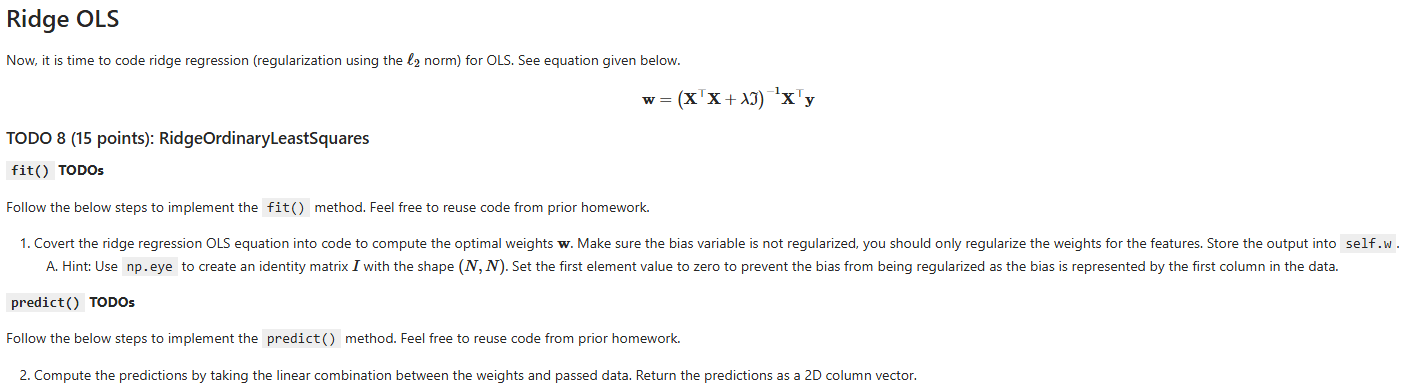
Now, it is time to code ridge regression regularization using the norm for OLS. See equation given below.
wXTTXlambdaIXTTy
TODO points: RidgeOrdinaryLeastSquares
fit TODOs
Follow the below steps to implement the fit method. Feel free to reuse code from prior homework.
Covert the ridge regression OLS equation into code to compute the optimal weights w Make sure the bias variable is not regularized, you should only regularize the weights for the features. Store the output into self.w
A Hint: Use np eye to create an identity matrix I with the shape NN Set the first element value to zero to prevent the bias from being regularized as the bias is represented by the first column in the data.
predict TODOs
Follow the below steps to implement the predict method. Feel free to reuse code from prior homework.
Compute the predictions by taking the linear combination between the weights and passed data. Return the predictions as a D column vector.
class RidgeOrdinaryLeastSquares:
Perfroms ordinary least squares regression
Attributes:
lamb float: Regularization parameter for controlling
L regularization.
w: Vector of weights
def initself lamb: float:
self.lamb lamb
self.w None
def fitself X: npndarray, y: npndarray object:
Train OLS to learn optimal weights
Args:
X: Training data given as a D matrix
y: Training labels given as a D vector
Returns:
The class's own object reference.
# TODO
return self
def predictself X: npndarray npndarray:
Make predictions using learned weights
Args:
X: Testing data given as a D matrix
Returns:
A D column vector of predictions for each data sample in X
# TODO
return None
Step by Step Solution
There are 3 Steps involved in it
1 Expert Approved Answer
Step: 1 Unlock

Question Has Been Solved by an Expert!
Get step-by-step solutions from verified subject matter experts
Step: 2 Unlock
Step: 3 Unlock
 Study Help