



Question: RIGHT CLICK IMAGE AND OPEN IN NEW TAB. PLEASE DONT COMMENT ''NOT PROPPER VISIBLE'' AS CHEGG DOESNT ALLOW ME TO MAKE IMAGES VISIBLE. RIGHT CLICK
RIGHT CLICK IMAGE AND OPEN IN NEW TAB. PLEASE DONT COMMENT ''NOT PROPPER VISIBLE'' AS CHEGG DOESNT ALLOW ME TO MAKE IMAGES VISIBLE. RIGHT CLICK OPEN IMAGE IN NEW TAB!
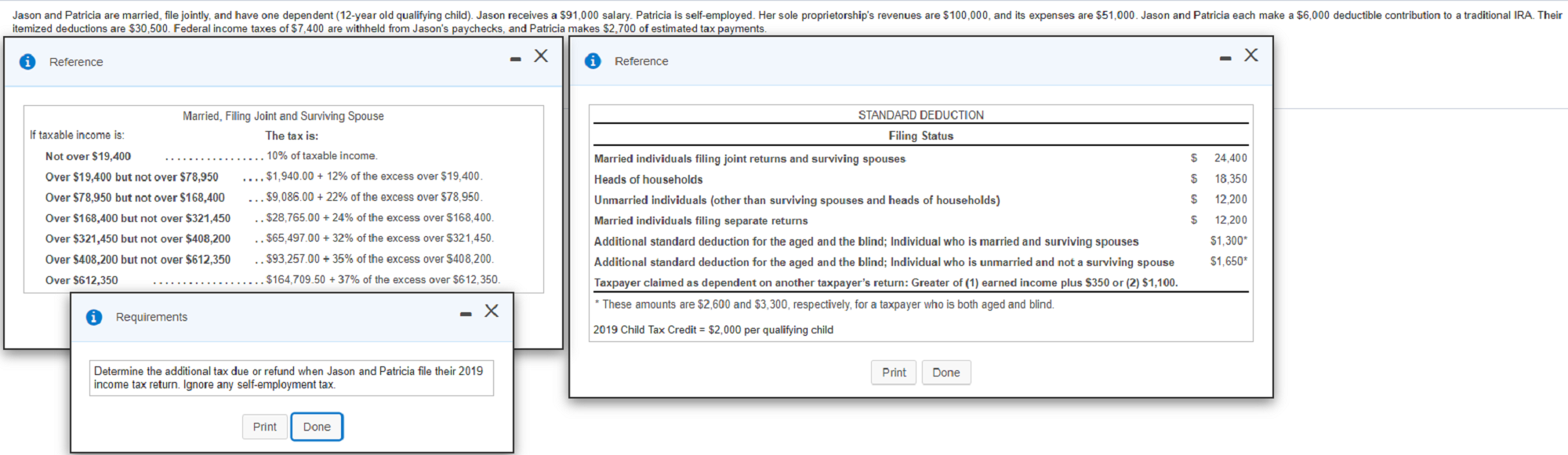
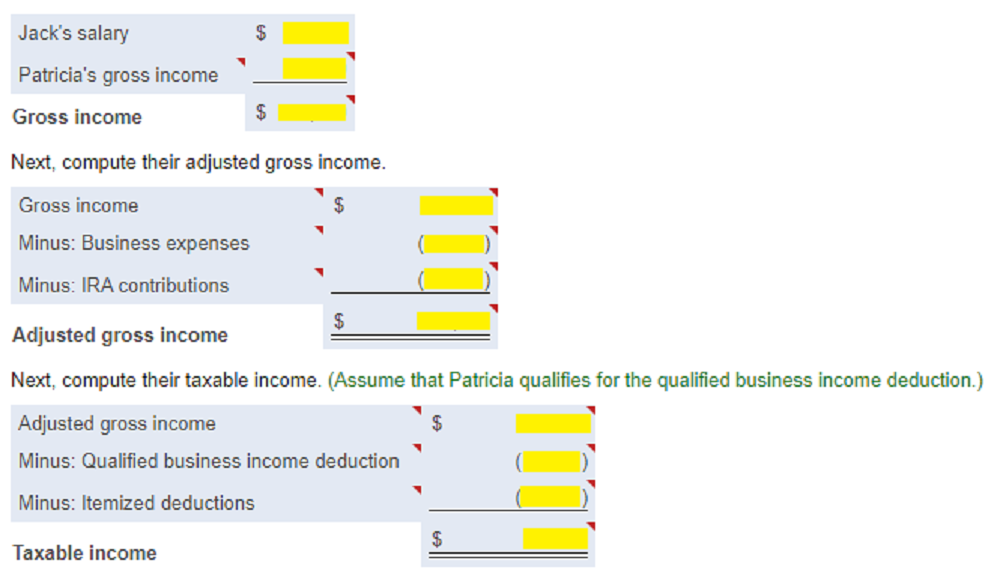

Jason and Patricia are married, file jointly, and have one dependent (12-year old qualifying child). Jason receives a $91,000 salary. Patricia is self-employed. Her sole proprietorship's revenues are $100,000, and its expenses are $51,000. Jason and Patricia each make a $6,000 deductible contribution to a traditional IRA. Their itemized deductions are $30,500. Federal income taxes of $7,400 are withheld from Jason's paychecks, and Patricia makes $2,700 of estimated tax payments. Reference x Reference - X Married, Filing Joint and Surviving Spouse If taxable income is: The tax is: Not over $19,400 10% of taxable income. Over $19,400 but not over $78,950 $1,940.00 + 12% of the excess over $19,400. Over $78,950 but not over $168,400 ... $9,086.00 + 22% of the excess over $78,950. Over $168,400 but not over $321,450 $28,765.00 +24% of the excess over $168,400. Over $321,450 but not over $408,200 $65.497.00 + 32% of the excess over $321,450. Over $408,200 but not over $612,350 .. $93,257.00 + 35% of the excess over $408,200. Over $612,350 $164,709.50 + 37% of the excess over $612,350 $ 24,400 $ 18,350 $ 12,200 $ STANDARD DEDUCTION Filing Status Married individuals filing joint returns and surviving spouses Heads of households Unmarried individuals (other than surviving spouses and heads of households) Married individuals filing separate returns Additional standard deduction for the aged and the blind; Individual who is married and surviving spouses Additional standard deduction for the aged and the blind; Individual who is unmarried and not a surviving spouse Taxpayer claimed as dependent on another taxpayer's return: Greater of (1) earned income plus $350 or (2) $1,100. * These amounts are $2,600 and $3,300, respectively, for a taxpayer who is both aged and blind. 2019 Child Tax Credit = $2,000 per qualifying child 12,200 $1.300* $1,650* - X Requirements Print Done Determine the additional tax due or refund when Jason and Patricia file their 2019 income tax return. Ignore any self-employment tax. Print Done Jack's salary $ Patricia's gross income Gross income $ Next, compute their adjusted gross income. Gross income $ Minus: Business expenses Minus: IRA contributions $ Adjusted gross income Next, compute their taxable income. (Assume that Patricia qualifies for the qualified business income deduction) $ Adjusted gross income Minus: Qualified business income deduction Minus: Itemized deductions $ Taxable income Now compute their additional tax due (refund). (Use the 2019 tax rate schedule for all tax calculations. Do not round intermediary calculations. Only round the amount you input in the cell to the nearest dollar. Remember to ignore any self-employment tax. Enter a refund with parentheses or a minus sign.) Gross tax Minus: Child credit Net tax Minus: Withholdings Minus: Estimated tax payments Additional tax due (refund) Jason and Patricia are married, file jointly, and have one dependent (12-year old qualifying child). Jason receives a $91,000 salary. Patricia is self-employed. Her sole proprietorship's revenues are $100,000, and its expenses are $51,000. Jason and Patricia each make a $6,000 deductible contribution to a traditional IRA. Their itemized deductions are $30,500. Federal income taxes of $7,400 are withheld from Jason's paychecks, and Patricia makes $2,700 of estimated tax payments. Reference x Reference - X Married, Filing Joint and Surviving Spouse If taxable income is: The tax is: Not over $19,400 10% of taxable income. Over $19,400 but not over $78,950 $1,940.00 + 12% of the excess over $19,400. Over $78,950 but not over $168,400 ... $9,086.00 + 22% of the excess over $78,950. Over $168,400 but not over $321,450 $28,765.00 +24% of the excess over $168,400. Over $321,450 but not over $408,200 $65.497.00 + 32% of the excess over $321,450. Over $408,200 but not over $612,350 .. $93,257.00 + 35% of the excess over $408,200. Over $612,350 $164,709.50 + 37% of the excess over $612,350 $ 24,400 $ 18,350 $ 12,200 $ STANDARD DEDUCTION Filing Status Married individuals filing joint returns and surviving spouses Heads of households Unmarried individuals (other than surviving spouses and heads of households) Married individuals filing separate returns Additional standard deduction for the aged and the blind; Individual who is married and surviving spouses Additional standard deduction for the aged and the blind; Individual who is unmarried and not a surviving spouse Taxpayer claimed as dependent on another taxpayer's return: Greater of (1) earned income plus $350 or (2) $1,100. * These amounts are $2,600 and $3,300, respectively, for a taxpayer who is both aged and blind. 2019 Child Tax Credit = $2,000 per qualifying child 12,200 $1.300* $1,650* - X Requirements Print Done Determine the additional tax due or refund when Jason and Patricia file their 2019 income tax return. Ignore any self-employment tax. Print Done Jack's salary $ Patricia's gross income Gross income $ Next, compute their adjusted gross income. Gross income $ Minus: Business expenses Minus: IRA contributions $ Adjusted gross income Next, compute their taxable income. (Assume that Patricia qualifies for the qualified business income deduction) $ Adjusted gross income Minus: Qualified business income deduction Minus: Itemized deductions $ Taxable income Now compute their additional tax due (refund). (Use the 2019 tax rate schedule for all tax calculations. Do not round intermediary calculations. Only round the amount you input in the cell to the nearest dollar. Remember to ignore any self-employment tax. Enter a refund with parentheses or a minus sign.) Gross tax Minus: Child credit Net tax Minus: Withholdings Minus: Estimated tax payments Additional tax due (refund)
Step by Step Solution
There are 3 Steps involved in it

Get step-by-step solutions from verified subject matter experts