







Question: Rigid body dynamics. As a SpaceX engineer ? 1 you must calculate the pressure in the fuel tank of a Falcon 9 rocket in various
Rigid body dynamics. As a SpaceX engineer you must calculate the pressure in the fuel tank of
a Falcon rocket in various launch stages prior to launch, during launch, and postlaunch While
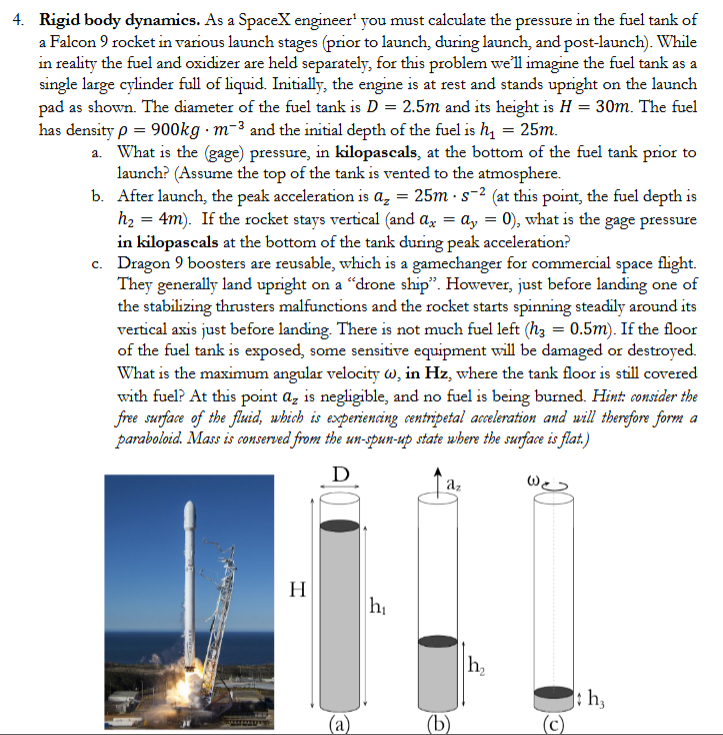
in reality the fuel and oxidizer are held separately, for this problem we'll imagine the fuel tank as a
single large cylinder full of liquid. Initially, the engine is at rest and stands upright on the launch
pad as shown. The diameter of the fuel tank is and its height is The fuel
has density and the initial depth of the fuel is
a What is the gage pressure, in kilopascals, at the bottom of the fuel tank prior to
launch? Assume the top of the tank is vented to the atmosphere.
b After launch, the peak acceleration is at this point, the fuel depth is
If the rocket stays vertical and what is the gage pressure
in kilopascals at the bottom of the tank during peak acceleration?
c Dragon boosters are reusable, which is a gamechanger for commercial space flight.
They generally land upright on a "drone ship". However, just before landing one of
the stabilizing thrusters malfunctions and the rocket starts spinning steadily around its
vertical axis just before landing. There is not much fuel left If the floor
of the fuel tank is exposed, some sensitive equipment will be damaged or destroyed.
What is the maximum angular velocity in Hz where the tank floor is still covered
with fuel? At this point is negligible, and no fuel is being burned. Hint: consider the
free surface of the fluid, which is experiencing centripetal acceleration and will therefore form a
paraboloid. Mass is conserved from the unspunup state where the surface is flat.
a
b
c
Step by Step Solution
There are 3 Steps involved in it
1 Expert Approved Answer
Step: 1 Unlock

Question Has Been Solved by an Expert!
Get step-by-step solutions from verified subject matter experts
Step: 2 Unlock
Step: 3 Unlock
 Study Help