







Question: Rising and Falling Motion Solve each problem using the equations of acceleration motion. In each case, assume there is no air resistance. 1. A ball
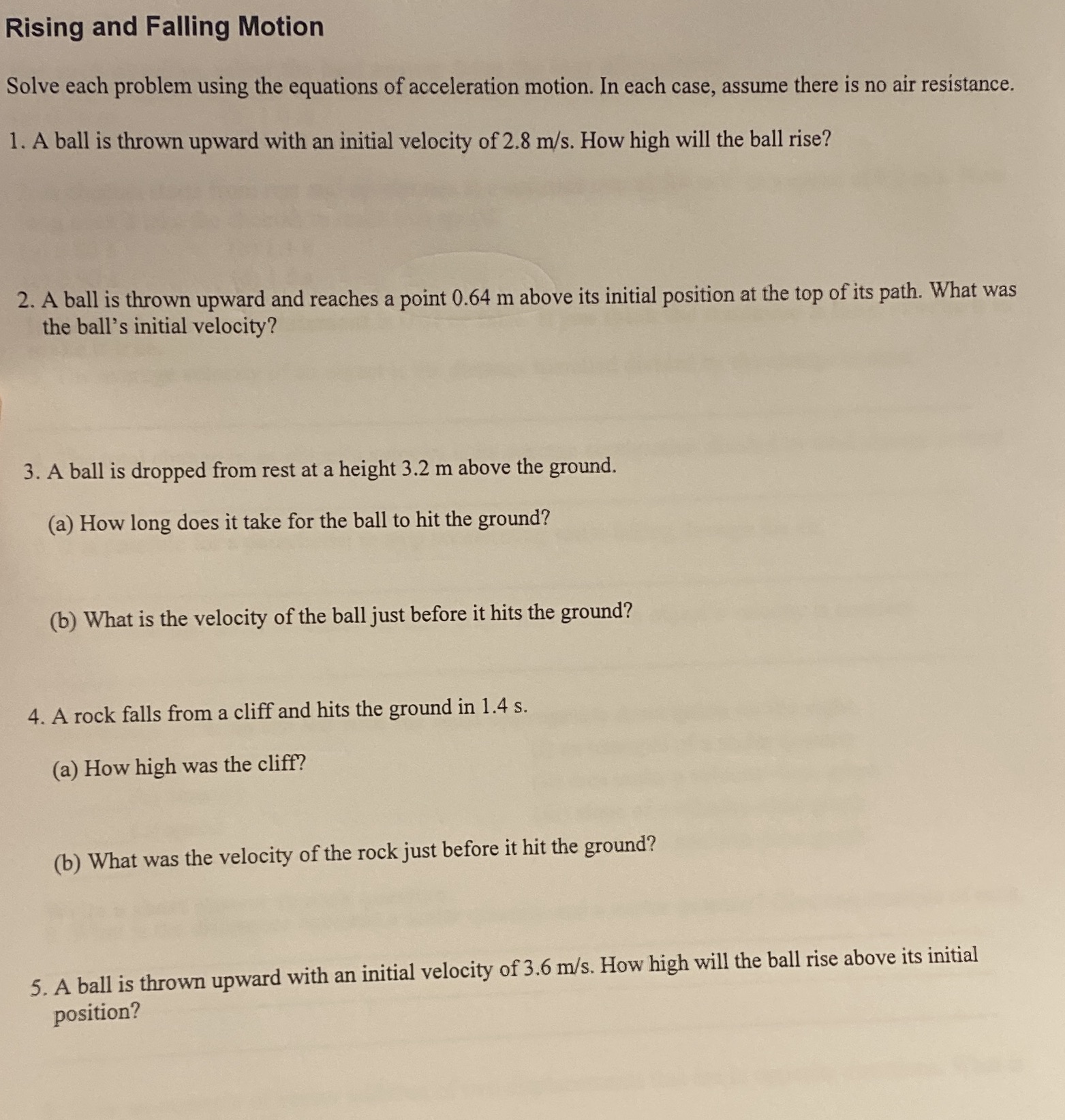
Rising and Falling Motion Solve each problem using the equations of acceleration motion. In each case, assume there is no air resistance. 1. A ball is thrown upward with an initial velocity of 2.8 m/s. How high will the ball rise? 2. A ball is thrown upward and reaches a point 0.64 m above its initial position at the top of its path. What was the ball's initial velocity? 3. A ball is dropped from rest at a height 3.2 m above the ground. (a) How long does it take for the ball to hit the ground? (b) What is the velocity of the ball just before it hits the ground? 4. A rock falls from a cliff and hits the ground in 1.4 s. (a) How high was the cliff? (b) What was the velocity of the rock just before it hit the ground? 5. A ball is thrown upward with an initial velocity of 3.6 m/s. How high will the ball rise above its initial position
Step by Step Solution
There are 3 Steps involved in it

Get step-by-step solutions from verified subject matter experts
 Study Help