Question: Risk Financing Lesson 4: Self-Insurance Case Study: Evaluating a Self-Insurance Plan Instructions Review the case study, as well as the grading rubric. Answer the questions
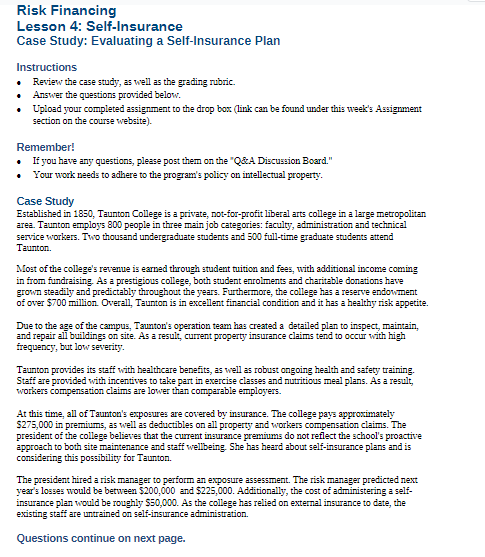
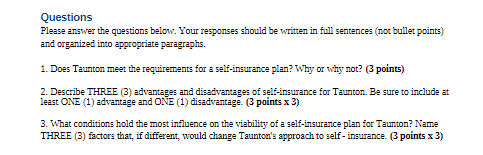
Risk Financing Lesson 4: Self-Insurance Case Study: Evaluating a Self-Insurance Plan Instructions Review the case study, as well as the grading rubric. Answer the questions provided below. Upload your completed assignment to the drop box (link can be found under this week's Assignment section on the course website). Remember! If you have any questions, please post them on the "Q4:A Discussion Board." Your work needs to adhere to the program's policy on intellectual property. Case Study Established in 1850, Taunton College is a private, not-for-profit liberal arts college in a large metropolitan area. Taunton employs 800 people in three main job categories: faculty, administration and technical service workers. Two thousand undergraduate students and 500 full-time graduate students attend Taunton. Most of the college's revenue is earned through student tuition and fees, with additional income coming in from fundraising. As a prestigious college, both student enrolments and charitable donations have grown steadily and predictably throughout the years. Furthermore, the college has a reserve endowment of over $700 million. Overall, Taunton is in excellent financial condition and it has a healthy risk appetite. Due to the age of the campus, Taunton's operation team has created a detailed plan to inspect, maintain, and repair all buildings on site. As a result, current property insurance claims tend to occur with high frequency, but low severity. Taunton provides its staff with healthcare benefits, as well as robust ongoing health and safety training. Staff are provided with incentives to take part in exercise classes and nutritious meal plans. As a result, workers compensation claims are lower than comparable employers. At this time, all of Taunton's exposures are covered by insurance. The college pays approximately $275,000 in premiums, as well as deductibles on all property and workers compensation claims. The president of the college believes that the current insurance premiums do not reflect the school's proactive approach to both site maintenance and staff wellbeing. She has heard about self-insurance plans and is considering this possibility for Taunton. The president hired a risk manager to perform an exposure assessment. The risk manager predicted next year's losses would be between $200,000 and $225,000. Additionally, the cost of administering a self- insurance plan would be roughly $50,000. As the college has relied on external insurance to date, the existing staff are untrained on self-insurance administration. Questions continue on next page.Questions Please answer the questions below. Your responses should be written in full sentences ( not bullet points) and organized into appropriate paragraphs. 1. Does Taunton meet the requirements for a self-insurance plan? Why or why not? (3 points) 2. Describe THREE (3) advantages and disadvantages of self-insurance for Taunton. Be sure to include at least ONE (1) advantage and ONE (1) disadvantage. (3 points x 3) 3. What conditions hold the most influence on the viability of a self-insurance plan for Taunton? Name THREE (3) factors that, if different, would change Taunton's approach to self - insurance. (3 points x 3)
Step by Step Solution
There are 3 Steps involved in it
1 Expert Approved Answer
Step: 1 Unlock
Question Has Been Solved by an Expert!
Get step-by-step solutions from verified subject matter experts
Step: 2 Unlock
Step: 3 Unlock
Students Have Also Explored These Related Finance Questions!









 Study Help