







Question: RISK MANAGEMENT QUESTION, SHOW STEPS AND EXPLAIN. ANSWER DIGITALLY INTO THE ANSWER BOX, AND EXPLAIN THE RISK MANAGEMENT CONCEPTS IF OR WHERE USED. need statistics
RISK MANAGEMENT QUESTION, SHOW STEPS AND EXPLAIN. ANSWER DIGITALLY INTO THE ANSWER BOX, AND EXPLAIN THE RISK MANAGEMENT CONCEPTS IF OR WHERE USED.
need statistics knowledge as well and incorporate this using terminology:
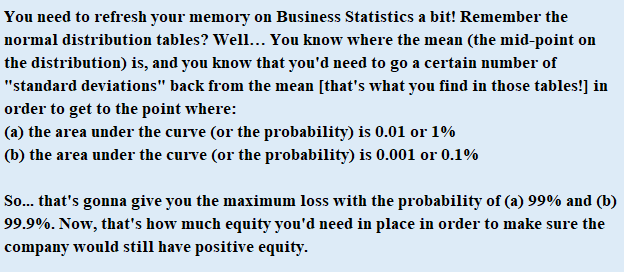
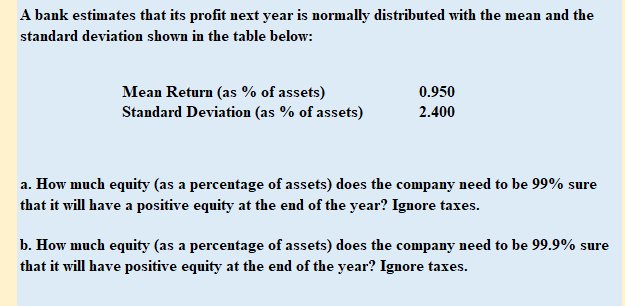
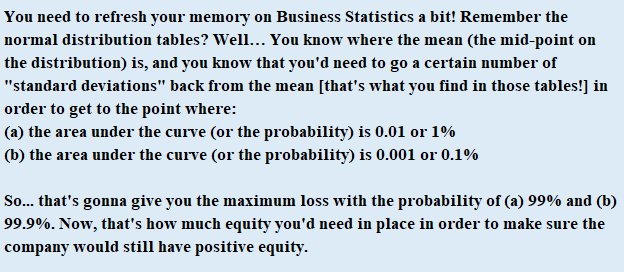
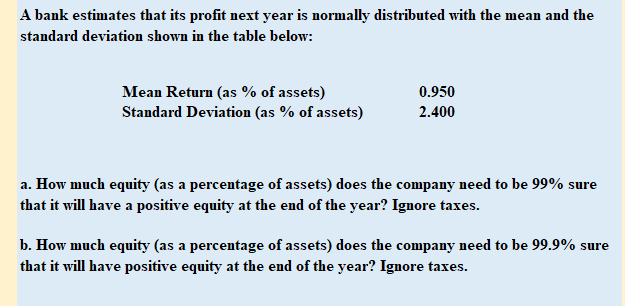
You need to refresh your memoly on Business Statistics a bit! Remember the normal distribution tables? Well. . . You know where the mean (the midpoint on the distribution) is, and you know that you'd need to go a certain number of "standard deviations" back from the mean [that's what you find in those tables!] in order to get to the point where: (a) the area under the curve (or the probability) is {1.91 or 1% (b) the area under the curve (or the probability) is {Ml-Ill or {1.1% So... that's gonna give you the maximum loss with the probability of (a) 99% and (b) 99.9%. Now, that's how much equity you'd need in place in order to make sure the company would still have positive equity. A bank estimates that its prot next year is normally distributed with the mean and the standard deviation shown in the table below: Mean Return (as $5: of assets] {1959 Standard Deviation {as 95 of assets} 2.409 a. How ranch eqnity (as a percentage of assets} does the company need to be 99% snre that it will have a positive eqnity at the end of the year? Ignore taxes. 11. How Innch eqnity {as a percentage of assets} does the company need to be 99.9% snre that it will have positive eqnity at the end of the year? Ignore taxes
Step by Step Solution
There are 3 Steps involved in it

Get step-by-step solutions from verified subject matter experts
 Study Help