Question: ROBERT GORDON INDICATES THAT THE TECHNOLOGY INDUSTRY IS UNIQUE IN THE RAPID GROWTH ACHIEVED SINCE 1960 IN THE PERFORMANCE-TO-PRICE RATIO OF PRODUCTS. HE POINTS TO
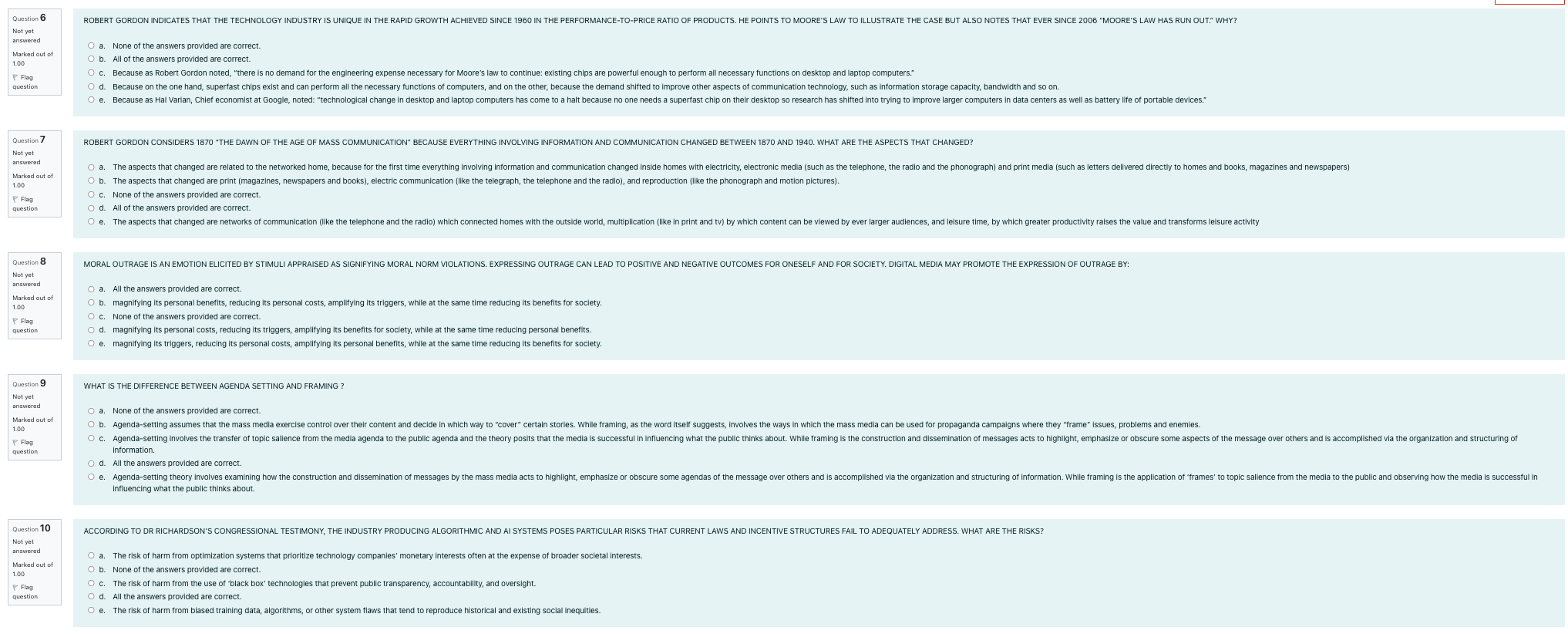
ROBERT GORDON INDICATES THAT THE TECHNOLOGY INDUSTRY IS UNIQUE IN THE RAPID GROWTH ACHIEVED SINCE 1960 IN THE PERFORMANCE-TO-PRICE RATIO OF PRODUCTS. HE POINTS TO MOORE'S LAW TO ILLUSTRATE THE CASE BUT ALSO NOTES THAT EVER SINCE 2006 "MOORE'S LAW HAS RUN OUT" WHY? Question 6 Not yet answered Marked out of 1.00 P Flag question O a None of the answers provided are correct. Ob All of the answers provided are correct. O c. Because as Robert Gordon noted, "there is no demand for the engineering expense necessary for Moore's law to continue: existing chips are powerful enough to perform all necessary functions on desktop and laptop computers." O d. Because on the one hand, superfast chips exist and can perform all the necessary functions of computers, and on the other, because the demand shifted to improve other aspects of communication technology, such as information storage capacity, bandwidth and so on. O e. Because as Hal Varian, Chlef economist at Google, noted: "technological change in desktop and laptop computers has come to a halt because no one needs a superfast chip on their desktop so research has shifted into trying Improve larger computers in data centers as well as battery life of portable devices." ROBERT GORDON CONSIDERS 1870 "THE DAWN OF THE AGE OF MASS COMMUNICATION" BECAUSE EVERYTHING INVOLVING INFORMATION AND COMMUNICATION CHANGED BETWEEN 1870 AND 1940. WHAT ARE THE ASPECTS THAT CHANGED? Question 7 Not yet answered Marked out of 1.00 P Flag question O a The aspects that changed are related to the networked home, because for the first time everything involving Information and communication changed inside homes with electricity, electronic media (such as the telephone, the radio and the phonograph) and print media (such as letters delivered directly to homes and books, magazines and newspapers) Ob The aspects that changed are print (magazines, newspapers and books), electric communication (like the telegraph, the telephone and the radio), and reproduction (like the phonograph and motion pictures). O c. None of the answers provided are correct. All of the answers provided are correct. O e. The aspects that changed are networks of communication (like the telephone and the radio) which connected homes with the outside world, multiplication (Ilike in print and tv) by which content can be viewed by ever larger audiences, and leisure time, by which greater productivity raises the value and transforms leisure activity MORAL OUTRAGE IS AN EMOTION ELICITED BY STIMULI APPRAISED AS SIGNIFYING MORAL NORM VIOLATIONS. EXPRESSING OUTRAGE CAN LEAD TO POSITIVE AND NEGATIVE OUTCOMES FOR ONESELF AND FOR SOCIETY. DIGITAL MEDIA MAY PROMOTE THE EXPRESSION OF OUTRAGE BY: Question 8 Not yet answered Marked out of 1.00 Flag question O a. All the answers provided are correct. ob. magnifying its personal benefits, reducing its personal costs, amplifying its triggers, while at the same time reducing its benefits for society. O c. None of the answers provided are correct. O d. magnifying its personal costs, reducing its triggers, amplifying its benefits for society, while at the same time reducing personal benefits. O e. magnifying its triggers, reducing Its personal costs, amplifying its personal benefits, while at the same time reducing its benefits for society. WHAT IS THE DIFFERENCE BETWEEN AGENDA SETTING AND FRAMING ? Question 9 Not yet answered Marked out of 1.00 P Flag question O a. None of the answers provided are correct. O b. Agenda-setting assumes that the mass media exercise control over their content and decide in which way to "cover" certain stories. While framing, as the word itself suggests, Involves the ways in which the mass media can be used for propaganda campaigns where they "frame" Issues, problems and enemies. O c. Agenda-setting involves the transfer of topic sallence from the media agenda to the public agenda and the theory posits that the media is successful in influencing what the public thinks about. While framing is the construction and dissemination of messages acts to highlight, emphasize or obscure some aspects of the message over others and is accomplished via the organization and structuring of Information O d. All the answers provided are correct. O e. Agenda-setting theory Involves examining how the construction and dissemination of messages by the mass media acts highlight, emphasize or obscure some agendas of the message over others and is accomplished via the organization and structuring Information. While framing is the application of frames' to topic sallence from the media to the public and observing how the media is successful in Influencing what the public thinks about. ACCORDING TO DR RICHARDSON'S CONGRESSIONAL TESTIMONY, THE INDUSTRY PRODUCING ALGORITHMIC AND AI SYSTEMS POSES PARTICULAR RISKS THAT CURRENT LAWS AND INCENTIVE STRUCTURES FAIL TO ADEQUATELY ADDRESS. WHAT ARE THE RISKS? Question 10 Not yet answered Marked out of 1.00 P Flag O a. The risk of harm from optimization systems that prioritize technology companies' monetary Interests often at the expense of broader societal Interests. O b. None of the answers provided are correct. O C. The risk of harm from the use of black box' technologies that prevent public transparency, accountability, and oversight. O d. All the answers provided are correct. O e. The risk of harm from blased training data, algorithms, or other system flaws that tend to reproduce historical and existing social inequities









 Study Help