



Question: Robert Solow in his 1956 article A Contribution to the Theory of Economic Growth considered the behavior of economy when output was produced according to
Robert Solow in his 1956 article "A Contribution to the Theory of Economic Growth" considered the behavior of economy when output was produced according to other than Cobb-Douglas production functions. One of them was the following Constant Elasticity of Substitution (CES) function: Yt = aK b?1 b t + (1 ? a)L b?1 b t b b?1 where a ? (0, 1) and b > 0 and for simplicity technology growth rate is set to 0. The CES function reduces to the Cobb-Douglas function in the limit of b ? 1. Saving and investment behaviour of the economy are described respectively as: it = s yt ?kt = it ? (? + n) kt where lower case letters it, yt, kt denote per worker quantities, n denotes population growth, and ? denotes the depreciation rate. (a) Transform the production function into per worker form, i.e. divide it by Lt. (b) Find the steady state value for capital per worker kt. (c) Show how an increase in the saving rate affects the steady state level of capital per worker (you can use graphical analysis instead of algebra). (d) Show how an increase in the population growth rate affects the steady state level of capital per worker (you can use graphical analysis instead of algebra).
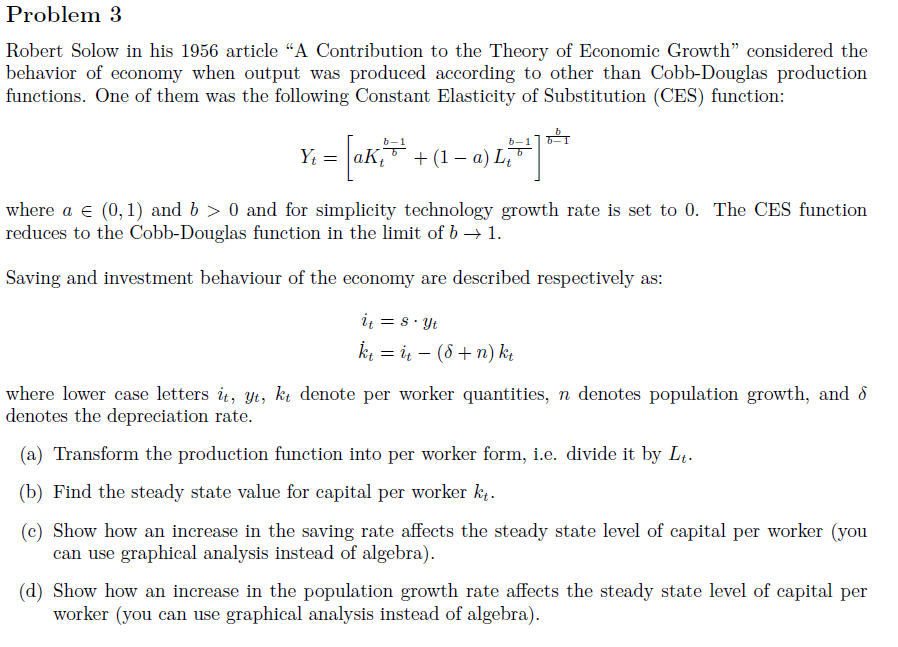
Problem 3 Robert Solow in his 1955 article \"A. Contribution to the Theory of Economic Growth\" considered the behavior of economy when output was produced according to other than Cothouglas production functions. One of them was the following Constant Elasticity of Substitution (CES) function: bl {31 ETI Y} : aKtT + (1 (1)137] where a E (0,1) and b > D and for simplicity technology growth rate is set to D. The CES function reduces to the CobbDouglas function in the limit of b > 1. Saving and investment behaviour of the economy are described respectively as: where lower case letters 3}, y;, la: denote per worker quantities, n denotes population growth, and 6 denotes the depreciation rate. (a) Transform the production function into per worker form, i.e. divide it by L;. (b) Find the steady state value for capital per worker kt. (c) Show how an increase in the saving rate affects the steady state level of capital per worker (you can use graphical analysis instead of algebra). (:1) Show how an increase in the population growth rate affects the steady state level of capital per worker (you can use graphical analysis instead of algebra)
Step by Step Solution
There are 3 Steps involved in it

Get step-by-step solutions from verified subject matter experts