







Question: Rob's (agent 1) and Eve's (agent 2) preferences can be described by the following utility functions: U1(x)=max{x1,x2} and U2(x)=x1+x2. Each one of the have equal
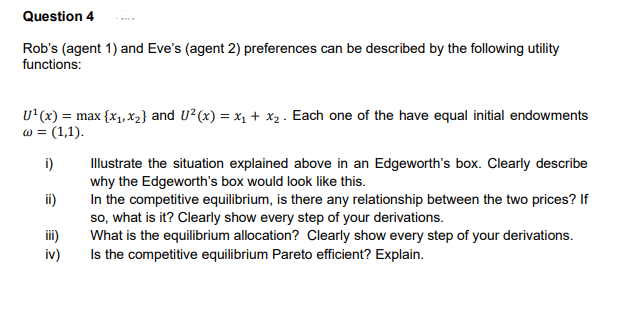
Rob's (agent 1) and Eve's (agent 2) preferences can be described by the following utility functions: U1(x)=max{x1,x2} and U2(x)=x1+x2. Each one of the have equal initial endowments =(1,1). i) Illustrate the situation explained above in an Edgeworth's box. Clearly describe why the Edgeworth's box would look like this. ii) In the competitive equilibrium, is there any relationship between the two prices? If so, what is it? Clearly show every step of your derivations. iii) What is the equilibrium allocation? Clearly show every step of your derivations. iv) Is the competitive equilibrium Pareto efficient? Explain. Rob's (agent 1) and Eve's (agent 2) preferences can be described by the following utility functions: U1(x)=max{x1,x2} and U2(x)=x1+x2. Each one of the have equal initial endowments =(1,1). i) Illustrate the situation explained above in an Edgeworth's box. Clearly describe why the Edgeworth's box would look like this. ii) In the competitive equilibrium, is there any relationship between the two prices? If so, what is it? Clearly show every step of your derivations. iii) What is the equilibrium allocation? Clearly show every step of your derivations. iv) Is the competitive equilibrium Pareto efficient? Explain
Step by Step Solution
There are 3 Steps involved in it

Get step-by-step solutions from verified subject matter experts
 Study Help