







Question: roduct 2 , and $28 for product 3 . (a) Formulate a linear programming model for maximizing total profit contribution. If the constant is
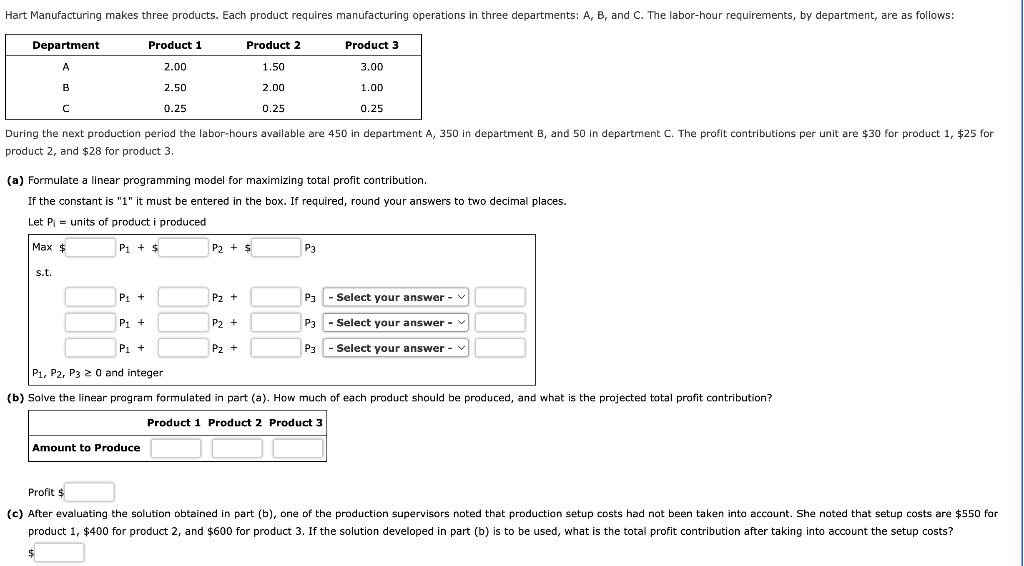
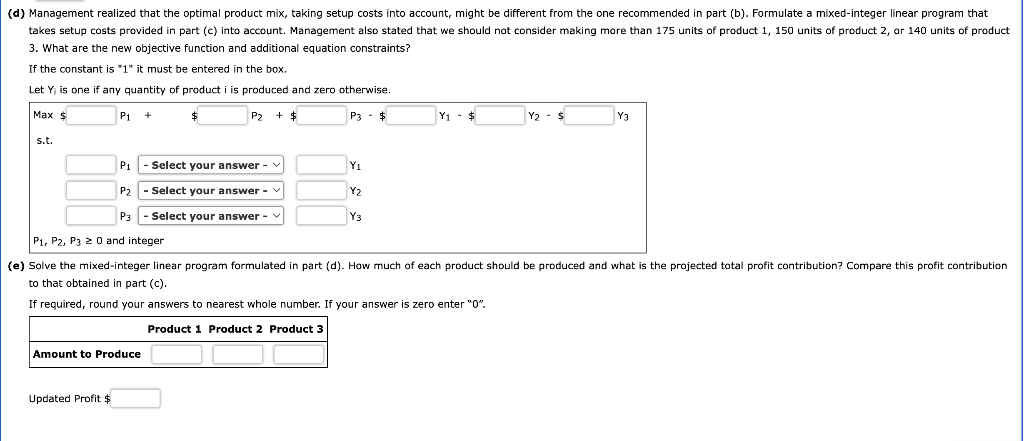
roduct 2 , and $28 for product 3 . (a) Formulate a linear programming model for maximizing total profit contribution. If the constant is " 1 " it must be entered in the box. If required, round your answers to two decimal places. Let Pi= units of product i produced (b) Solve the linear program formulated in part (a). How much of each product should be produced, and what is the projected total profit contribution? Profit 4 (d) Management realized that the optimal product mix, taking setup costs into account, might be different from the one recommended in part (b). Formulate a mixed-integer linear program that takes setup costs provided in part (c) into account. Management also stated that we should not consider making more than 175 units of product 1,150 units of product 2 , or 140 units of product 3. What are the new objective function and additional equation constraints? If the constant is " 1" " it must be entered in the box. Let Yi is one if any quantity of product i is produced and zero otherwise. \begin{tabular}{|llllll|} \hline Max & P1+ & P2+$ & P3$ & Y1$ & \\ s.t. & & Y2$ \\ & P1 & Y1 \\ & P2 \\ & P3 \\ & Y3 \end{tabular} (e) Solve the mixed-integer linear program formulated in part (d). How much of each product should be produced and what is the projected total profit contribution? Compare this profit contribution to that obtained in part (c). If required, round your answers to nearest whole number. If your answer is zero enter "0". roduct 2 , and $28 for product 3 . (a) Formulate a linear programming model for maximizing total profit contribution. If the constant is " 1 " it must be entered in the box. If required, round your answers to two decimal places. Let Pi= units of product i produced (b) Solve the linear program formulated in part (a). How much of each product should be produced, and what is the projected total profit contribution? Profit 4 (d) Management realized that the optimal product mix, taking setup costs into account, might be different from the one recommended in part (b). Formulate a mixed-integer linear program that takes setup costs provided in part (c) into account. Management also stated that we should not consider making more than 175 units of product 1,150 units of product 2 , or 140 units of product 3. What are the new objective function and additional equation constraints? If the constant is " 1" " it must be entered in the box. Let Yi is one if any quantity of product i is produced and zero otherwise. \begin{tabular}{|llllll|} \hline Max & P1+ & P2+$ & P3$ & Y1$ & \\ s.t. & & Y2$ \\ & P1 & Y1 \\ & P2 \\ & P3 \\ & Y3 \end{tabular} (e) Solve the mixed-integer linear program formulated in part (d). How much of each product should be produced and what is the projected total profit contribution? Compare this profit contribution to that obtained in part (c). If required, round your answers to nearest whole number. If your answer is zero enter "0
Step by Step Solution
There are 3 Steps involved in it

Get step-by-step solutions from verified subject matter experts
 Study Help