







Question: romberg function : function [q,ea,iter]=romberg(f,a,b,es,maxIt) % romberg: Romberg integration quadrature % q = romberg(f,a,b,es,maxIt): Romberg Integration % % inputs: % f = function to integrate
![romberg function : function [q,ea,iter]=romberg(f,a,b,es,maxIt) % romberg: Romberg integration quadrature %](https://s3.amazonaws.com/si.experts.images/answers/2024/09/66d809f03ed11_35166d809efb4019.jpg)
romberg function :
function [q,ea,iter]=romberg(f,a,b,es,maxIt)
% romberg: Romberg integration quadrature
% q = romberg(f,a,b,es,maxIt): Romberg Integration
%
% inputs:
% f = function to integrate
% a, b = integration limits
% es = desired relative error (default = .000001%)
% maxIt = maximum allowable iterations (default=50)
% outputs:
% q = integral estimate
% ea = approximate relative error
% iter = number of iterations
if nargin
if nargin
if nargin
I(1,1) = trap(f,a,b,1);
iter = 0;
while iter
iter = iter+1;
n = 2^iter;
I(iter+1,1) = trap(f,a,b,n);
for k = 2: iter+1
j = 2+iter-k;
I(j,k) = (4^(k-1)*I(j+1,k-1)-I(j,k-1)) /(4^(k-1)-1);
end
ea = abs((I(1,iter+1)-I(2,iter))/I(1,iter+1))*100;
if ea
end
q = I(1,iter+1);
end
here is the fuction of problem 1 and the problem 1
function I = GaussQuad(f,a,b,n)
% GaussQuad: gauss quadrature integration
% I=GaussQuad(f,a,b,n)
% Input:
% f = name of function to be integrated
% a, b = integration limits
% n = number of quad points (default=8)
% Other Variables:
% xd = Gauss points to evaluate
% w = Weight factors
% x = True position of evaluation
% Output:
% I = Integral estimate
if nargin
if ~(b>a), error('Upper bound must be greater than lower'), end
if nargin
[xd,w]=GLTable(n);
I = 0;
c1 = (b+a)/2;
c2 = (b-a)/2;
for i = 1:n
x = c1 + c2 * xd(i);
I = I + f(x) * w(i);
end
I = I * c2;
end
function [x,w] = GLTable(n)
% GLTable Nodes and weights for Gauss-Legendre quadrature of order n
%
% Synopsis: [x,w] = GLTable(n)
%
% Input: n = number of nodes in quadrature rule, maximum: n = 8
%
% Output: x = vector of nodes
% w = vector of weights
% Numerical values from "Handbook of Mathematical Functions",
% Abramowitz and Stegun, eds., 1965 Dover (reprint), Table 25.4, p. 916
nn = fix(n); % Make sure number of nodes is an integer
x = zeros(nn,1); w = x; % Preallocate x and w vectors
switch nn
case 1
x = 0; w = 2;
case 2
x(1) = -1/sqrt(3); x(2) = -x(1);
w(1) = 1; w(2) = w(1);
case 3
x(1) = -sqrt(3/5); x(2) = 0; x(3) = -x(1);
w(1) = 5/9; w(2) = 8/9; w(3) = w(1);
case 4
x(1) = -0.861136311594053; x(4) = -x(1);
x(2) = -0.339981043584856; x(3) = -x(2);
w(1) = 0.347854845137454; w(4) = w(1);
w(2) = 0.652145154862546; w(3) = w(2);
case 5
x(1) = -0.906179845938664; x(5) = -x(1);
x(2) = -0.538469310105683; x(4) = -x(2);
x(3) = 0;
w(1) = 0.236926885056189; w(5) = w(1);
w(2) = 0.478628670499366; w(4) = w(2);
w(3) = 0.568888888888889;
case 6
x(1) = -0.932469514203152; x(6) = -x(1);
x(2) = -0.661209386466265; x(5) = -x(2);
x(3) = -0.238619186083197; x(4) = -x(3);
w(1) = 0.171324492379170; w(6) = w(1);
w(2) = 0.360761573048139; w(5) = w(2);
w(3) = 0.467913934572691; w(4) = w(3);
case 7
x(1) = -0.949107912342759; x(7) = -x(1);
x(2) = -0.741531185599394; x(6) = -x(2);
x(3) = -0.405845151377397; x(5) = -x(3);
x(4) = 0;
w(1) = 0.129484966168870; w(7) = w(1);
w(2) = 0.279705391489277; w(6) = w(2);
w(3) = 0.381830050505119; w(5) = w(3);
w(4) = 0.417959183673469;
case 8
x(1) = -0.960289856497536; x(8) = -x(1);
x(2) = -0.796666477413627; x(7) = -x(2);
x(3) = -0.525532409916329; x(6) = -x(3);
x(4) = -0.183434642495650; x(5) = -x(4);
w(1) = 0.101228536290376; w(8) = w(1);
w(2) = 0.222381034453374; w(7) = w(2);
w(3) = 0.313706645877887; w(6) = w(3);
w(4) = 0.362683783378362; w(5) = w(4);
otherwise
error(sprintf('Gauss quadrature with %d nodes not supported',nn));
end
end
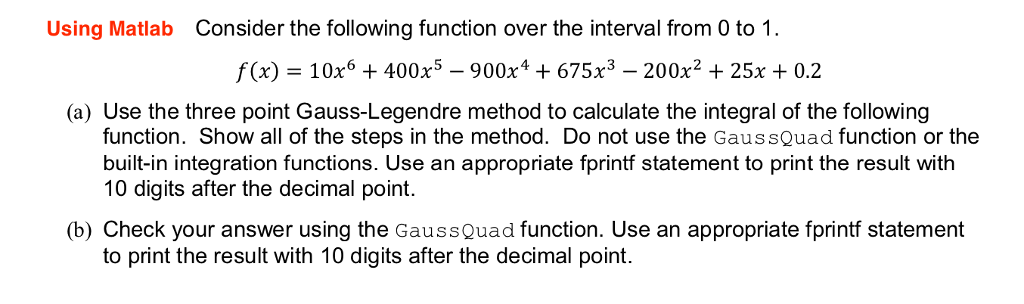
oConsider the function given in problem 1 over the interval from 0 to 1 (a) Use the Romberg integration technique to calculate the integral with an error of o(h8) Using Matlab Show all of the steps. You can use the trap function but not the romberg function. Print the results in a table like the one below 4X. xxXXxXXXXx (b) Use the romberg function with default tolerance and maximum iterations to verify your answer. Use an appropriate fprintf statement to print the result with 10 digits after the decimal point. (c) Why is the error not zero for the Gauss-Legendre method? Use an fprintf statement to print your answer. oConsider the function given in problem 1 over the interval from 0 to 1 (a) Use the Romberg integration technique to calculate the integral with an error of o(h8) Using Matlab Show all of the steps. You can use the trap function but not the romberg function. Print the results in a table like the one below 4X. xxXXxXXXXx (b) Use the romberg function with default tolerance and maximum iterations to verify your answer. Use an appropriate fprintf statement to print the result with 10 digits after the decimal point. (c) Why is the error not zero for the Gauss-Legendre method? Use an fprintf statement to print your
Step by Step Solution
There are 3 Steps involved in it

Get step-by-step solutions from verified subject matter experts
 Study Help