



Question: Ronald Roth started his new job as controller with Aeorsystems today. The human resource professional gave him a packet that contains information on the company's
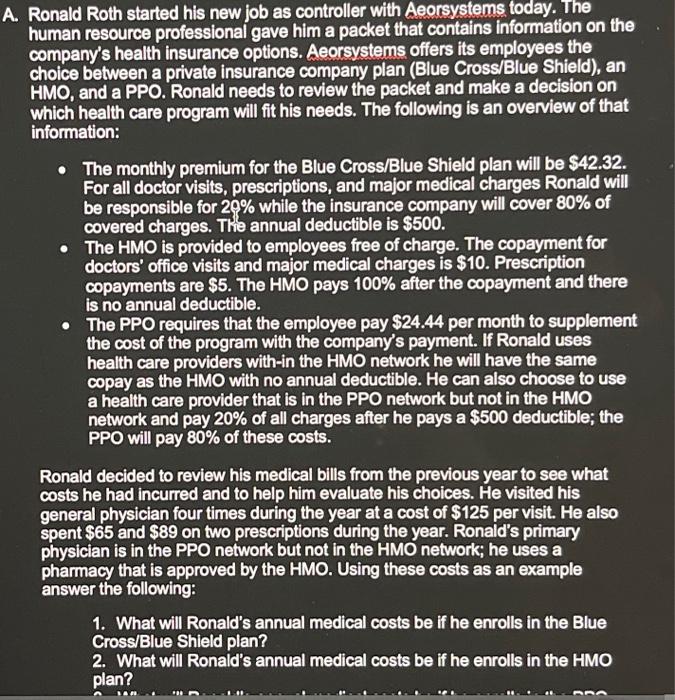
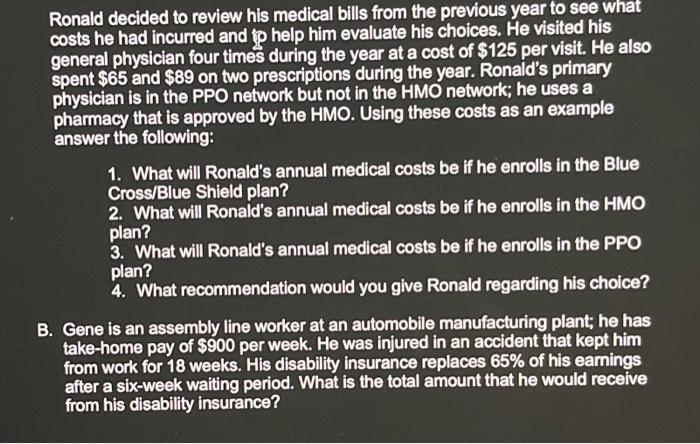
Ronald Roth started his new job as controller with Aeorsystems today. The human resource professional gave him a packet that contains information on the company's health insurance options. Aeorsystems offers its employees the choice between a private insurance company plan (Blue Cross/Blue Shield), an HMO, and a PPO. Ronald needs to review the packet and make a decision on which health care program will fit his needs. The following is an overview of that information: - The monthly premium for the Blue Cross/Blue Shield plan will be $42.32. For all doctor visits, prescriptions, and major medical charges Ronald will be responsible for 20% while the insurance company will cover 80% of covered charges. The annual deductible is $500. - The HMO is provided to employees free of charge. The copayment for doctors' office visits and major medical charges is $10. Prescription copayments are $5. The HMO pays 100% after the copayment and there is no annual deductible. - The PPO requires that the employee pay $24.44 per month to supplement the cost of the program with the company's payment. If Ronald uses health care providers with-in the HMO network he will have the same copay as the HMO with no annual deductible. He can also choose to use a health care provider that is in the PPO network but not in the HMO network and pay 20% of all charges after he pays a $500 deductible; the PPO will pay 80% of these costs. Ronald decided to review his medical bills from the previous year to see what costs he had incurred and to help him evaluate his choices. He visited his general physician four times during the year at a cost of $125 per visit. He also spent $65 and $89 on two prescriptions during the year. Ronald's primary physician is in the PPO network but not in the HMO network; he uses a pharmacy that is approved by the HMO. Using these costs as an example answer the following: 1. What will Ronald's annual medical costs be if he enrolls in the Blue Cross/Blue Shield plan? 2. What will Ronald's annual medical costs be if he enrolls in the HMO plan? Ronald decided to review his medical bills from the previous year to see wilat costs he had incurred and top help him evaluate his choices. He visited his general physician four times during the year at a cost of $125 per visit. He also spent $65 and $89 on two prescriptions during the year. Ronald's primary physician is in the PPO network but not in the HMO network; he uses a pharmacy that is approved by the HMO. Using these costs as an example answer the following: 1. What will Ronald's annual medical costs be if he enrolls in the Blue Cross/Blue Shield plan? 2. What will Ronald's annual medical costs be if he enrolls in the HMO plan? 3. What will Ronald's annual medical costs be if he enrolls in the PPO plan? 4. What recommendation would you give Ronald regarding his choice? B. Gene is an assembly line worker at an automobile manufacturing plant; he has take-home pay of $900 per week. He was injured in an accident that kept him from work for 18 weeks. His disability insurance replaces 65% of his earnings after a six-week waiting period. What is the total amount that he would receive from his disability insurance? Ronald Roth started his new job as controller with Aeorsystems today. The human resource professional gave him a packet that contains information on the company's health insurance options. Aeorsystems offers its employees the choice between a private insurance company plan (Blue Cross/Blue Shield), an HMO, and a PPO. Ronald needs to review the packet and make a decision on which health care program will fit his needs. The following is an overview of that information: - The monthly premium for the Blue Cross/Blue Shield plan will be $42.32. For all doctor visits, prescriptions, and major medical charges Ronald will be responsible for 20% while the insurance company will cover 80% of covered charges. The annual deductible is $500. - The HMO is provided to employees free of charge. The copayment for doctors' office visits and major medical charges is $10. Prescription copayments are $5. The HMO pays 100% after the copayment and there is no annual deductible. - The PPO requires that the employee pay $24.44 per month to supplement the cost of the program with the company's payment. If Ronald uses health care providers with-in the HMO network he will have the same copay as the HMO with no annual deductible. He can also choose to use a health care provider that is in the PPO network but not in the HMO network and pay 20% of all charges after he pays a $500 deductible; the PPO will pay 80% of these costs. Ronald decided to review his medical bills from the previous year to see what costs he had incurred and to help him evaluate his choices. He visited his general physician four times during the year at a cost of $125 per visit. He also spent $65 and $89 on two prescriptions during the year. Ronald's primary physician is in the PPO network but not in the HMO network; he uses a pharmacy that is approved by the HMO. Using these costs as an example answer the following: 1. What will Ronald's annual medical costs be if he enrolls in the Blue Cross/Blue Shield plan? 2. What will Ronald's annual medical costs be if he enrolls in the HMO plan? Ronald decided to review his medical bills from the previous year to see wilat costs he had incurred and top help him evaluate his choices. He visited his general physician four times during the year at a cost of $125 per visit. He also spent $65 and $89 on two prescriptions during the year. Ronald's primary physician is in the PPO network but not in the HMO network; he uses a pharmacy that is approved by the HMO. Using these costs as an example answer the following: 1. What will Ronald's annual medical costs be if he enrolls in the Blue Cross/Blue Shield plan? 2. What will Ronald's annual medical costs be if he enrolls in the HMO plan? 3. What will Ronald's annual medical costs be if he enrolls in the PPO plan? 4. What recommendation would you give Ronald regarding his choice? B. Gene is an assembly line worker at an automobile manufacturing plant; he has take-home pay of $900 per week. He was injured in an accident that kept him from work for 18 weeks. His disability insurance replaces 65% of his earnings after a six-week waiting period. What is the total amount that he would receive from his disability insurance
Step by Step Solution
There are 3 Steps involved in it

Get step-by-step solutions from verified subject matter experts