







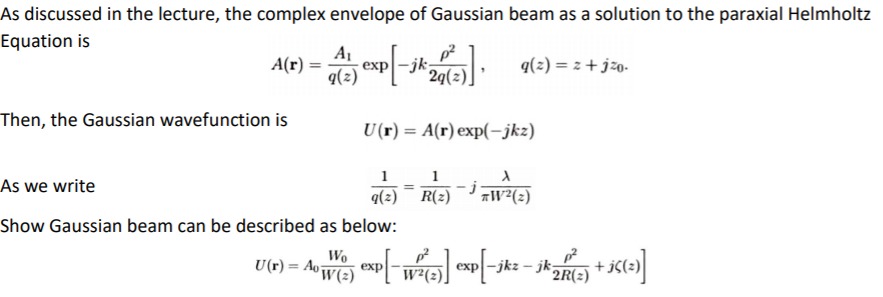
Question: Rotational geometry As discussed in the lecture, the complex envelope of Gaussian beam as a solution to the paraxial Helmholtz Equation is A(r) = q(z)
Rotational geometry
![q(z) exp - j 29(2)] q(2) = z + jzo- Then, the](https://dsd5zvtm8ll6.cloudfront.net/si.experts.images/questions/2024/09/66eee1e9ea4e1_43366eee1e9d6e2b.jpg)
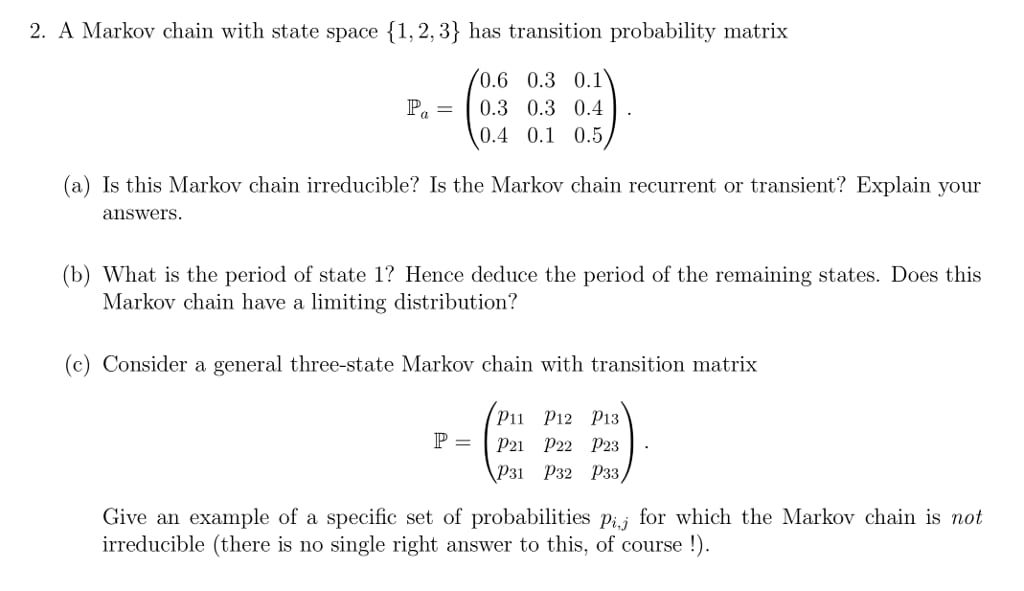
As discussed in the lecture, the complex envelope of Gaussian beam as a solution to the paraxial Helmholtz Equation is A(r) = q(z) exp - j 29(2)] q(2) = z + jzo- Then, the Gaussian wavefunction is U(r) = A(r) exp(-jkz) 1 A As we write q(z) R(z) TW2(2) Show Gaussian beam can be described as below: Wo U(r) = Ao exp -jkz - jk p2 W (2) exp Wz (2) 2 R(2) + is(=)2. A Markov chain with state space {1, 2, 3} has transition probability matrix 0.6 0.3 0.1 [Pa = 0.3 0.3 0.4 0.4 0.1 0.5 (a) Is this Markov chain irreducible? Is the Markov chain recurrent or transient? Explain your answers. (1)] What is the period of state 1? Hence deduce the period of the remaining states. Does this Markov chain have a limiting distribution? (0) Consider a general three-state Markov chain with transition matrix P11 P12 P13 1?: 1021 1022 p23 P31 P32 P33 Give an example of a specic set of probabilities pm; for which the Markov chain is not irreducible (there is no single right answer to this, of course l]. 8. Rotational geometry is the geometry (C. R) where R is the group of rotations about the origin. That is R = (Ro(=) = e"= [0ER). a. Prove that R is a group of transformations. b. Is D = {all lines in C) an invariant set in rotational geometry? Is it a minimally invariant set? c. Find a minimally invariant set of rotational geometry that contains the circle |z - (2 + 1)| = 4. d. Is (C, R) homogeneous? Isotropic
Step by Step Solution
There are 3 Steps involved in it

Get step-by-step solutions from verified subject matter experts
 Study Help