







Question: (Rounding-Error Analysis) Consider a computer using the following Floating Point System representing real numbers: given any1.di d2 d3 ds dg...)2 x 25, its floating point
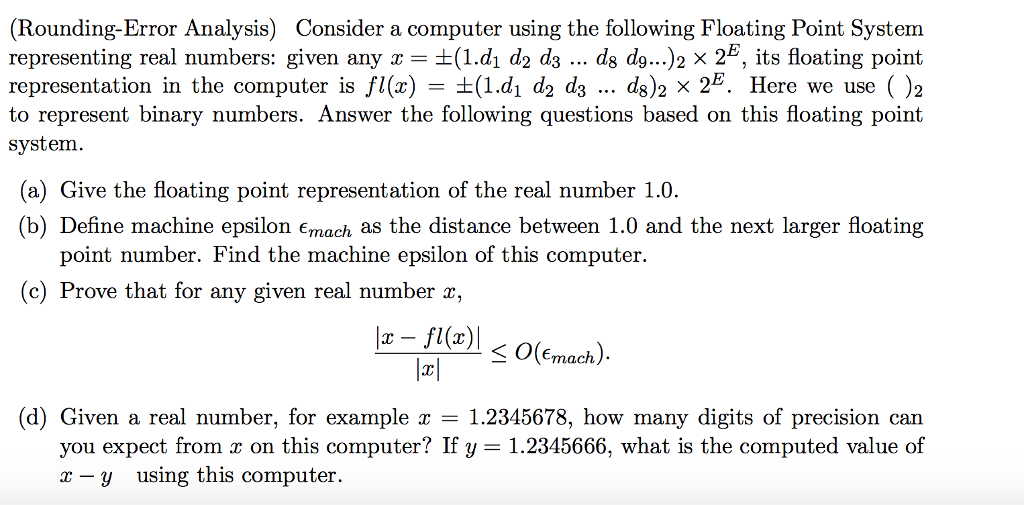
(Rounding-Error Analysis) Consider a computer using the following Floating Point System representing real numbers: given any1.di d2 d3 ds dg...)2 x 25, its floating point representation in the computer is fl(+(1.di d2 d3 ds)2 x 2". Here we use )2 to represent binary numbers. Answer the following questions based on this floating point system (a) Give the floating point representation of the real number 1.0. (b) Define machine epsilon ?mach as the distance between 1.0 and the next larger floating point number. Find the machine epsilon of this computer. (c) Prove that for any given real number x, mach) (d) Given a real number, for example x 1.2345678, how many digits of precision can 1.2345666, what is the computed value of you expect from on this computer? If y x - y using this computer. (Rounding-Error Analysis) Consider a computer using the following Floating Point System representing real numbers: given any1.di d2 d3 ds dg...)2 x 25, its floating point representation in the computer is fl(+(1.di d2 d3 ds)2 x 2". Here we use )2 to represent binary numbers. Answer the following questions based on this floating point system (a) Give the floating point representation of the real number 1.0. (b) Define machine epsilon ?mach as the distance between 1.0 and the next larger floating point number. Find the machine epsilon of this computer. (c) Prove that for any given real number x, mach) (d) Given a real number, for example x 1.2345678, how many digits of precision can 1.2345666, what is the computed value of you expect from on this computer? If y x - y using this computer
Step by Step Solution
There are 3 Steps involved in it

Get step-by-step solutions from verified subject matter experts
 Study Help