Question: RR Console x > model_1 summary model_1) Call: im (formula - Target. Tocal.orders. - Urgent.order, data - data) Residuals: Min 1Q -117.177 -39.350 Median -8.785
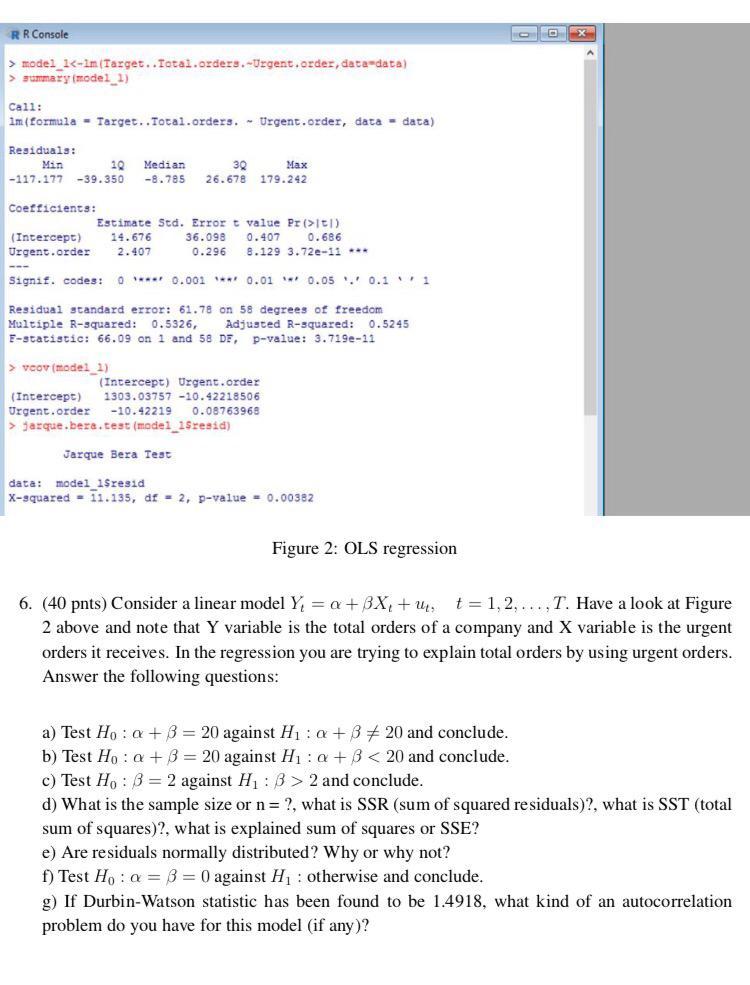
RR Console x > model_1 summary model_1) Call: im (formula - Target. Tocal.orders. - Urgent.order, data - data) Residuals: Min 1Q -117.177 -39.350 Median -8.785 39 26.678 Max 179.242 Coefficients: Estimate Std. Error t value Pr (>101) (Intercept) 14.676 36.099 0.407 0.686 Urgent.order 2.407 0.296 8.129 3.72e-11 . Signif. codes: 0 0.001 ***+ 0.01 0.05. 0.1.1 Residual standard error: 61.78 on 58 degrees of freedom Multiple R-squared: 0.5326, Adjusted R-squared: 0.5245 F-statistic: 66.09 on 1 and 58 DF, p-value: 3.719e-11 > veov (model_2) (Intercept) Urgent.order (Intercept) 1303.03757 -20.42218506 Urgent.order -10.42219 0.08763965 > jarque.bera.test(model_15resid) Jarque Bera Test data: model 1$resid X-squared = 11.135, df = 2, p-value = 0.00382 Figure 2: OLS regression 6. (40 pnts) Consider a linear model Y, = a + BX, + ut, t=1,2,..., T. Have a look at Figure 2 above and note that Y variable is the total orders of a company and X variable is the urgent orders it receives. In the regression you are trying to explain total orders by using urgent orders. Answer the following questions: a) Test Ho: a +3 = 20 against H : a +8 #20 and conclude. b) Test Ho : 0 + B = 20 against H : 0 + B 2 and conclude. d) What is the sample size or n= ?, what is SSR (sum of squared residuals)?, what is SST (total sum of squares)?, what is explained sum of squares or SSE? e) Are residuals normally distributed? Why or why not? f) Test H : a = B = 0 against H : otherwise and conclude. g) If Durbin-Watson statistic has been found to be 1.4918, what kind of an autocorrelation problem do you have for this model (if any)? RR Console x > model_1 summary model_1) Call: im (formula - Target. Tocal.orders. - Urgent.order, data - data) Residuals: Min 1Q -117.177 -39.350 Median -8.785 39 26.678 Max 179.242 Coefficients: Estimate Std. Error t value Pr (>101) (Intercept) 14.676 36.099 0.407 0.686 Urgent.order 2.407 0.296 8.129 3.72e-11 . Signif. codes: 0 0.001 ***+ 0.01 0.05. 0.1.1 Residual standard error: 61.78 on 58 degrees of freedom Multiple R-squared: 0.5326, Adjusted R-squared: 0.5245 F-statistic: 66.09 on 1 and 58 DF, p-value: 3.719e-11 > veov (model_2) (Intercept) Urgent.order (Intercept) 1303.03757 -20.42218506 Urgent.order -10.42219 0.08763965 > jarque.bera.test(model_15resid) Jarque Bera Test data: model 1$resid X-squared = 11.135, df = 2, p-value = 0.00382 Figure 2: OLS regression 6. (40 pnts) Consider a linear model Y, = a + BX, + ut, t=1,2,..., T. Have a look at Figure 2 above and note that Y variable is the total orders of a company and X variable is the urgent orders it receives. In the regression you are trying to explain total orders by using urgent orders. Answer the following questions: a) Test Ho: a +3 = 20 against H : a +8 #20 and conclude. b) Test Ho : 0 + B = 20 against H : 0 + B 2 and conclude. d) What is the sample size or n= ?, what is SSR (sum of squared residuals)?, what is SST (total sum of squares)?, what is explained sum of squares or SSE? e) Are residuals normally distributed? Why or why not? f) Test H : a = B = 0 against H : otherwise and conclude. g) If Durbin-Watson statistic has been found to be 1.4918, what kind of an autocorrelation problem do you have for this model (if any)









 Study Help