







Question: RSA Cryptography 5. (10 pts) Consider the deterministic RSA, where the signature is computed using the private exponent and the modulus for the message m:
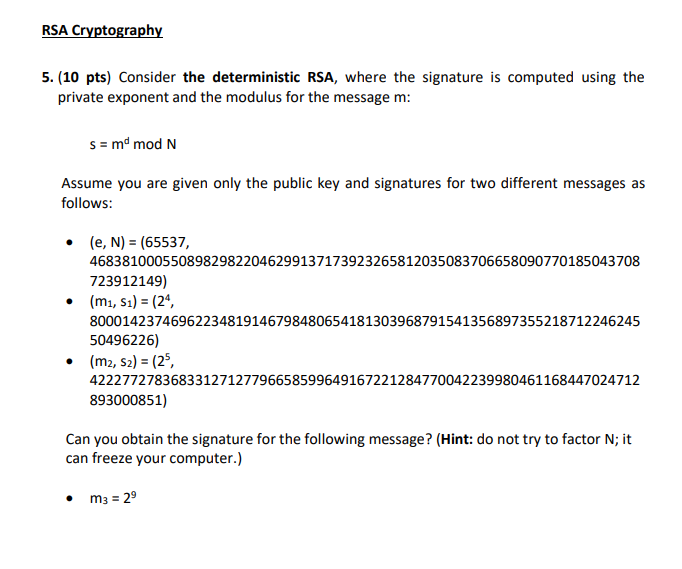
RSA Cryptography 5. (10 pts) Consider the deterministic RSA, where the signature is computed using the private exponent and the modulus for the message m: s = md mod N Assume you are given only the public key and signatures for two different messages as follows: . (e, N) = (65537, 46838100055089829822046299137173923265812035083706658090770185043708 723912149) (mi, S1) = (24, 80001423746962234819146798480654181303968791541356897355218712246245 50496226) (m2, 52) = (25, 42227727836833127127796658599649167221284770042239980461168447024712 893000851) Can you obtain the signature for the following message? (Hint: do not try to factor N; it can freeze your computer.) m3 = 29 RSA Cryptography 5. (10 pts) Consider the deterministic RSA, where the signature is computed using the private exponent and the modulus for the message m: s = md mod N Assume you are given only the public key and signatures for two different messages as follows: . (e, N) = (65537, 46838100055089829822046299137173923265812035083706658090770185043708 723912149) (mi, S1) = (24, 80001423746962234819146798480654181303968791541356897355218712246245 50496226) (m2, 52) = (25, 42227727836833127127796658599649167221284770042239980461168447024712 893000851) Can you obtain the signature for the following message? (Hint: do not try to factor N; it can freeze your computer.) m3 = 29
Step by Step Solution
There are 3 Steps involved in it

Get step-by-step solutions from verified subject matter experts
 Study Help