







Question: RSTUDIO CODE Shoshoni rectangles . Consider a rectangle with height h and width w , with w > h. Within the rectangle, draw a square
RSTUDIO CODE
Shoshoni rectangles. Consider a rectangle with height h and width w, with w > h. Within the rectangle, draw a square with side h. This procedure creates another rectangle of width w h and height h, as in Figure (1).
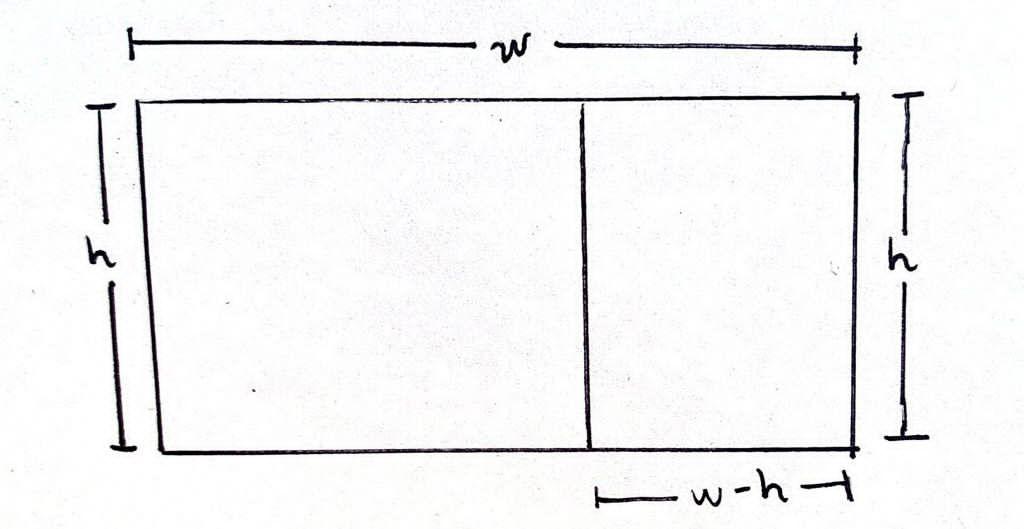
Figure 1: A rectangle with a square of h h within.
A large rectangle satisfying

was called by ancients Greeks as a golden rectangle. Finding the right values, we get h/w = (5 1) /2 0.6180, which is called the "golden number". The golden number is considered by some as a mathematical standard of esthetics in Western cultures. However, Is the golden number really inherent in our mental (human) structure as the ultimate rule of esthetics? Or can there be other cultures having their own esthetics standard?
As a concrete case, the Shoshoni indians decorate their leather goods according to certain rectangles and proportions. Table (3) shows some h/w ratios used by Shoshoni indians in their decorations. Do the Shoshoni indians have the same sense of esthetics as Western societies? In other words, Do Shoshoni indians use (on average) in their decorations the golden number, or is it a different number?
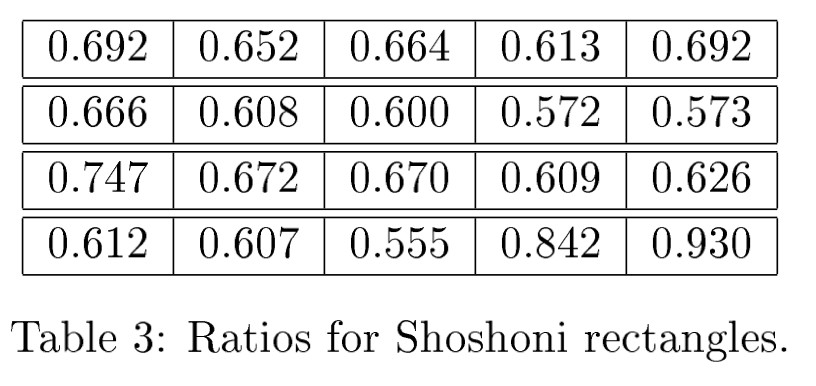
To start solving the question, think of the Shoshoni ratios as a random sample from certain (unknown) distribution with expected value . Here, the parameter represents the true esthetic preference for h/w ratios of the Shoshoni indians. Now, the question gets more concrete: is , the true esthetic parameter of the Shoshoni, the same as the golden number? Do we have evidence for thinking that? Do we have evidence for thinking is not the same?
a) Consider using the t-test. Get the observed value of the t statistic. Now, think about the following aspects and answer the questions:
a1) According to the theory, from what type of distribution should the data must come in order to apply the t-test?
a2) Do you think the base assumption for using the t-test hold in this case? Why or why not?
a3) In trying to use the t-test, What would it be the problem if the base assumption doesn't hold?
b) Based on your previous answers, complement this exercise using a more flexible method for deciding whether the Shoshoni indians have the same esthetic sense as the Western societies. Compare your answers and conclude accordingly.
I will appreciate if you put the RStudio code to solve the exercise
Table 3: Ratios for Shoshoni rectangles. Table 3: Ratios for Shoshoni rectangles
Step by Step Solution
There are 3 Steps involved in it

Get step-by-step solutions from verified subject matter experts
 Study Help