







Question: Run the provided code (below) based on Chapter 6 and answer the following MC questions. Based on the six-variable model (in Part 1), it seems
Run the provided code (below) based on Chapter 6 and answer the following MC questions.
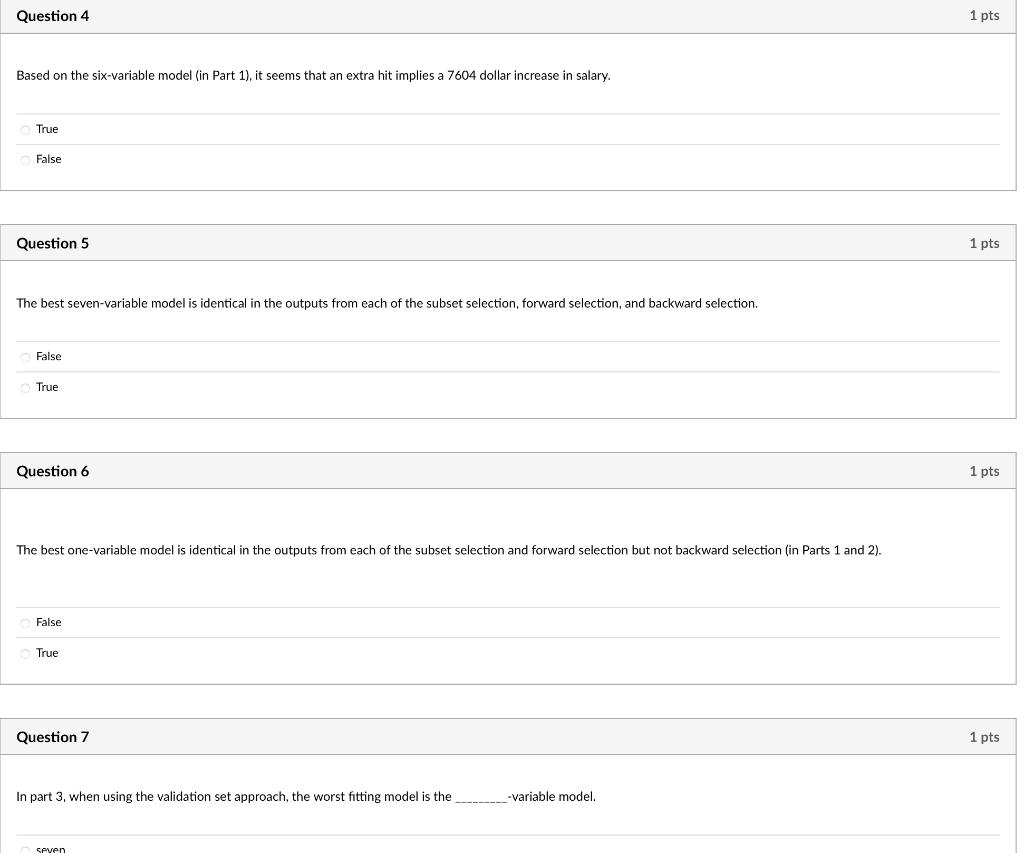
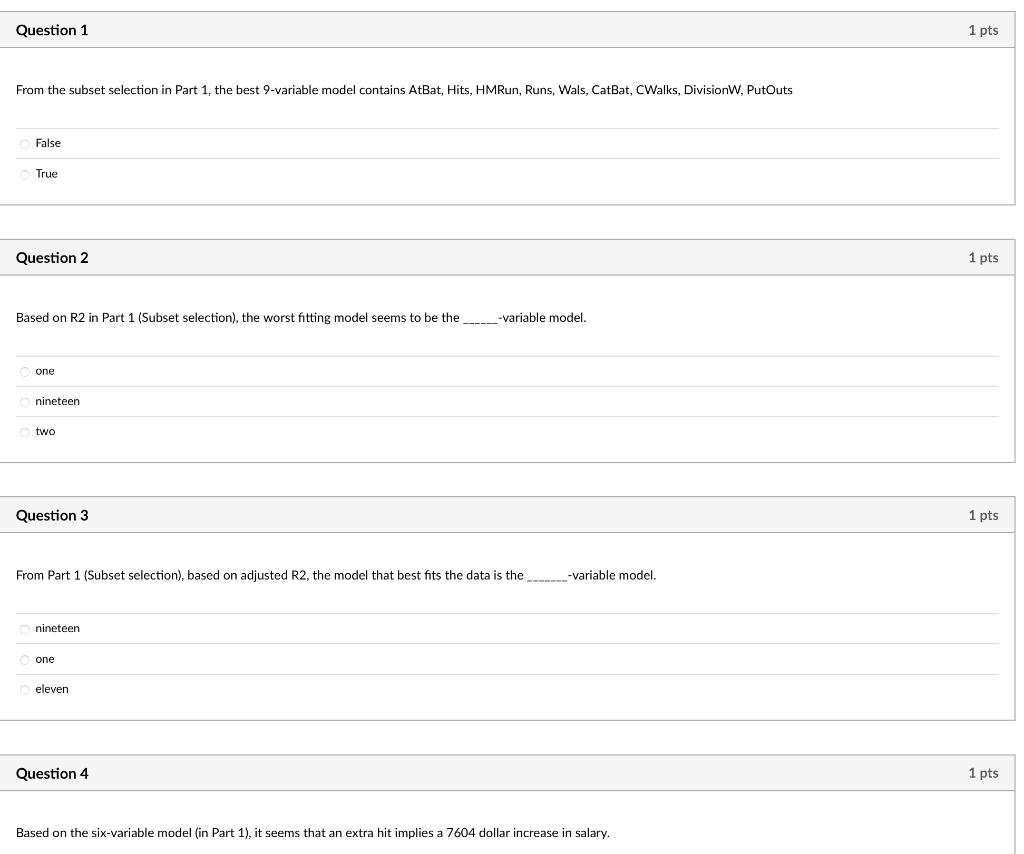
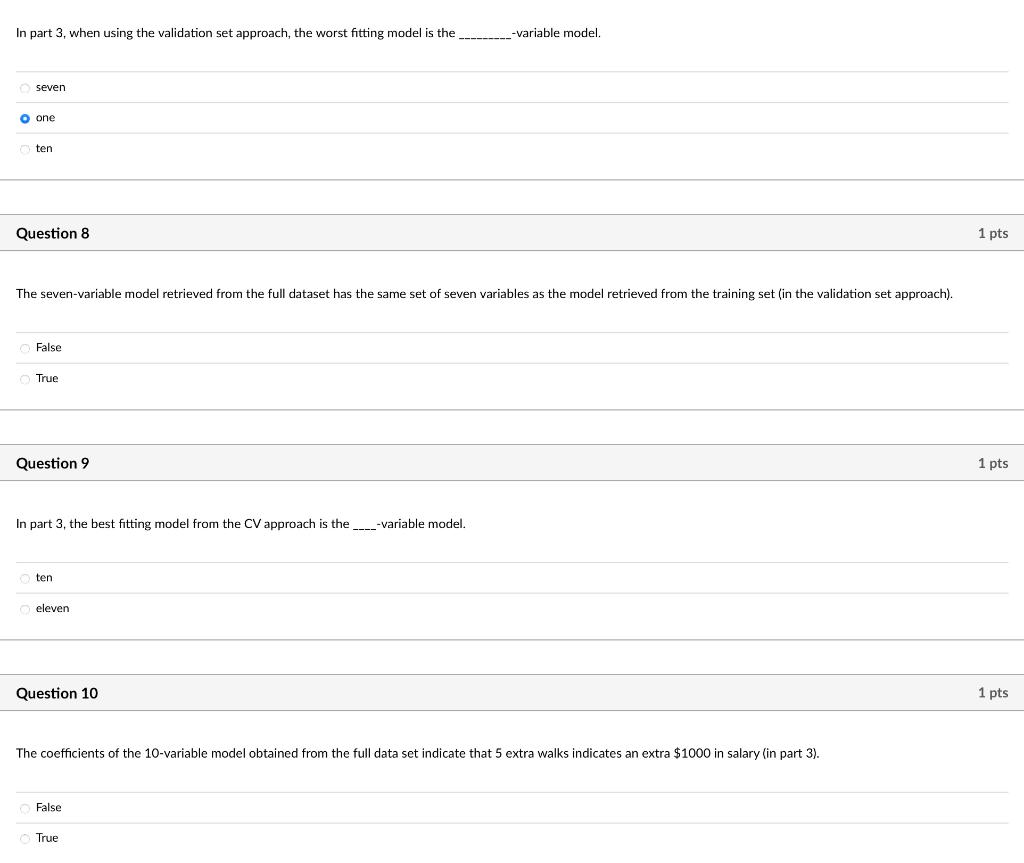
Based on the six-variable model (in Part 1), it seems that an extra hit implies a 7604 dollar increase in salary. True False Question 5 The best seven-variable model is identical in the outputs from each of the subset selection, forward selection, and backward selection. False True Question 6 The best one-variable model is identical in the outputs from each of the subset selection and forward selection but not backward selection (in Parts 1 and 2). False True Question 7 In part 3 , when using the validation set approach, the worst fitting model is the -variable model. From the subset selection in Part 1, the best 9-variable model contains AtBat, Hits, HMRun, Runs, Wals, CatBat, CWalks, DivisionW, PutOuts False True Question 2 Based on R2 in Part 1 (Subset selection), the worst fitting model seems to be the -variable model. Question 3 From Part 1 (Subset selection), based on adjusted R2, the model that best fits the data is the -variable model. nineteen one eleven Question 4 Based on the six-variable model (in Part 1), it seems that an extra hit implies a 7604 dollar increase in salary. In part 3 , when using the validation set approach, the worst fitting model is the -variable model. seven one ten Question 8 The seven-variable model retrieved from the full dataset has the same set of seven variables as the model retrieved from the training set (in the validation set approach). False True Question 9 In part 3 , the best fitting model from the CV approach is the -variable model. Question 10 The coefficients of the 10-variable model obtained from the full data set indicate that 5 extra walks indicates an extra $1000 in salary (in part 3 ). False True Based on the six-variable model (in Part 1), it seems that an extra hit implies a 7604 dollar increase in salary. True False Question 5 The best seven-variable model is identical in the outputs from each of the subset selection, forward selection, and backward selection. False True Question 6 The best one-variable model is identical in the outputs from each of the subset selection and forward selection but not backward selection (in Parts 1 and 2). False True Question 7 In part 3 , when using the validation set approach, the worst fitting model is the -variable model. From the subset selection in Part 1, the best 9-variable model contains AtBat, Hits, HMRun, Runs, Wals, CatBat, CWalks, DivisionW, PutOuts False True Question 2 Based on R2 in Part 1 (Subset selection), the worst fitting model seems to be the -variable model. Question 3 From Part 1 (Subset selection), based on adjusted R2, the model that best fits the data is the -variable model. nineteen one eleven Question 4 Based on the six-variable model (in Part 1), it seems that an extra hit implies a 7604 dollar increase in salary. In part 3 , when using the validation set approach, the worst fitting model is the -variable model. seven one ten Question 8 The seven-variable model retrieved from the full dataset has the same set of seven variables as the model retrieved from the training set (in the validation set approach). False True Question 9 In part 3 , the best fitting model from the CV approach is the -variable model. Question 10 The coefficients of the 10-variable model obtained from the full data set indicate that 5 extra walks indicates an extra $1000 in salary (in part 3 ). False True
Step by Step Solution
There are 3 Steps involved in it

Get step-by-step solutions from verified subject matter experts
 Study Help