Question: RUSH - Need B, C & D Case: Air Traffic Controller School (ATCS) Cost per Flight 100 ATCS provides training for future air traffic controllers.
RUSH - Need B, C & D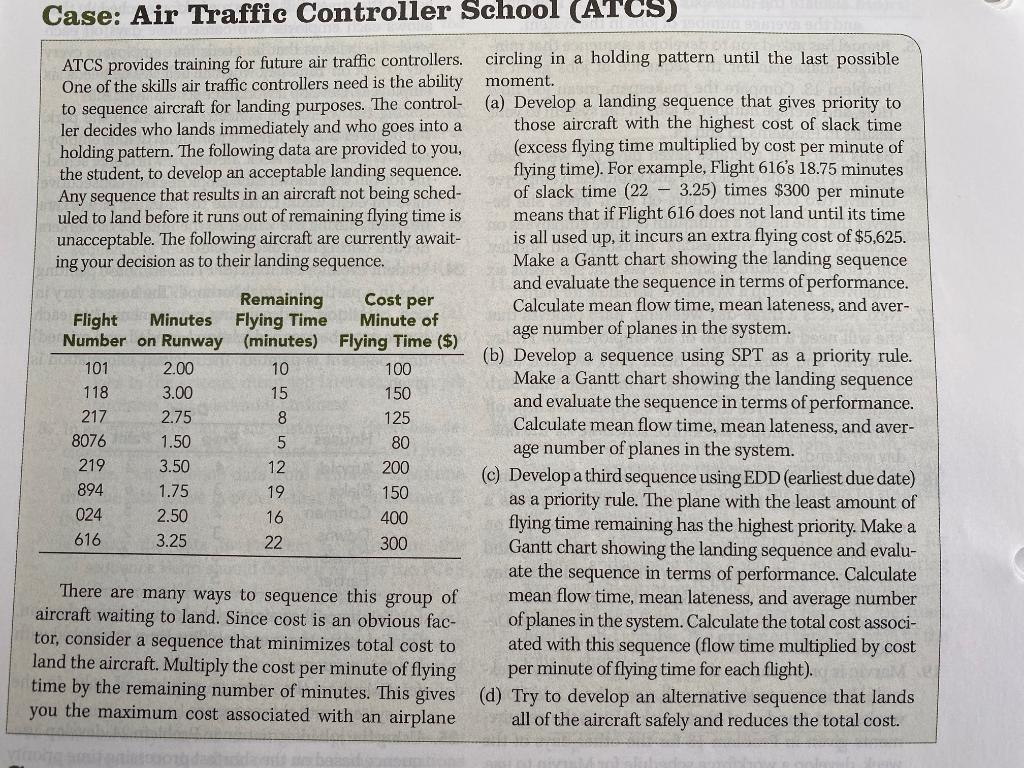
Case: Air Traffic Controller School (ATCS) Cost per Flight 100 ATCS provides training for future air traffic controllers. circling in a holding pattern until the last possible moment. One of the skills air traffic controllers need is the ability to sequence aircraft for landing purposes. The control (a) Develop a landing sequence that gives priority to ler decides who lands immediately and who goes into a those aircraft with the highest cost of slack time holding pattern. The following data are provided to you, (excess flying time multiplied by cost per minute of the student, to develop an acceptable landing sequence. flying time). For example, Flight 616's 18.75 minutes Any sequence that results in an aircraft not being sched of slack time (22 - 3.25) times $300 per minute uled to land before it runs out of remaining flying time is means that if Flight 616 does not land until its time unacceptable. The following aircraft are currently await is all used up, it incurs an extra flying cost of $5,625. ing your decision as to their landing sequence. Make a Gantt chart showing the landing sequence and evaluate the sequence in terms of performance. Remaining Calculate mean flow time, mean lateness, and aver- Minutes Flying Time Minute of age number of planes in the system. Number on Runway (minutes) Flying Time ($) (b) Develop a sequence using SPT as a priority rule. 101 2.00 10 Make a Gantt chart showing the landing sequence 118 15 150 and evaluate the sequence in terms of performance. 8 125 Calculate mean flow time, mean lateness, and aver- 8076 1.50 5 80 age number of planes in the system. 219 3.50 12 200 (C) Develop a third sequence using EDD (earliest due date) 894 1.75 19 as a priority rule. The plane with the least amount of 024 2.50 16 400 flying time remaining has the highest priority. Make a 616 3.25 22 300 Gantt chart showing the landing sequence and evalu- ate the sequence in terms of performance. Calculate There are many ways to sequence this group of mean flow time, mean lateness, and average number aircraft waiting to land. Since cost is an obvious fac of planes in the system. Calculate the total cost associ- tor, consider a sequence that minimizes total cost to ated with this sequence (flow time multiplied by cost land the aircraft. Multiply the cost per minute of flying per minute of flying time for each flight). time by the remaining number of minutes. This gives (d) Try to develop an alternative sequence that lands you the maximum cost associated with an airplane all of the aircraft safely and reduces the total cost. 3.00 217 2.75 150 Case: Air Traffic Controller School (ATCS) Cost per Flight 100 ATCS provides training for future air traffic controllers. circling in a holding pattern until the last possible moment. One of the skills air traffic controllers need is the ability to sequence aircraft for landing purposes. The control (a) Develop a landing sequence that gives priority to ler decides who lands immediately and who goes into a those aircraft with the highest cost of slack time holding pattern. The following data are provided to you, (excess flying time multiplied by cost per minute of the student, to develop an acceptable landing sequence. flying time). For example, Flight 616's 18.75 minutes Any sequence that results in an aircraft not being sched of slack time (22 - 3.25) times $300 per minute uled to land before it runs out of remaining flying time is means that if Flight 616 does not land until its time unacceptable. The following aircraft are currently await is all used up, it incurs an extra flying cost of $5,625. ing your decision as to their landing sequence. Make a Gantt chart showing the landing sequence and evaluate the sequence in terms of performance. Remaining Calculate mean flow time, mean lateness, and aver- Minutes Flying Time Minute of age number of planes in the system. Number on Runway (minutes) Flying Time ($) (b) Develop a sequence using SPT as a priority rule. 101 2.00 10 Make a Gantt chart showing the landing sequence 118 15 150 and evaluate the sequence in terms of performance. 8 125 Calculate mean flow time, mean lateness, and aver- 8076 1.50 5 80 age number of planes in the system. 219 3.50 12 200 (C) Develop a third sequence using EDD (earliest due date) 894 1.75 19 as a priority rule. The plane with the least amount of 024 2.50 16 400 flying time remaining has the highest priority. Make a 616 3.25 22 300 Gantt chart showing the landing sequence and evalu- ate the sequence in terms of performance. Calculate There are many ways to sequence this group of mean flow time, mean lateness, and average number aircraft waiting to land. Since cost is an obvious fac of planes in the system. Calculate the total cost associ- tor, consider a sequence that minimizes total cost to ated with this sequence (flow time multiplied by cost land the aircraft. Multiply the cost per minute of flying per minute of flying time for each flight). time by the remaining number of minutes. This gives (d) Try to develop an alternative sequence that lands you the maximum cost associated with an airplane all of the aircraft safely and reduces the total cost. 3.00 217 2.75 150









 Study Help