







Question: S e Consider the following relationship between the realized number of sales (s) and a sale-agent's effort (e, which could be the number of hours
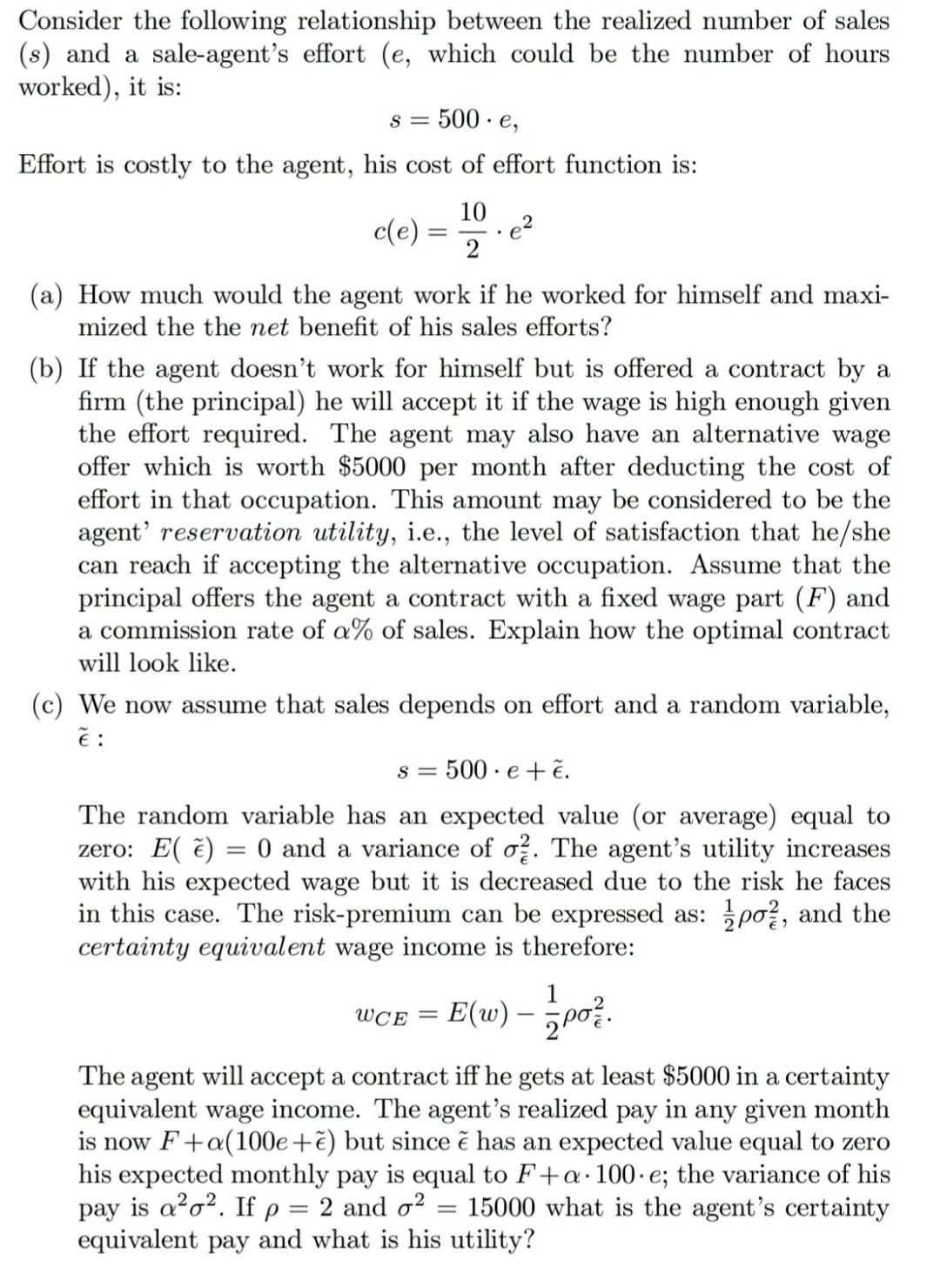
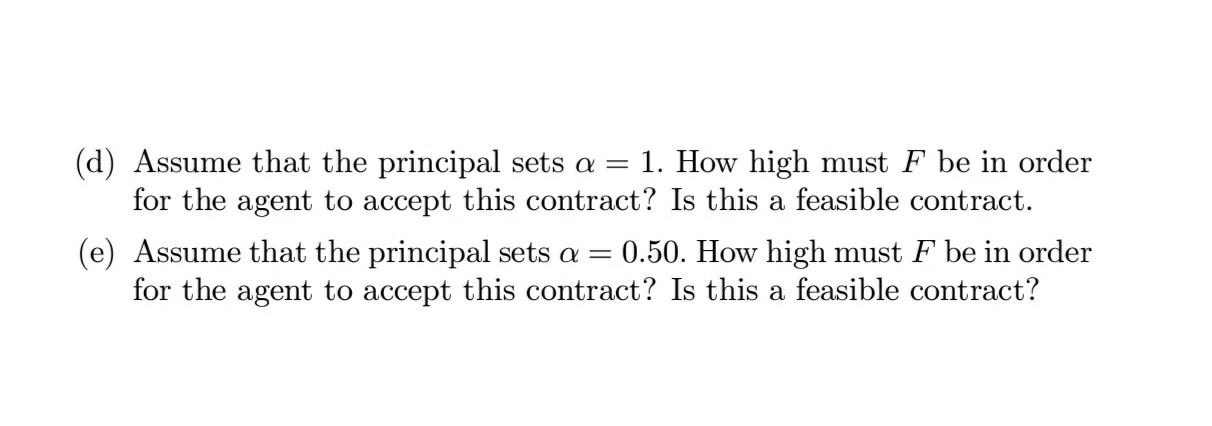
S e Consider the following relationship between the realized number of sales (s) and a sale-agent's effort (e, which could be the number of hours worked), it is: 500. e, Effort is costly to the agent, his cost of effort function is: 10 c(e) = e2 2 (a) How much would the agent work if he worked for himself and maxi- mized the the net benefit of his sales efforts? (b) If the agent doesn't work for himself but is offered a contract by a firm (the principal) he will accept it if the wage is high enough given the effort required. The agent may also have an alternative wage offer which is worth $5000 per month after deducting the cost of effort in that occupation. This amount may be considered to be the agent' reservation utility, i.e., the level of satisfaction that he/she can reach if accepting the alternative occupation. Assume that the principal offers the agent a contract with a fixed wage part (F) and a commission rate of a% of sales. Explain how the optimal contract will look like. (c) We now assume that sales depends on effort and a random variable, : = 500e + . The random variable has an expected value (or average) equal to zero: El ) = 0 and a variance of oz. The agent's utility increases with his expected wage but it is decreased due to the risk he faces in this case. The risk-premium can be expressed as: po, and the certainty equivalent wage income is therefore: S = wce = E(w) 3 poz. The agent will accept a contract iff he gets at least $5000 in a certainty equivalent wage income. The agent's realized pay in any given month is now F +a(100e +) but since ? has an expected value equal to zero his expected monthly pay is equal to F+a: 100.e; the variance of his pay is ao2. If p 2 and 02 15000 what is the agent's certainty equivalent pay and what is his utility? (d) Assume that the principal sets a = 1. How high must F be in order for the agent to accept this contract? Is this a feasible contract. (e) Assume that the principal sets a = 0.50. How high must F be in order for the agent to accept this contract? Is this a feasible contract? S e Consider the following relationship between the realized number of sales (s) and a sale-agent's effort (e, which could be the number of hours worked), it is: 500. e, Effort is costly to the agent, his cost of effort function is: 10 c(e) = e2 2 (a) How much would the agent work if he worked for himself and maxi- mized the the net benefit of his sales efforts? (b) If the agent doesn't work for himself but is offered a contract by a firm (the principal) he will accept it if the wage is high enough given the effort required. The agent may also have an alternative wage offer which is worth $5000 per month after deducting the cost of effort in that occupation. This amount may be considered to be the agent' reservation utility, i.e., the level of satisfaction that he/she can reach if accepting the alternative occupation. Assume that the principal offers the agent a contract with a fixed wage part (F) and a commission rate of a% of sales. Explain how the optimal contract will look like. (c) We now assume that sales depends on effort and a random variable, : = 500e + . The random variable has an expected value (or average) equal to zero: El ) = 0 and a variance of oz. The agent's utility increases with his expected wage but it is decreased due to the risk he faces in this case. The risk-premium can be expressed as: po, and the certainty equivalent wage income is therefore: S = wce = E(w) 3 poz. The agent will accept a contract iff he gets at least $5000 in a certainty equivalent wage income. The agent's realized pay in any given month is now F +a(100e +) but since ? has an expected value equal to zero his expected monthly pay is equal to F+a: 100.e; the variance of his pay is ao2. If p 2 and 02 15000 what is the agent's certainty equivalent pay and what is his utility? (d) Assume that the principal sets a = 1. How high must F be in order for the agent to accept this contract? Is this a feasible contract. (e) Assume that the principal sets a = 0.50. How high must F be in order for the agent to accept this contract? Is this a feasible contract
Step by Step Solution
There are 3 Steps involved in it

Get step-by-step solutions from verified subject matter experts
 Study Help