





Question: S IAIbS_pspp: Exercise Usmg PSPP to Explore HypotneSIs Testing One-Sample t Test Author: Ed Nelson Department of Sociology MlS SSQT California State University, Fresno Fresno,
S IAIbS_pspp: Exercise Usmg PSPP to Explore
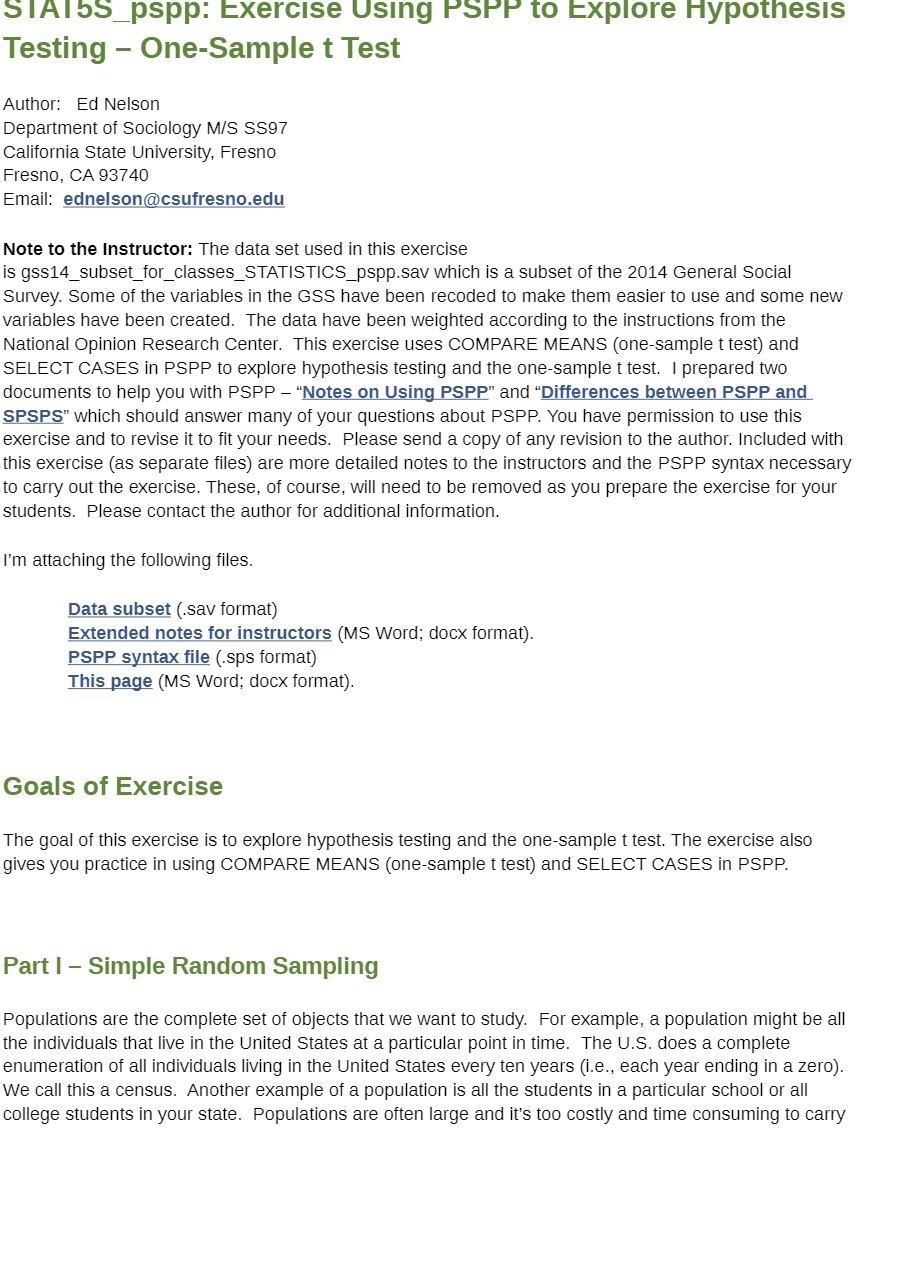
S IAIbS_pspp: Exercise Usmg PSPP to Explore HypotneSIs Testing One-Sample t Test Author: Ed Nelson Department of Sociology MlS SSQT California State University, Fresno Fresno, CA 93740 Email: ed nelson@csufresno.edu Note to the Instructor: The data set used in this exercise is gss14_subset_for_classes_STATlSTICS_pspp.sav which is a subset of the 2014 General Social Survey. Some of the variables in the GSS have been recoded to make them easier to use and some new variables have been created. The data have been weighted according to the instructions from the National Opinion Research Center. This exercise uses COMPARE MEANS [onesample ttest} and SELECT CASES in PSPP to explore hypothesis testing and the onesample ttest. I prepared two documents to help you with PSPP "Notes on Using PSPP" and \"Differences between PSPP and SPSPS" which should answer many of your questions about PSPP. You have permission to use this exercise and to revise it to t your needs. Please send a copy of any revision to the author. included with this exercise {as separate les) are more detailed notes to the instructors and the PSPP syntax necessary to carry out the exercise. These. of course, will need to be removed as you prepare the exercise for your students. Please contact the author for additional information. I'm attaching the following les. Data subset (.sav format) Extended notes for instructors {MS Word; docx format). PSPP syntax file (.sps format) This page (MS Word; docx format). Goals of Exercise The goal of this exercise is to explore hypothesis testing and the onesample ttest. The exercise also gives you practice in using COMPARE MEANS (onesample t test) and SELECT CASES in PSPP. Part I Simple Random Sampling Populations are the complete set of objects that we want to study. For example, a population might be all the individuals that live in the United States at a particular point in time. The U.S. does a complete enumeration of all individuals living in the United States every ten years e, each year ending in a zero). We call this a census. Another example of a population is all the students in a particular school or all college students in your state. Populations are often large and it's too costly and time consuming to carry

Step by Step Solution

There are 3 Steps involved in it

1 Expert Approved Answer
Step: 1 Unlock blur-text-image

Question Has Been Solved by an Expert!

Get step-by-step solutions from verified subject matter experts

Step: 2 Unlock
Step: 3 Unlock

Students Have Also Explored These Related Mathematics Questions!