





Question: S. K.D PHYS 6150 Fall 2021 Assignment 2 . The zero matrix 0 (also written as ( ) is defined as the matrix with all
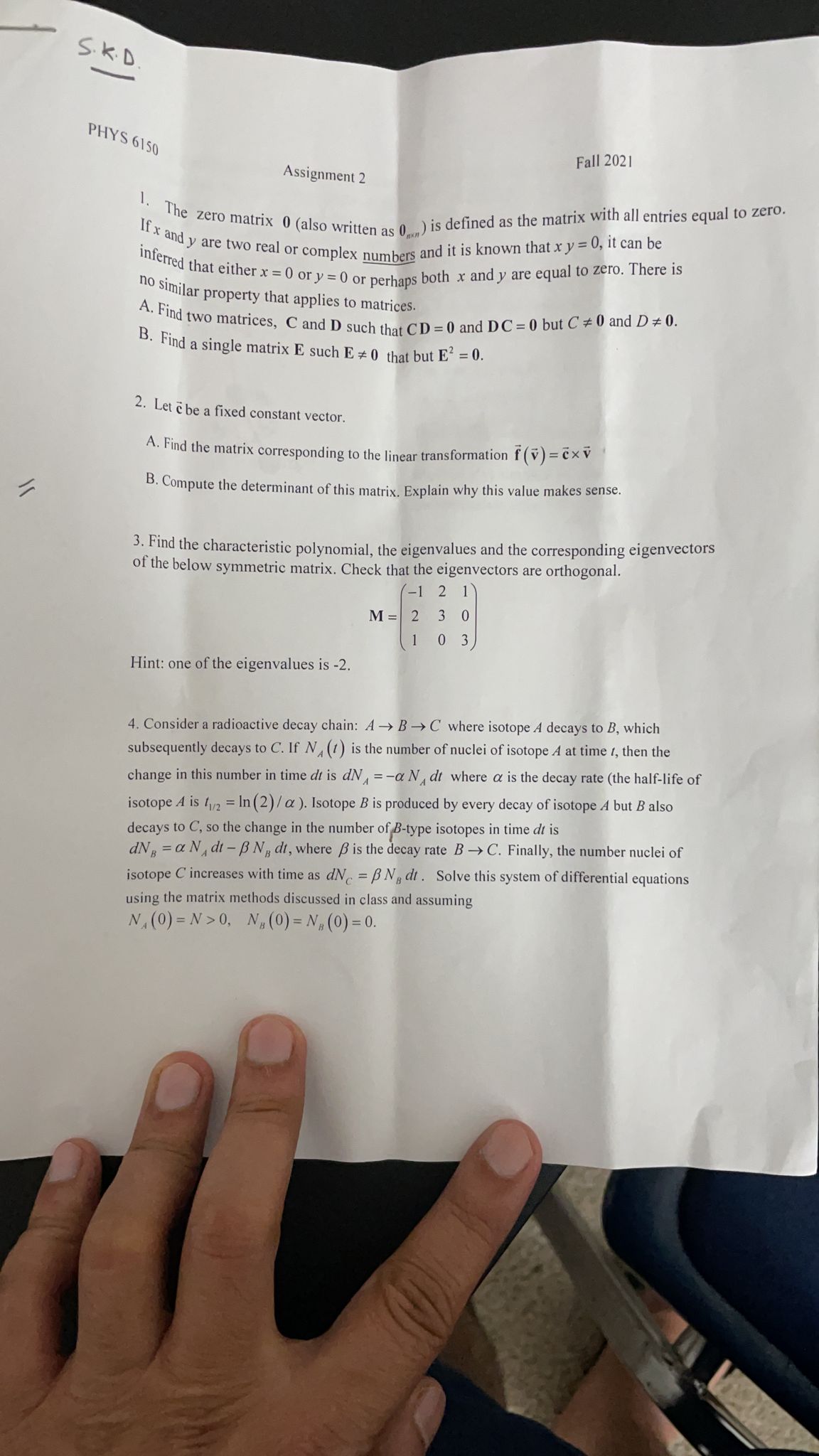
S. K.D PHYS 6150 Fall 2021 Assignment 2 . The
S. K.D PHYS 6150 Fall 2021 Assignment 2 . The zero matrix 0 (also written as ( ) is defined as the matrix with all entries equal to zero. If x and y are two real or complex numbers and it is known that x y = 0, it can be inferred that either x = 0 or y = 0 or perhaps both x and y are equal to zero. There is no similar property that applies to ma A. Find two matrices, C and D such that CD = 0 and DC = 0 but C # 0 and D # 0. B. Find a single matrix E such E #0 that but E? = 0. 2. Let c be a fixed constant vector. A. Find the matrix corresponding to the linear transformation f (v) = cxv B. Compute the determinant of this matrix. Explain why this value makes sense. 3. Find the characteristic polynomial, the eigenvalues and the corresponding eigenvectors of the below symmetric matrix. Check that the eigenvectors are orthogonal. -1 2 1 M = 2 3 0 0 Hint: one of the eigenvalues is -2. 4. Consider a radioactive decay chain: A - B - C where isotope A decays to B, which subsequently decays to C. If NA (1) is the number of nuclei of isotope A at time , then the change in this number in time di is dN, = -a N, dt where a is the decay rate (the half-life of isotope A is 1/2 = In (2) / a ). Isotope B is produced by every decay of isotope A but B also decays to C, so the change in the number of B-type isotopes in time di is dNB = a NA di - B N, di, where B is the decay rate B -> C. Finally, the number nuclei of isotope C increases with time as dNc = B Ng di . Solve this system of differential equations using the matrix methods discussed in class and assuming N. (0) = N > O, NH (0) = N. (0) = 0

Step by Step Solution

There are 3 Steps involved in it

1 Expert Approved Answer
Step: 1 Unlock blur-text-image

Question Has Been Solved by an Expert!

Get step-by-step solutions from verified subject matter experts

Step: 2 Unlock
Step: 3 Unlock

Students Have Also Explored These Related Mathematics Questions!