







Question: S. Mala Company has 2 product lines, Basic and Premium, It produces 2.000 units of Basic and 4,000 units of Premium. Basic uses $5 of
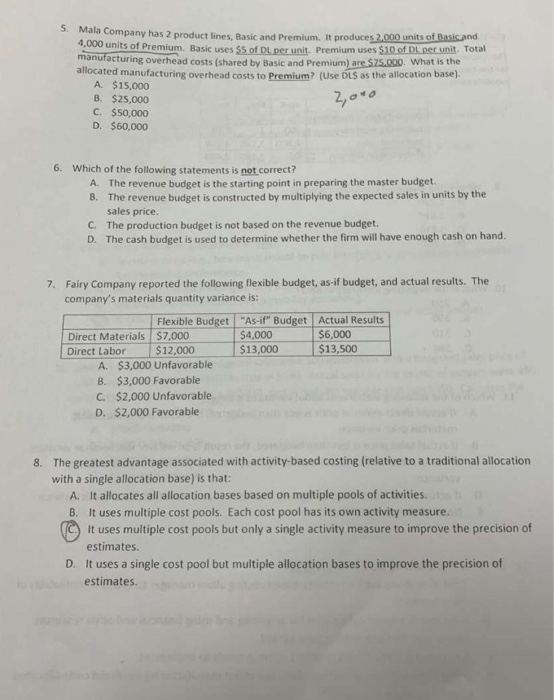
S. Mala Company has 2 product lines, Basic and Premium, It produces 2.000 units of Basic and 4,000 units of Premium. Basic uses $5 of DL per unit. Premium uses $10 of DL per unit. Total manufacturing overhead costs (shared by Basic and Premium) are $Z5.000. What is the allocated manufacturing overhead costs to Premium? (Use DLS as the allocation base). A. $15,000 2,000 B. $25,000 C. $50,000 D. $60,000 6. Which of the following statements is not correct? A. The revenue budget is the starting point in preparing the master budget. B. The revenue budget is constructed by multiplying the expected sales in units by the sales price. C. The production budget is not based on the revenue budget. D. The cash budget is used to determine whether the firm will have enough cash on hand. 7. Fairy Company reported the following flexible budget, as-if budget, and actual results. The company's materials quantity variance is: Actual Results $6,000 Flexible Budget "As-if" Budget $4,000 $13,000 Direct Materials $7,000 Direct Labor A. $3,000 Unfavorable $12,000 $13,500 B. $3,000 Favorable C. $2,000 Unfavorable D. $2,000 Favorable 8. The greatest advantage associated with activity-based costing (relative to a traditional allocation with a single allocation base) is that: A. It allocates all allocation bases based on multiple pools of activities. B. It uses multiple cost pools. Each cost pool has its own activity measure. C It uses multiple cost pools but only a single activity measure to improve the precision of estimates. D. It uses a single cost pool but multiple allocation bases to improve the precision of estimates
Step by Step Solution
There are 3 Steps involved in it

Get step-by-step solutions from verified subject matter experts
 Study Help