



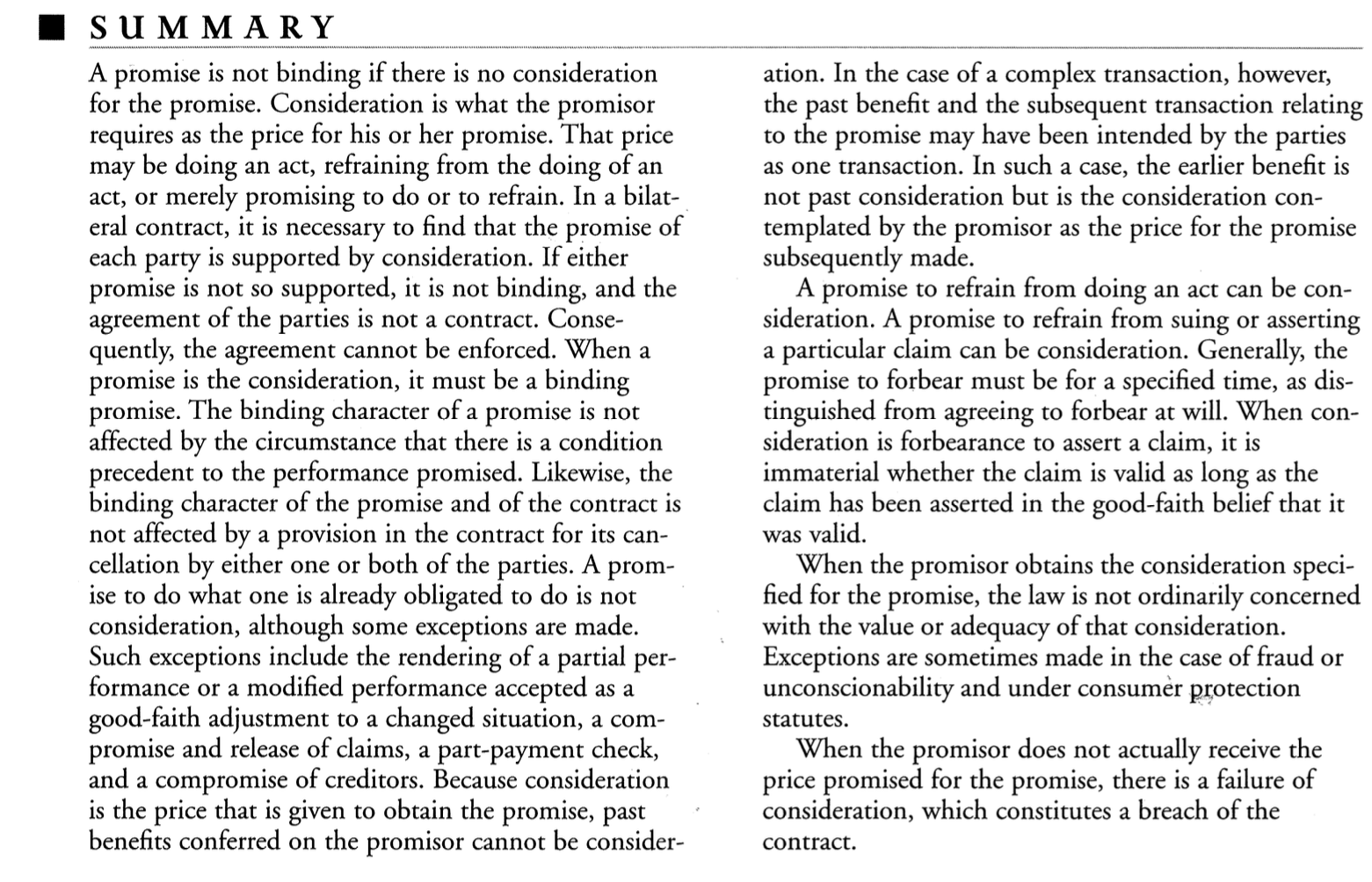
Question: S U M M A R Y A promise is not binding if there is no consideration for the promise. Consideration is what the promisor
S U M M A R Y
A promise is not binding if there is no consideration
for the promise. Consideration is what the promisor
requires as the price for his or her promise. That price
may be doing an act, refraining from the doing of an
act, or merely promising to do or to refrain. In a bilat
eral contract, it is necessary to find that the promise of
each party is supported by consideration. If either
promise is not so supported, it is not binding, and the
agreement of the parties is not a contract. Conse
quently, the agreement cannot be enforced. When a
promise is the consideration, it must be a binding
promise. The binding character of a promise is not
affected by the circumstance that there is a condition
precedent to the performance promised. Likewise, the
binding character of the promise and of the contract is
not affected by a provision in the contract for its can
cellation by either one or both of the parties. A prom
ise to do what one is already obligated to do is not
consideration, although some exceptions are made.
Such exceptions include the rendering of a partial per
formance or a modified performance accepted as a
goodfaith adjustment to a changed situation, a com
promise and release of claims, a partpayment check,
and a compromise of creditors. Because consideration
is the price that is given to obtain the promise, past
benefits conferred on the promisor cannot be consider
ation. In the case of a complex transaction, however,
the past benefit and the subsequent transaction relating
to the promise may have been intended by the parties
as one transaction. In such a case, the earlier benefit is
not past consideration but is the consideration con
templated by the promisor as the price for the promise
subsequently made.
A promise to refrain from doing an act can be con
sideration. A promise to refrain from suing or asserting
a particular claim can be consideration. Generally, the
promise to forbear must be for a specified time, as dis
tinguished from agreeing to forbear at will. When con
sideration is forbearance to assert a claim, it is
immaterial whether the claim is valid as long as the
claim has been asserted in the goodfaith belief that it
was valid.
When the promisor obtains the consideration speci
fied for the promise, the law is not ordinarily concerned
with the value or adequacy of that consideration.
Exceptions are sometimes made in the case of fraud or
unconscionability and under consumer protection
statutes.
When the promisor does not actually receive the
price promised for the promise, there is a failure of
consideration, which constitutes a breach of the
contract. ANSWER QUESTION BASED ON IRAC ISSUE RULE ANALYSIS CONCLUSION ; Sarah's house caught on fire. Through the prompt assistance of her neighbor Odessa, the fire was quickly extinguished. In gratitude, Sarah promised to pay Odessa $ Can Odessa enforce this promise fi Sarah does not pay the money? Dale Dyer, who was employed by National By
Products, Inc., was seriously injured at work as the
result of a jobrelated accident. He agreed to give up
his right to sue the employer for damages in considera
tion of the employer's giving him a lifetime job. The
employer later claimed that this agreement was not
binding because Dyer's promise not to sue could not
be consideration for the promise to employon the
ground that Dyer in fact had no right to sue. Dyer's only remedy was to make a claim under workers' com
pensation. Was the agreement binding? Dyer v National ByProducts, Inc., NWd Iowa
Step by Step Solution
There are 3 Steps involved in it
1 Expert Approved Answer
Step: 1 Unlock

Question Has Been Solved by an Expert!
Get step-by-step solutions from verified subject matter experts
Step: 2 Unlock
Step: 3 Unlock