







Question: s x ( s ) = A x ( s ) + B u ( s ) y ( s ) = C x (
Where is a column vector containing the Laplace transforms of the state variables The input is and the output is The output may or may not be a state variable, but it must be a linear combination of the state variables and of the input as shown in Equation is a system of coupled algebraic equations that are linear combinations of the state variables. The matrices and contain the coefficients of the linear equations. The transfer function is given by Eq below:
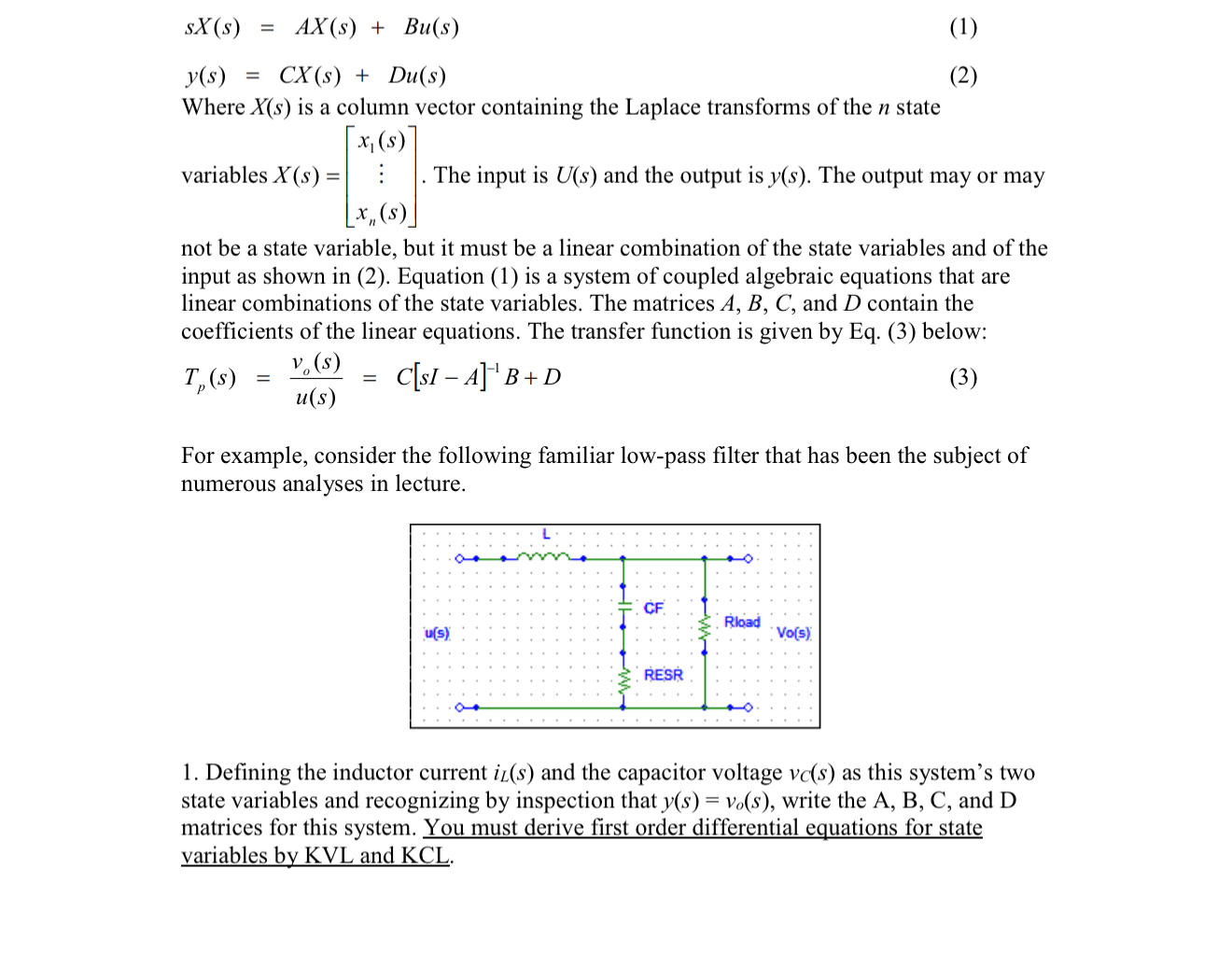
For example, consider the following familiar lowpass filter that has been the subject of numerous analyses in lecture.
Defining the inductor current and the capacitor voltage as this system's two state variables and recognizing by inspection that write the A B C and D matrices for this system. You must derive first order differential equations for state variables by KVL and KCL
Step by Step Solution
There are 3 Steps involved in it
1 Expert Approved Answer
Step: 1 Unlock

Question Has Been Solved by an Expert!
Get step-by-step solutions from verified subject matter experts
Step: 2 Unlock
Step: 3 Unlock
 Study Help