







Question: Salary Increases at ORD Services Instructions: Each group should work as the compensation committee of ORD Services. This committee is charged with making recommendations for
Salary Increases at ORD Services Instructions: Each group should work as the compensation committee of ORD Services. This committee is charged with making recommendations for salary increases for 10 professional engineers, who have been with your firm for one year. In making your recommendations, keep in mind that: 1. You are likely to be setting precedents for future salary decisions. 2. Your group has been asked to hold down salary costs to the company, as much as you can. 3. You are concerned about equity. All decisions ought to be consistent with each other. 4. You want to keep Al, Bill, and the others from leaving; you want to make them feel satisfied with their salary increases. 5. Al, Bill, and the others for whom you are making recommendations all have a B.S. degree in engineering. The probabilities are very high that any of these men would leave if they did not feel they had been rewarded equitably. Employment opportunities are good for engineers in other companies, and replacement costs are very high. 6. ORD has a policy of maintaining salaries that correspond to similar jobs in the community and the industry at large. ORD is competitive in attracting and holding employees. However, it has no fixed job evaluation plans or salary schedules, preferring to remain as flexible and adaptive as possible in offering competitive salaries and salary increasesalthough it is constrained by the desire to keep salary costs down and maintain fair and equitable relations among its employees. After reading the information that follows about the 10 engineers, enter your recommendations (in percentage of the present salary) for each persons salary increase in the spaces provided on the Salary Recommendation Form. Before discussing the matter with anyone else, enter you own personal recommendations. Then, when everyone else in your study group is ready, discuss the issues to decide on a set of group recommendations. Do not simply average the individual judgments of group members to reach a group decision. Rather, by group discussion, try to reach a group decision by reflecting the integrated thinking and consensus of all the members. Here are further details about each of the 10 engineers: A. Als job is reasonably interesting to him, it provides him comfortable working conditions, and is seen to offer security as well as opportunities for advancement. At the end of one year, Al is rated as performing as well as the average man in his category. Al brought with him considerable experience from your largest competitor when he joined ORD last year. B. Bill has the same type of job as Al, except that at the end of one year he is rated as performing better than 90 percent of the men in his category. The one drawback is that he is so smart you get the feeling he is not really working as hard as his coworkers. C. Charlie has the same type of job as Al. At the end of one year he is rated as performing better than only 30 percent of the men in his category. Charlies family is independently wealthy and he has several important political connections that could possibly help ORD obtain some very lucrative defense contracts. He is unlikely to find out what increases the others were awarded. D. Dan, like Al, is rated average at the end of a year but Dan has joined a department of ORD working on a government contract. When he joined it seemed sure that the contract would run for many years, but now the contract is in jeopardy. This job can be terminated with two weeks notice at any time because of conditions outside the control of either Dan or the department. Because of Dans highly specialized skills if his job was eliminated it would be difficult to transfer him to another position within the firm. However, if the job continues it would be very difficult to find a replacement for Dan, if he left. Dan likes his work, but because of the uncertainty of the job, he has notified his supervisor that he is actively seeking a position with another company. E. Eds performance and job are similar to Als. However, Ed is responsible for the support of a large family, which includes his parents and several younger brothers and sisters who have no source of income other than what Ed earns. He has had to leave work early on several occasions to take care of family responsibilities. Although these absences have not actually interfered with his job performance, they have become a minor irritation to coworkers. F. Frank, likewise, is rated average in performance at the end of the year. But he has been assigned by ORD to a dirty, hazardous, unpleasant, and uncomfortable job for an unspecified amount of time. Hes very unhappy with his work and complains a lot. You are trying to improve his working conditions, but not much can be done. G. Garry is like Al in performance and has a job like Als, except that Garrys job is with a low-prestige subsidiary operating in a low-prestige industry. Garry wants to transfer to a high-prestige location, but you need him where he is. And, frankly, you wonder if Garry would like his work better if he had less of an egotistical attitude. He attended an elite school and frequently mentions his educational pedigree in conversations. H. Henry is like Al in experience, education, personality, and average rating. He does similar work to Als under similar conditions, except that Henry has to work closely with a crew of uncongenial, unfriendly, competitive coworkers. This is particularly unfortunate because Henry is in a wheelchair and you wish he could be around more supportive colleagues. However, a transfer is not likely in the near future. I. Irwin is also like Al in personality and performance rating at the end of the first year, but Irwin has worked extra hard with various service projects in the firm, including coordinating fund-raising projects, blood drives, and office parties. Everyone knows and likes Irwin. Hes a bundle of energy and highly motivated. J. Jim is also like Al in background, personality, performance rating, and job. He has a definite job offer from a competitor (where working conditions and opportunities are like ORDs) with a starting salary that Jim says is substantially better than what I am now earning at ORD. You would like to keep Jim and expect that he will stay on if you can come close to matching the competitors offer to him, as changing jobs would require him to move from one town to another. 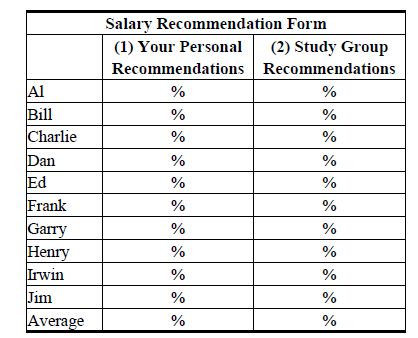 Upon completion of the exercise, each group should answer the following questions: Which of the engineers characteristics were easiest/hardest for your group to agree on? What assumptions did you make about the proper role of money in compensating for undesirable aspects of the job/work? What factors besides performance did you feel should be considered? What weight did you place on ability versus effort contributors to performance? Are there any potential unintended consequences of your compensation decisions that concern you?
Step by Step Solution
There are 3 Steps involved in it

Get step-by-step solutions from verified subject matter experts
 Study Help