







Question: same data nothing new A survey asked students of different age groups whether or not they had applied to more than one school. After gathering
same data nothing new
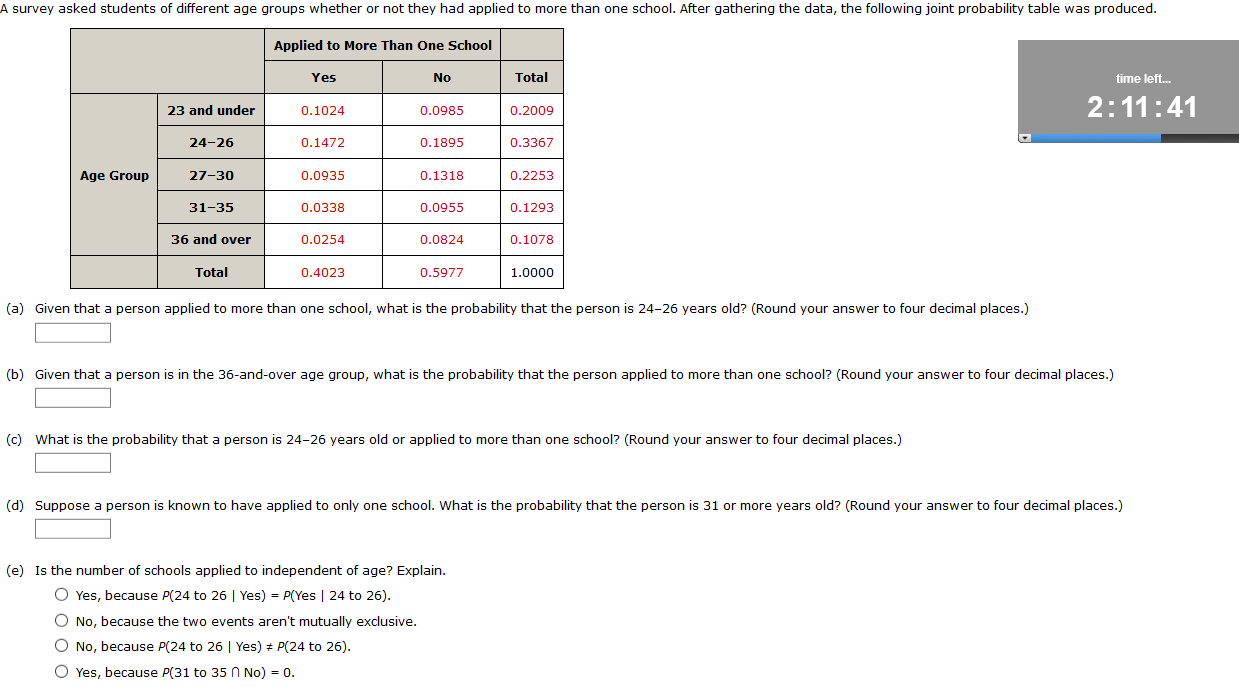
A survey asked students of different age groups whether or not they had applied to more than one school. After gathering the data, the following joint probability table was produced. Applied to More Than One School Yes No Total time left. 23 and under 0.1024 0.0985 0.2009 2:11:41 24-26 0.1472 0.1895 0.3367 Age Group 27-30 0.0935 0. 1318 0.2253 31-35 0.0338 0.0955 0.1293 36 and over 0.0254 0.0824 0.1078 Total 0.4023 0.5977 1.0000 (a) Given that a person applied to more than one school, what is the probability that the person is 24-26 years old? (Round your answer to four decimal places.) (b) Given that a person is in the 36-and-over age group, what is the probability that the person applied to more than one school? (Round your answer to four decimal places.) (c) What is the probability that a person is 24-26 years old or applied to more than one school? (Round your answer to four decimal places.) (d) Suppose a person is known to have applied to only one school. What is the probability that the person is 31 or more years old? (Round your answer to four decimal places.) (e) Is the number of schools applied to independent of age? Explain. O Yes, because P(24 to 26 | Yes) = P(Yes | 24 to 26). O No, because the two events aren't mutually exclusive. O No, because P(24 to 26 | Yes) # P(24 to 26). O Yes, because P(31 to 35 0 No) = 0
Step by Step Solution
There are 3 Steps involved in it

Get step-by-step solutions from verified subject matter experts
 Study Help