







Question: Same thing the commandServer2.c is provided in the previous question. Thanks ============================================================================================= This is the original file. #include #include #include #include #include #include #include #include
Same thing the commandServer2.c is provided in the previous question. Thanks
 ============================================================================================= This is the original file.
#include#include #include #include #include #include #include #include #include #include #include #include void ctrlCHandler(int signum) { fprintf(stderr,"Command server terminated using C "); exit(1); } //Examples of stub routines - the purpose here is to test commmand and control char * f1() { return "Command 'one' was received"; } char * f2(char *cmd) { return "Command 'two' was received"; } char * f3() { return "Command 'three' was received"; } char * f4() { return "Command four was received"; } //2 parallel arrays. commands is a list of commands to recognize // methods is an array of function pointers to call. char *commands[10]={"one","two","three","four", "alias"} ; char *(*methods[10])()={f1,f2,f3,f4,f2}; //Alternate declaration struct CMDSTRUCT { char *cmd; char *(*method)(); } cmdStruct[]={{"fred",f1},{"mary",f2},{"clark",f3},{"sonia",f4},{NULL,NULL}} ; char *interpret(char *cmdline) { char **tokens; char *cmd; int i; char *result; tokens=history_tokenize(cmdline); //Split cmdline into individual words. if(!tokens) return "no response needed"; cmd=tokens[0]; //Detecting commands: table lookup: 2 techniques //Using the parallel arrays to look up function calls for(i=0;commands[i];i++) { if(strcasecmp(cmd,commands[i])==0) return (methods[i])(cmd,&tokens[1]); } //Using struct CMDSTRUCT as an alternative lookup method. Pick either technique, not both //Note that its possible to create multiple aliases for the same command using either method. for(i=0;cmdStruct[i].cmd;i++) if(strcasecmp(cmd,cmdStruct[i].cmd)==0) return (cmdStruct[i].method)(cmd,&tokens[1]); return "command not found"; } int main(int argc, char * argv[],char * envp[]) { char cmd[100]; char *cmdLine; char *expansion; time_t now=time(NULL); int nBytes; //size of msg rec'd signal(SIGINT,ctrlCHandler); read_history("shell.log"); add_history(ctime(&now)); fprintf(stdout,"Starting the shell at: %s ",ctime(&now)); while(true) { cmdLine=readline("Enter a command: "); if(!cmdLine) break; history_expand(cmdLine,&expansion); add_history(expansion); if(strcasecmp(cmdLine,"bye")==0) break; char *response=interpret(cmdLine); fprintf(stdout,"%s ",response); } write_history("shell.log"); system("echo Your session history is; cat -n shell.log"); fprintf(stdout,"Server is now terminated "); return 0; }
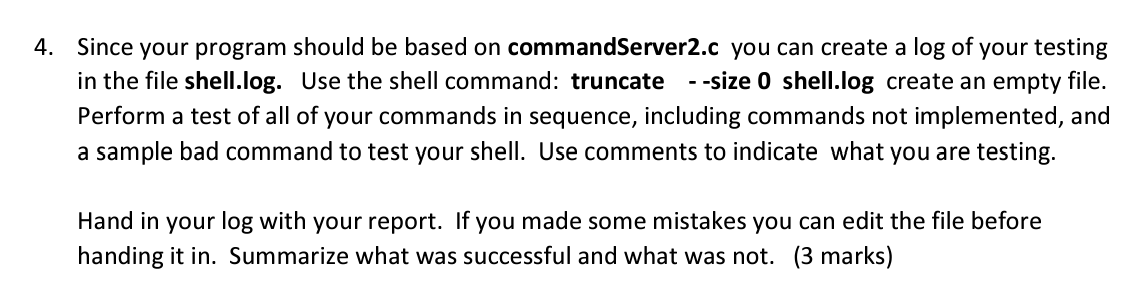
Since your program should be based on commandServer2.c you can create a log of your testing in the file shell.log. Use the shell command: truncate - -size 0 shell.log create an empty file. Perform a test of all of your commands in sequence, including commands not implemented, and a sample bad command to test your shell. Use comments to indicate what you are testing. Hand in your log with your report. If you made some mistakes you can edit the file before handing it in. Summarize what was successful and what was not
Step by Step Solution
There are 3 Steps involved in it

Get step-by-step solutions from verified subject matter experts
 Study Help