



Question: Sample A 10 kg box that is no longer being pushed along the floor is moving forwards along the floor. The coefficient of friction between
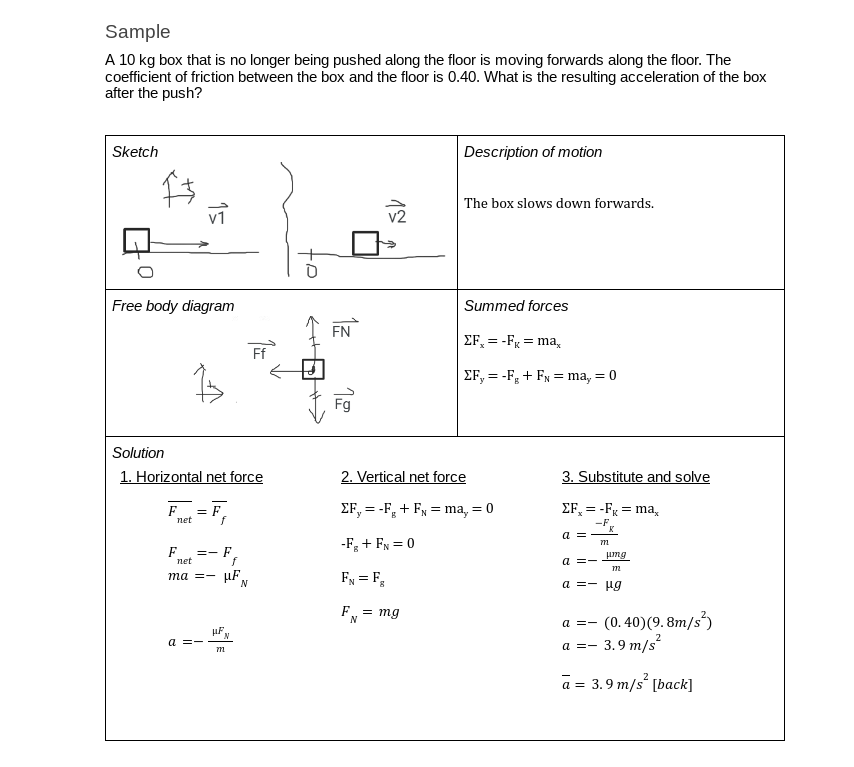
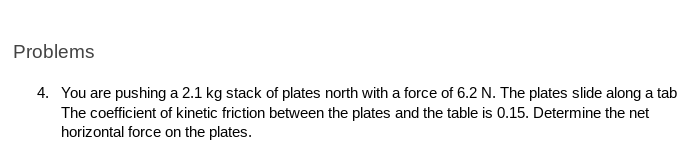
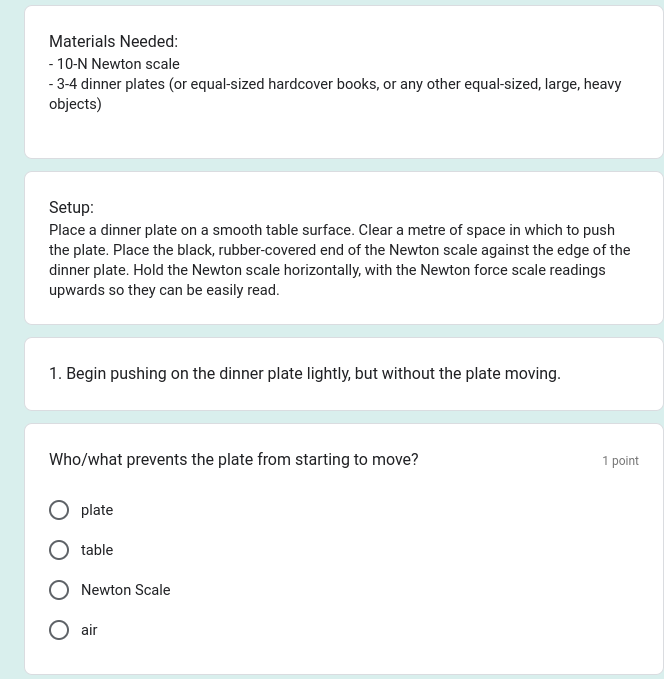
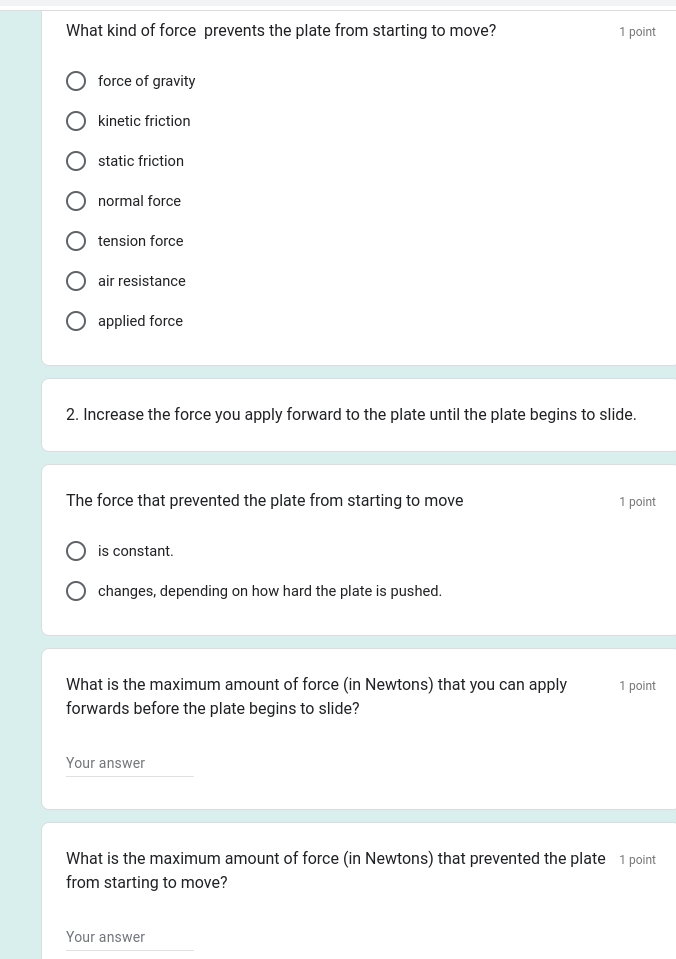
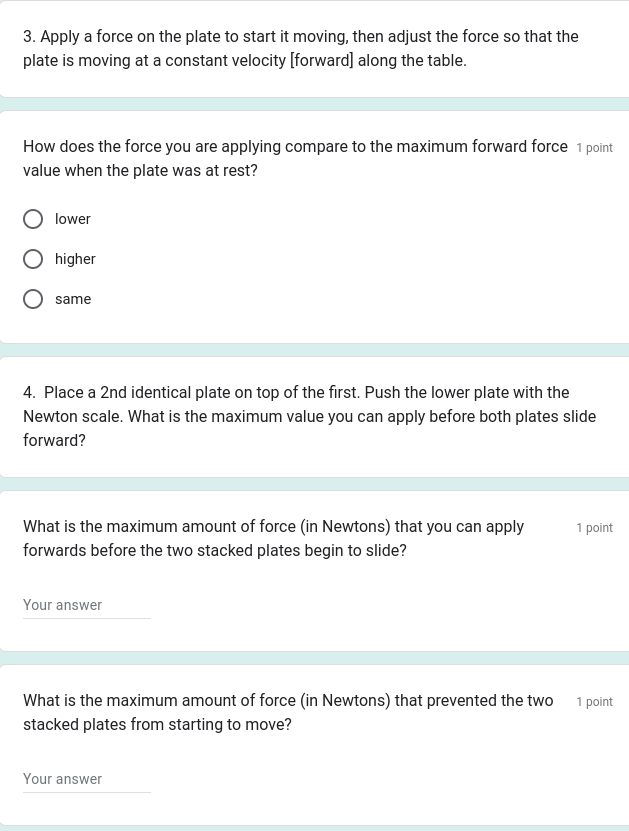
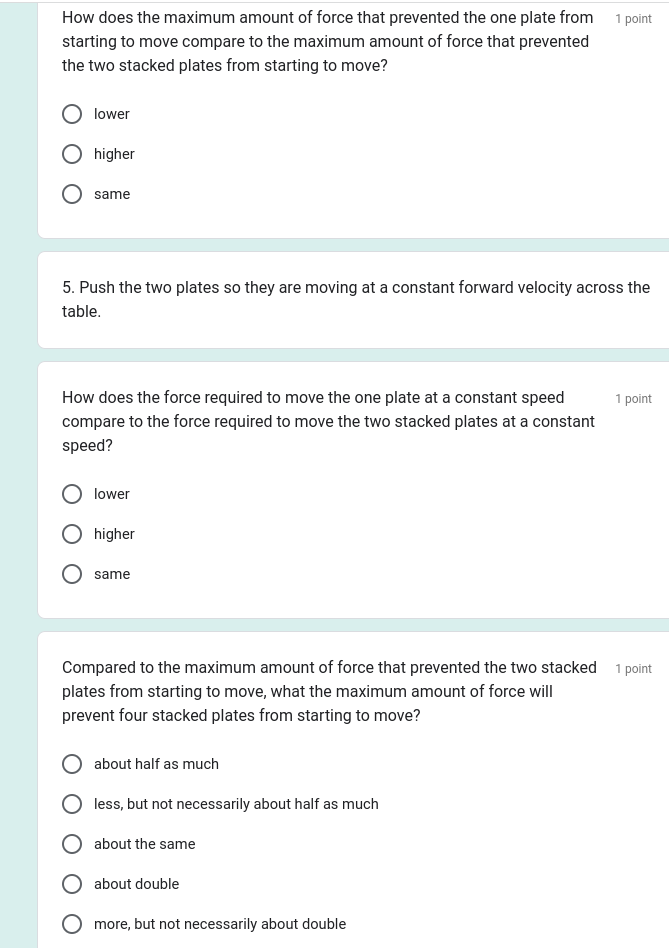
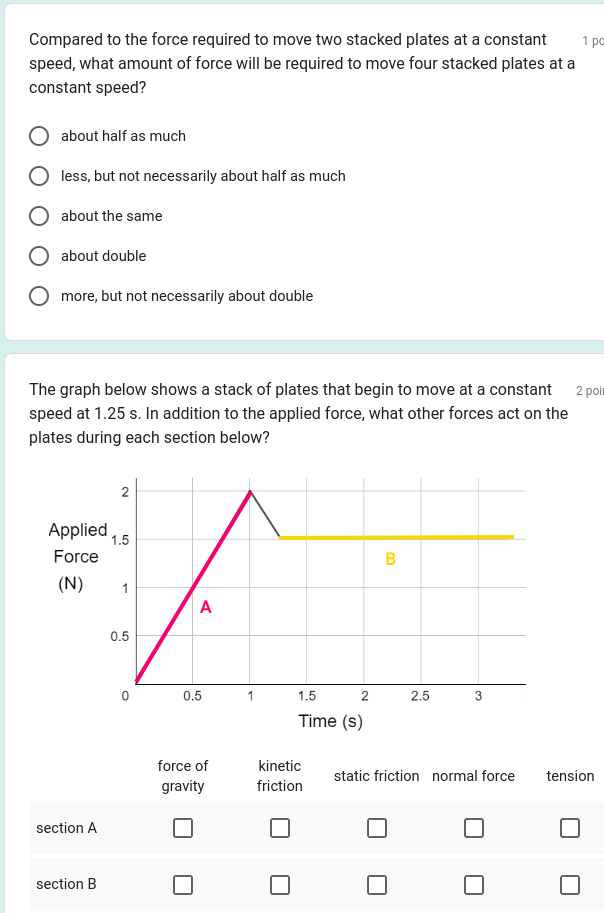

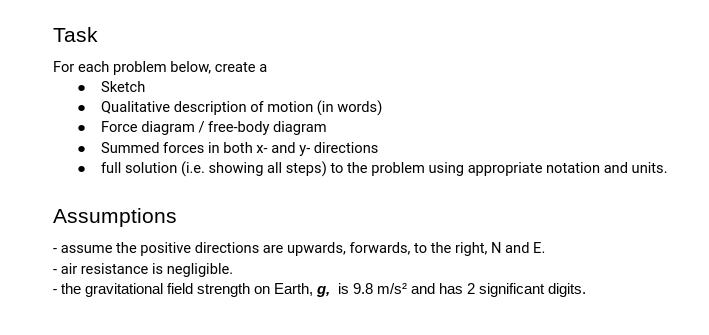
Sample A 10 kg box that is no longer being pushed along the floor is moving forwards along the floor. The coefficient of friction between the box and the floor is 0.40. What is the resulting acceleration of the box after the push? Sketch Description of motion Vi V2 The box slows down forwards. D Free body diagram Summed forces FN Ff EF = -Fx = ma, EF, = -F + FN = ma, = 0 Fg Solution 1. Horizontal net force 2. Vertical net force 3. Substitute and solve F = F EF = -F + FN = ma, = 0 EF, = -FK = ma, 1 = - Fa + FN = 0 =- F ma =- HF IN FN =F 1 =- ug F = mg a =- (0. 40) (9. 8m/s ) ( =- m a =- 3.9 m/s a = 3.9m/s [back]Problems 4. You are pushing a 2.1 kg stack of plates north with a force of 6.2 N. The plates slide along a tab The coefficient of kinetic friction between the plates and the table is 0.15. Determine the net horizontal force on the plates.Materials Needed: - 1DN Newton scale 34 dinner plates {or equalsized hardcover books. or anyr other equalsized, large, heavy objects) Setup: Place a dinner plate on a smooth table surface. |[llear a metre of space in which to push the plate. Place the black, rubber-covered end of the Newton scale against the edge of the dinner plate. Hold the Newton scale horizontallyr with the Newton force scale readings upwards so they can be easily read. 1. Begin pushing on the dinner plate lightly. but without the plate moving. Whofwhat prevents the plate from starting to move? 1 point 0 Newton Scale 0 air What kind of force prevents the plate from starting to move? 1 point force of gravity O kinetic friction O static friction O normal force O tension force O air resistance O applied force 2. Increase the force you apply forward to the plate until the plate begins to slide. The force that prevented the plate from starting to move 1 point is constant. O changes, depending on how hard the plate is pushed. What is the maximum amount of force (in Newtons) that you can apply 1 point forwards before the plate begins to slide? Your answer What is the maximum amount of force (in Newtons) that prevented the plate 1 point from starting to move? Your answer3. Apply a force on the plate to start it moving, then adjust the force so that the plate is moving at a constant velocity [forward] along the table. How does the force you are applying compare to the maximum forward force 1 point value when the plate was at rest? lower O higher O same 4. Place a 2nd identical plate on top of the first. Push the lower plate with the Newton scale. What is the maximum value you can apply before both plates slide forward? What is the maximum amount of force (in Newtons) that you can apply 1 point forwards before the two stacked plates begin to slide? Your answer What is the maximum amount of force (in Newtons) that prevented the two 1 point stacked plates from starting to move? Your answerHow does the maximum amount of force that prevented the one plate from 1 point starting to move compare to the maximum amount of force that prevented the two stacked plates from starting to move? lower O higher O same 5. Push the two plates so they are moving at a constant forward velocity across the table. How does the force required to move the one plate at a constant speed 1 point compare to the force required to move the two stacked plates at a constant speed? lower O higher O same Compared to the maximum amount of force that prevented the two stacked 1 point plates from starting to move, what the maximum amount of force will prevent four stacked plates from starting to move? O about half as much O less, but not necessarily about half as much O about the same about double O more, but not necessarily about doubleCompared to the force required to move two stacked plates at a constant 1 p speed, what amount of force will be required to move four stacked plates at a constant speed? O about half as much less, but not necessarily about half as much O about the same O about double O more, but not necessarily about double The graph below shows a stack of plates that begin to move at a constant 2 poi speed at 1.25 s. In addition to the applied force, what other forces act on the plates during each section below? Applied 1.5 Force B (N) 1 A 0.5 0 0.5 1 1.5 2 2.5 3 Time (s) force of kinetic static friction normal force tension gravity friction section A O O section B O O 0 OWould it be better to push a heavy box along a floor in stages or continually? O stages O continually Explain your previous selection. Your answerLearning Goals / Rubric Criteria Represent the situation in multiple ways including free body diagrams and explain how representations are interconnected Use algebra, along with other representations, to model and then solve problemsTask For each problem heloirlrr create a - Sketch Qualitative description of motion {in words} Force diagram i" freebody diagram Summed forces in both x and y directions full solution [i.e. showing all steps} to the problem using appropriate notation and units. Assumptions - assume the positive directions are upwards; fonnrards. to the right. N and E. air resistance is negligible. the gravitational field strength on Earth, 9, is 3.8 mils2 and has 2 significant digits
Step by Step Solution
There are 3 Steps involved in it

Get step-by-step solutions from verified subject matter experts