



Question: Say the financial managers agree that the new computer system will increase the riskiness of the firm so they add 1.6% to the current WACC.
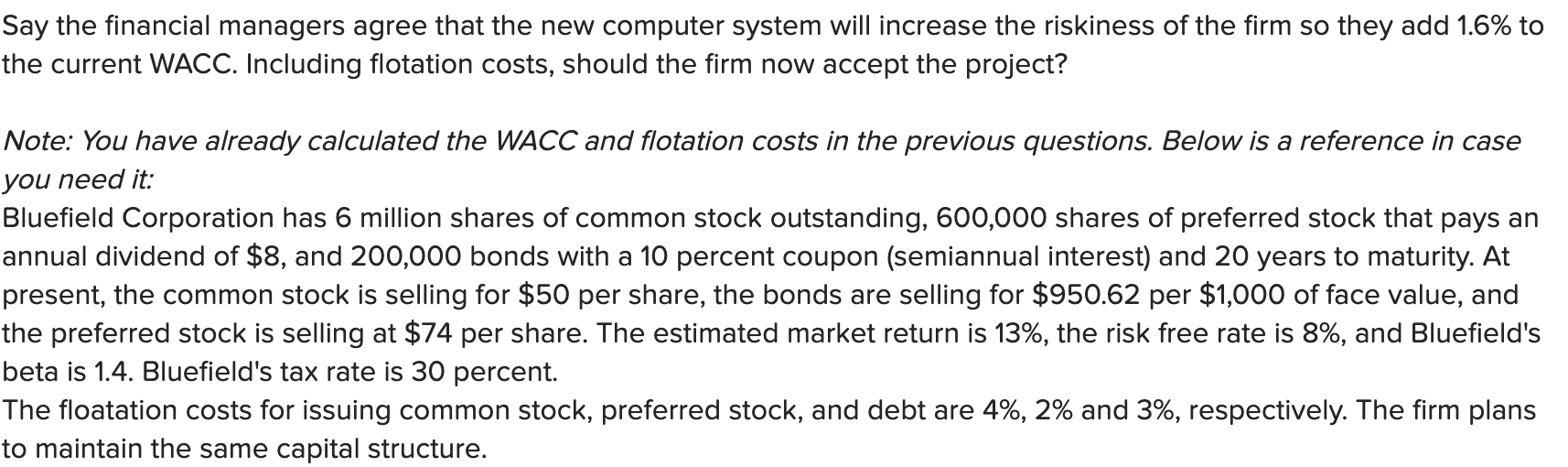
Say the financial managers agree that the new computer system will increase the riskiness of the firm so they add 1.6% to the current WACC. Including flotation costs, should the firm now accept the project? Note: You have already calculated the WACC and flotation costs in the previous questions. Below is a reference in case you need it: Bluefield Corporation has 6 million shares of common stock outstanding, 600,000 shares of preferred stock that pays an annual dividend of $8, and 200,000 bonds with a 10 percent coupon (semiannual interest) and 20 years to maturity. At present, the common stock is selling for $50 per share, the bonds are selling for $950.62 per $1,000 of face value, and the preferred stock is selling at $74 per share. The estimated market return is 13%, the risk free rate is 8%, and Bluefield's beta is 1.4. Bluefield's tax rate is 30 percent. The floatation costs for issuing common stock, preferred stock, and debt are 4%, 2% and 3%, respectively. The firm plans to maintain the same capital structure. Say the financial managers agree that the new computer system will increase the riskiness of the firm so they add 1.6% to the current WACC. Including flotation costs, should the firm now accept the project? Note: You have already calculated the WACC and flotation costs in the previous questions. Below is a reference in case you need it: Bluefield Corporation has 6 million shares of common stock outstanding, 600,000 shares of preferred stock that pays an annual dividend of $8, and 200,000 bonds with a 10 percent coupon (semiannual interest) and 20 years to maturity. At present, the common stock is selling for $50 per share, the bonds are selling for $950.62 per $1,000 of face value, and the preferred stock is selling at $74 per share. The estimated market return is 13%, the risk free rate is 8%, and Bluefield's beta is 1.4. Bluefield's tax rate is 30 percent. The floatation costs for issuing common stock, preferred stock, and debt are 4%, 2% and 3%, respectively. The firm plans to maintain the same capital structure
Step by Step Solution
There are 3 Steps involved in it

Get step-by-step solutions from verified subject matter experts