







Question: Scenario 1: Consider a simple pricing game in which two rms can each choose whether to undercut their opponent or not. We will assume the
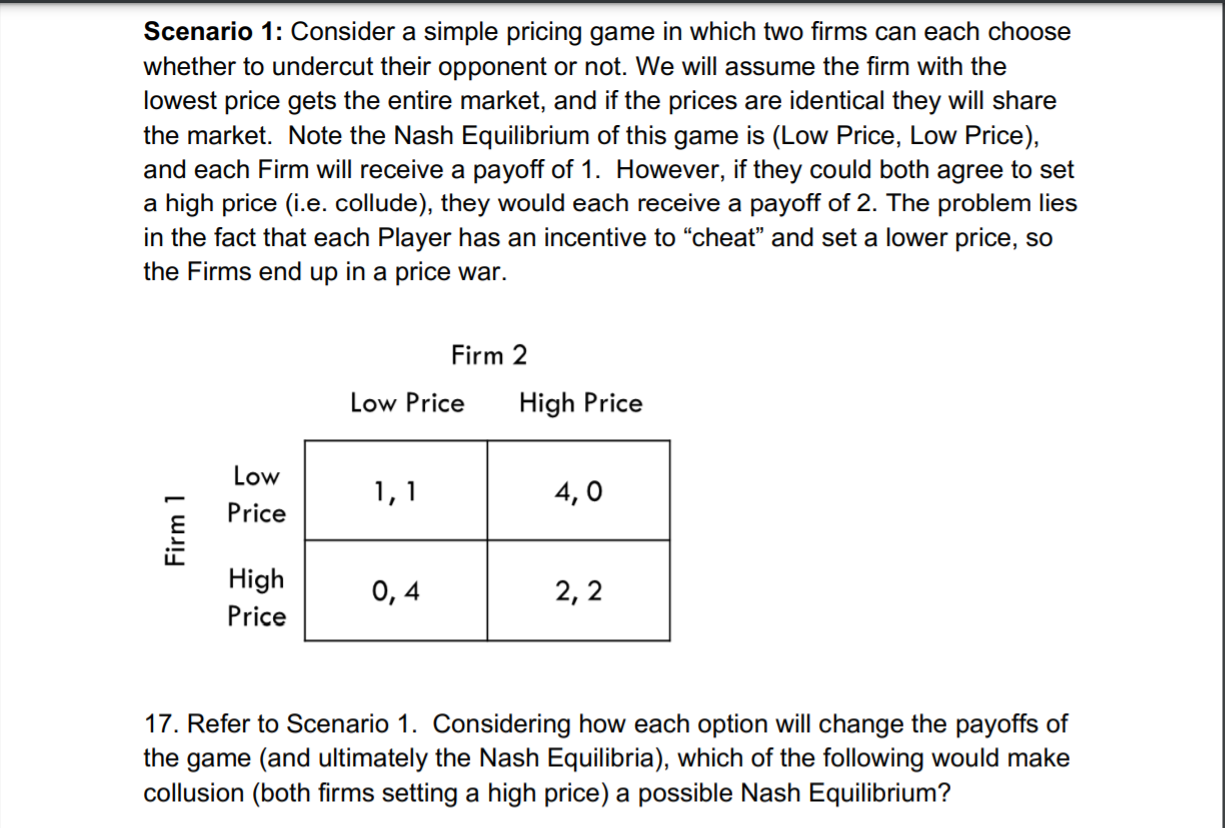
Scenario 1: Consider a simple pricing game in which two rms can each choose whether to undercut their opponent or not. We will assume the rm with the lowest price gets the entire market, and if the prices are identical they will share the market. Note the Nash Equilibrium of this game is (Low Price, Low Price), and each Firm will receive a payoff of 1. However, if they could both agree to set a high price (i.e. collude), they would each receive a payoff of 2. The problem lies in the fact that each Player has an incentive to \"cheat" and set a lower price, so the Firms end up in a price war. Firm 2 Low Price High Price Low 4, 0 Price Firm 1 Price ' 17. Refer to Scenario 1. Considering how each option will change the payoffs of the game (and ultimately the Nash Equilibria), which of the following would make collusion (both rms setting a high price) a possible Nash Equilibrium
Step by Step Solution
There are 3 Steps involved in it

Get step-by-step solutions from verified subject matter experts
 Study Help