







Question: SCENARIO 2 Repeat all the steps (1-5) shown above assuming that the number of units expected to be sold increase by 20%. The months January
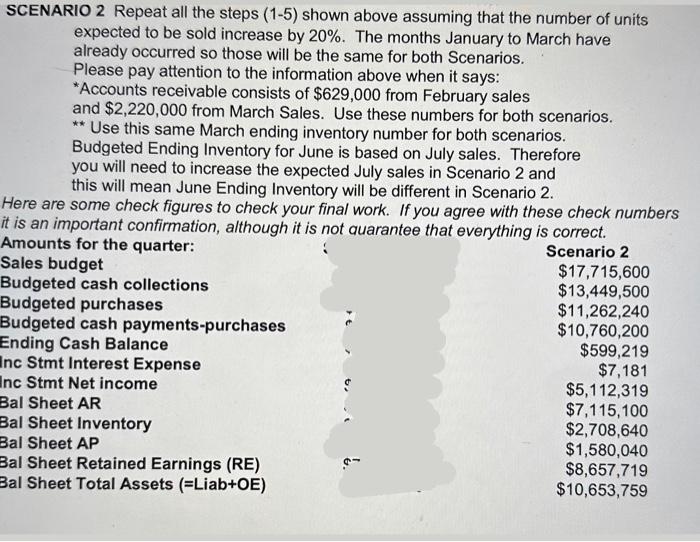
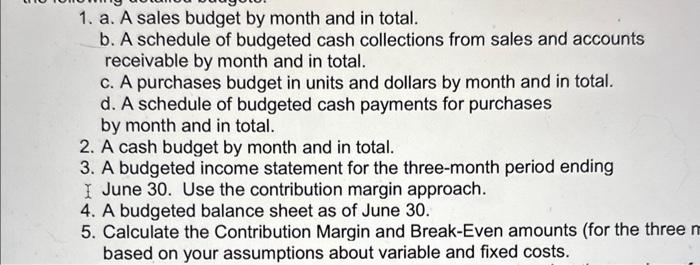
SCENARIO 2 Repeat all the steps (1-5) shown above assuming that the number of units expected to be sold increase by 20%. The months January to March have already occurred so those will be the same for both Scenarios. Please pay attention to the information above when it says: *Accounts receivable consists of $629,000 from February sales and $2,220,000 from March Sales. Use these numbers for both scenarios. ** Use this same March ending inventory number for both scenarios. Budgeted Ending Inventory for June is based on July sales. Therefore you will need to increase the expected July sales in Scenario 2 and this will mean June Ending Inventory will be different in Scenario 2. Here are some check figures to check your final work. If you agree with these check numbers it is an important confirmation, although it is not quarantee that everything is correct. Amountsforthequarter:SalesbudgetBudgetedcashcollectionsBudgetedpurchasesBudgetedcashpayments-purchasesEndingCashBalancenncStmtInterestExpenseIncStmtNetincomeBalSheetARBalSheetInventoryBalSheetAPBalSheetRetainedEarnings(RE)BalSheetTotalAssets(=Liab+OE)$17,715,600$13,449,500$11,262,240$10,760,200$599,219$7,181$5,112,319$7,115,100$2,708,640$1,580,040$8,657,719$Scenario2$10,653,759 1. a. A sales budget by month and in total. b. A schedule of budgeted cash collections from sales and accounts receivable by month and in total. c. A purchases budget in units and dollars by month and in total. d. A schedule of budgeted cash payments for purchases by month and in total. 2. A cash budget by month and in total. 3. A budgeted income statement for the three-month period ending June 30 . Use the contribution margin approach. 4. A budgeted balance sheet as of June 30 . 5. Calculate the Contribution Margin and Break-Even amounts (for the three based on your assumptions about variable and fixed costs. SCENARIO 2 Repeat all the steps (1-5) shown above assuming that the number of units expected to be sold increase by 20%. The months January to March have already occurred so those will be the same for both Scenarios. Please pay attention to the information above when it says: *Accounts receivable consists of $629,000 from February sales and $2,220,000 from March Sales. Use these numbers for both scenarios. ** Use this same March ending inventory number for both scenarios. Budgeted Ending Inventory for June is based on July sales. Therefore you will need to increase the expected July sales in Scenario 2 and this will mean June Ending Inventory will be different in Scenario 2. Here are some check figures to check your final work. If you agree with these check numbers it is an important confirmation, although it is not quarantee that everything is correct. Amountsforthequarter:SalesbudgetBudgetedcashcollectionsBudgetedpurchasesBudgetedcashpayments-purchasesEndingCashBalancenncStmtInterestExpenseIncStmtNetincomeBalSheetARBalSheetInventoryBalSheetAPBalSheetRetainedEarnings(RE)BalSheetTotalAssets(=Liab+OE)$17,715,600$13,449,500$11,262,240$10,760,200$599,219$7,181$5,112,319$7,115,100$2,708,640$1,580,040$8,657,719$Scenario2$10,653,759 1. a. A sales budget by month and in total. b. A schedule of budgeted cash collections from sales and accounts receivable by month and in total. c. A purchases budget in units and dollars by month and in total. d. A schedule of budgeted cash payments for purchases by month and in total. 2. A cash budget by month and in total. 3. A budgeted income statement for the three-month period ending June 30 . Use the contribution margin approach. 4. A budgeted balance sheet as of June 30 . 5. Calculate the Contribution Margin and Break-Even amounts (for the three based on your assumptions about variable and fixed costs
Step by Step Solution
There are 3 Steps involved in it

Get step-by-step solutions from verified subject matter experts
 Study Help