



Question: Scenario: In real-life applications, statistics helps us analyze data to extract information about a population. Take on the role of Susan, a high school principal.
Scenario:
In real-life applications, statistics helps us analyze data to extract information about a population. Take on the role of Susan, a high school principal. She is planning on having a large movie night for the high school. She has received a lot of feedback on which movie to show and sees differences in movie preferences by gender and also by grade level.
She knows if the wrong movie is shown, it could reduce event turnout by 50%. She would like to maximize the number of students who attend and would like to select a PG-rated movie based on the overall student population's movie preferences. Each student is assigned a classroom with other students in their grade. She has a spreadsheet that lists the names of each student, their classroom, and their grade. Susan knows a simple random sample would provide a good representation of the population of students at their high school, but wonders if a different method would be better.
Questions:
1. How could Susan take a sample of the student population that would not represent the population well?
2. How could Susan take a sample of the student population that would represent the population well?
3. What is the relationship of a sample to a population? Classify your two samples as random, cluster, stratified, or convenience.
Student Demographic below:
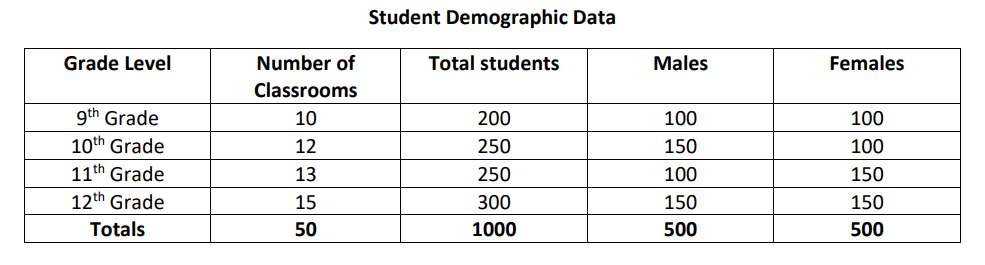
Student Demographic Data Grade Level Number of Total students Males Females Classrooms 9th Grade 10 200 100 100 10th Grade 12 250 150 100 11th Grade 13 250 100 150 12th Grade 15 300 150 150 Totals 50 1000 500 500
Step by Step Solution
There are 3 Steps involved in it

Get step-by-step solutions from verified subject matter experts