







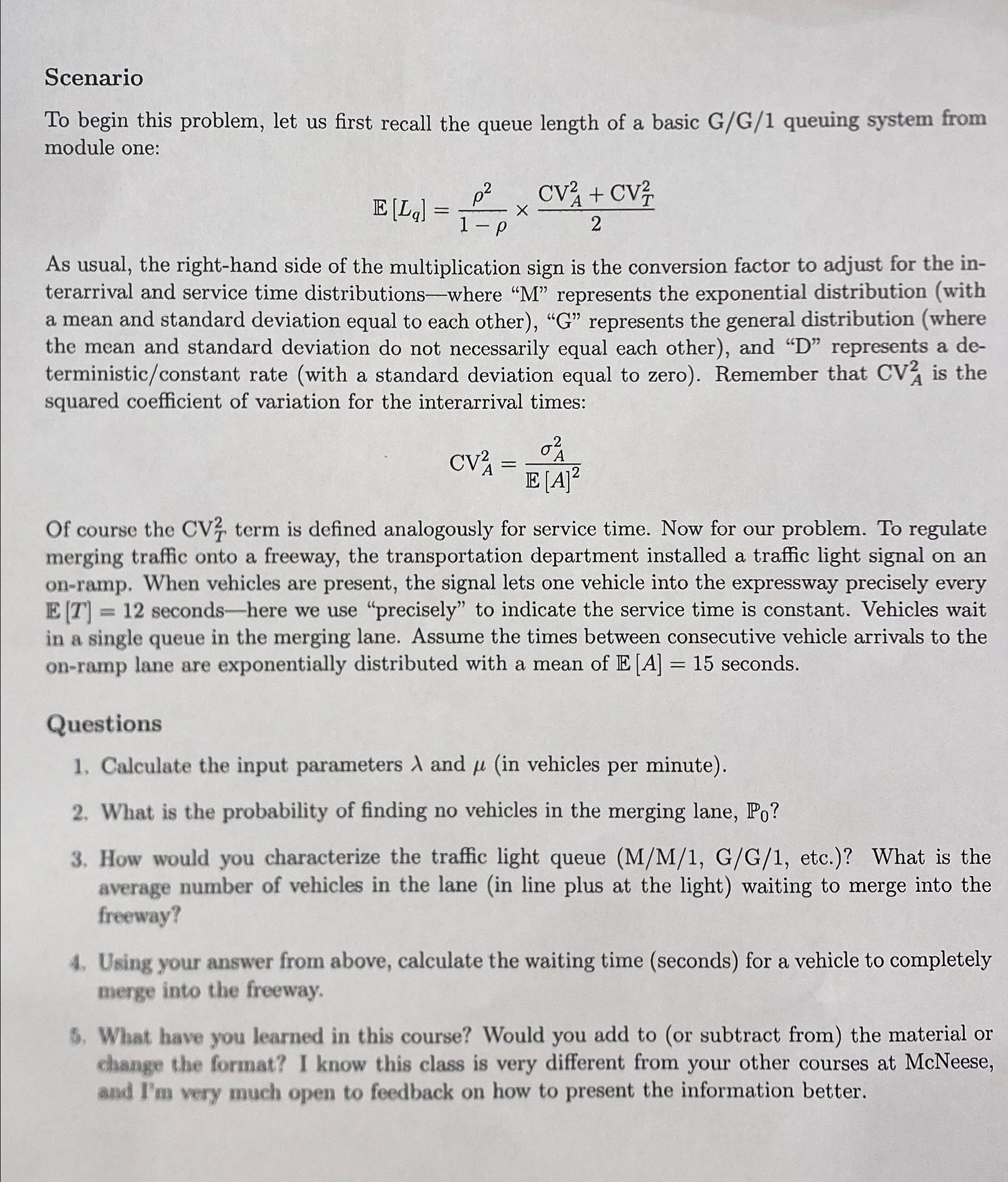
Question: Scenario To begin this problem, let us first recall the queue length of a basic G / G / 1 queuing system from module one:
Scenario
To begin this problem, let us first recall the queue length of a basic GG queuing system from module one:
As usual, the righthand side of the multiplication sign is the conversion factor to adjust for the interarrival and service time distributionswhere represents the exponential distribution with a mean and standard deviation equal to each other represents the general distribution where the mean and standard deviation do not necessarily equal each other and represents a deterministicconstant rate with a standard deviation equal to zero Remember that is the squared coefficient of variation for the interarrival times:
Of course the term is defined analogously for service time. Now for our problem. To regulate merging traffic onto a freeway, the transportation department installed a traffic light signal on an onramp. When vehicles are present, the signal lets one vehicle into the expressway precisely every secondshere we use "precisely" to indicate the service time is constant. Vehicles wait in a single queue in the merging lane. Assume the times between consecutive vehicle arrivals to the onramp lane are exponentially distributed with a mean of seconds.
Questions
Calculate the input parameters and in vehicles per minute
What is the probability of finding no vehicles in the merging lane,
How would you characterize the traffic light queue etc. What is the average number of vehicles in the lane in line plus at the light waiting to merge into the freeway?
Using your answer from above, calculate the waiting time seconds for a vehicle to completely merge into the freeway.
What have you learned in this course? Would you add to or subtract from the material or change the format? I know this class is very different from your other courses at McNeese, and very much open to feedback on how to present the information better.
Step by Step Solution
There are 3 Steps involved in it
1 Expert Approved Answer
Step: 1 Unlock

Question Has Been Solved by an Expert!
Get step-by-step solutions from verified subject matter experts
Step: 2 Unlock
Step: 3 Unlock
 Study Help