







Question: SCHEME LISP PROBLEMS (FROM MIT SICP BOOK) problem 1 Please so the solution step by step . Thanks Problem 2 The following pattern of numbers
SCHEME LISP PROBLEMS (FROM MIT SICP BOOK) problem 1
 Please so the solution step by step . Thanks
Problem 2
The following pattern of numbers is called Pascals triangle. 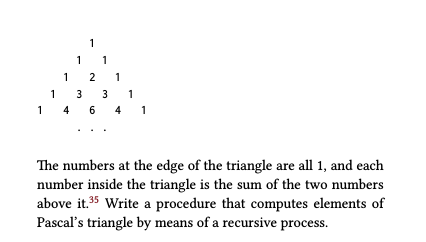 Please show and explain answers step by step. They should be written in LISP . Thanks
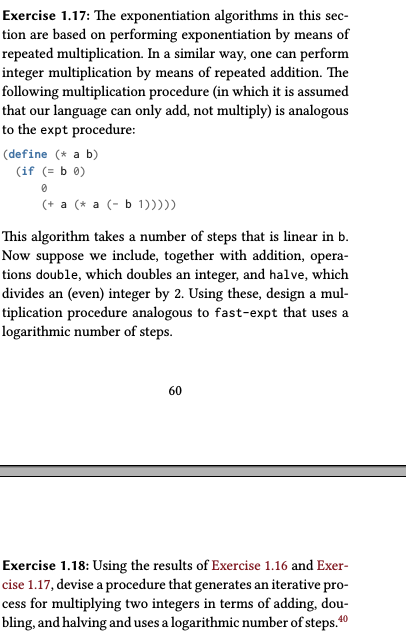
Exercise 1.17: The exponentiation algorithms in this sec- tion are based on performing exponentiation by means of repeated multiplication. In a similar way, one can perform integer multiplication by means of repeated addition. The following multiplication procedure (in which it is assumed that our language can only add, not multiply) is analogous to the expt procedure (define ( a b) if b 0) +a a (b 1) This algorithm takes a number of steps that is linear in b Now suppose we include, together with addition, opera tions double, which doubles an integer, and halve, which divides an (even) integer by 2. Using these, design a mul tiplication procedure analogous to fast-expt that uses a logarithmic number of steps. 60 Exercise 1.18: Using the results of Exercise 1.16 and Exer cise 1.17, devise a procedure that generates an iterative pro- cess for multiplying two integers in terms of adding, dou bling, and halving and uses a logarithmic number of steps.40
Step by Step Solution
There are 3 Steps involved in it

Get step-by-step solutions from verified subject matter experts
 Study Help