







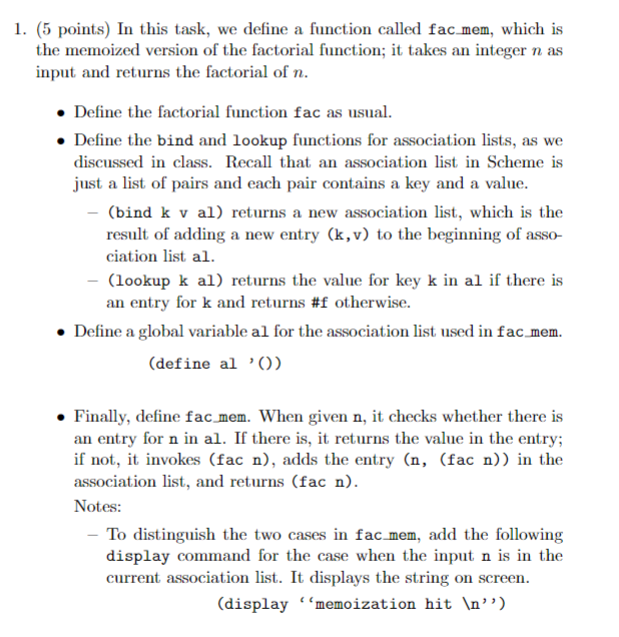
Question: Scheme plz DrRacket 1. (5 points) In this task, we define a function called fac.mem, which is takes an integer n as the memoized version
Scheme plz
DrRacket
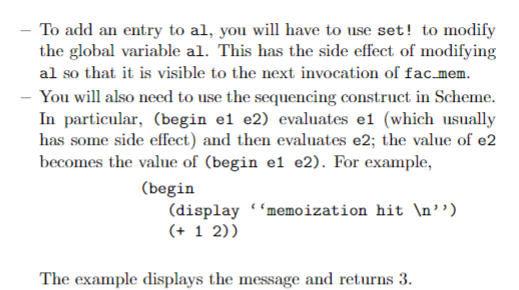
1. (5 points) In this task, we define a function called fac.mem, which is takes an integer n as the memoized version of the factorial function; input and returns the factorial of n Define the factorial function fac as usual Define the bind and lookup functions for association lists, as we discussed in class. Recall that an association list in Scheme is ust a list of pairs and each pair contains a key and a value. (bind k v al) returns a new association list, which is the result of adding a new entry (k, v) to the beginning of asso- ciation list al. (lookup k al) returns the value for key k in al if there is an entry for k and returns #f otherwise. Define a global variable al for the association list used in fac mem. (define alO) Finally, define fac mem. When given n, it checks whether there is an entry for n in al. If there is, it returns the value in the entry; if not, it invokes (fac n), adds the entry (n, (fac n)) in the association list, and returns (fac n Notes: To distinguish the two cases in fac mem, add the following display command for the case when the input n is in the current association list. It displays the string on screen (display 'memoization hit In'') 1. (5 points) In this task, we define a function called fac.mem, which is takes an integer n as the memoized version of the factorial function; input and returns the factorial of n Define the factorial function fac as usual Define the bind and lookup functions for association lists, as we discussed in class. Recall that an association list in Scheme is ust a list of pairs and each pair contains a key and a value. (bind k v al) returns a new association list, which is the result of adding a new entry (k, v) to the beginning of asso- ciation list al. (lookup k al) returns the value for key k in al if there is an entry for k and returns #f otherwise. Define a global variable al for the association list used in fac mem. (define alO) Finally, define fac mem. When given n, it checks whether there is an entry for n in al. If there is, it returns the value in the entry; if not, it invokes (fac n), adds the entry (n, (fac n)) in the association list, and returns (fac n Notes: To distinguish the two cases in fac mem, add the following display command for the case when the input n is in the current association list. It displays the string on screen (display 'memoization hit In'')
Step by Step Solution
There are 3 Steps involved in it

Get step-by-step solutions from verified subject matter experts
 Study Help